

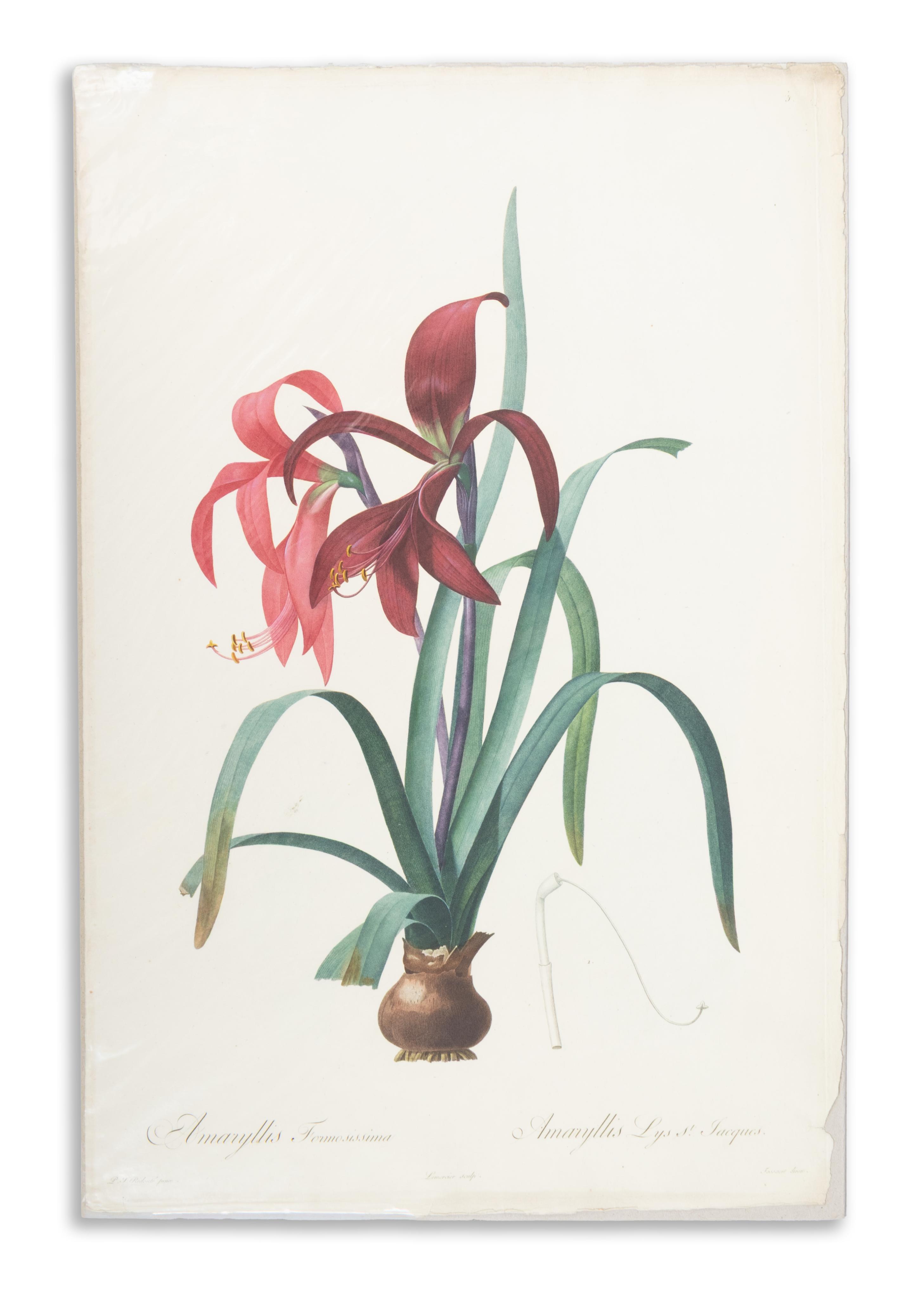
Amaryllis Formosissima. Amaryllis Lys St. Jacques
1807-1816Pierre-Joseph Redouté (1759–1840) francia festőművész és botanikus munkája. Az Amaryllis Formosissima ( jakabliliom vagy spanyol liliom) ábrázoló kép az 486 táblát tartalmazó Les Liliacées című munka 5. táblája. Jelezve lent: „P.J. Redouté pinx. De Gouy sculp.”
Pierre-Joseph Redouté, akit kortársai a „virágok Raffaellója” névvel illettek, a botanikai illusztráció és a tudományos növénymorfológiai ábrázolás történetének legjelentősebb mestere; professzionális életműve több mint 2100 rézlemez-nyomatot számlál, amelyek mintegy 1800 növényfajt dokumentálnak. Munkássága szorosan összefonódott a francia udvar történelmével: pályafutása a Versailles-i királyi kertekben kezdődött Marie-Antoinette udvari festőjeként, majd a francia forradalom viharait túlélve a napóleoni korszak legfontosabb botanikai mecénása, Josephine császárné hivatalos művésze lett. A császárné malmaisoni kastélyában létrehozott exkluzív kertje és ritka növénygyűjteménye adta az ihletet és a tudományos alapot Redouté legfontosabb főműveihez. Taxonómiai szempontból is kiemelkedő monumentális kiadványai közé tartozik a nyolc kötetből álló Les Liliacées (amely a liliomfélék mellett az íriszeket, orchideákat és amarylliszeket is dokumentálta), valamint a nemzetközi hírű Les Roses monográfia.
Redouté a hagyományos vonalas rézmetszet (line engraving) plasztikai korlátait felismerve fejlesztette tökélyre a pontozó modorú metszetet (stipple engraving). E technika lényege, hogy a grafikus a mélynyomású rézlemez felületébe nem folytonos barázdákat metsz, hanem pontok sűrű hálózatát alakítja ki, ahol a tónusértékeket és a finom árnyékolást a pontsűrűség (denzitás) modulálásával hozza létre. A kompozíciós struktúrát tekintve a művek klasszikus, kontextus és háttér nélküli izolált növényportrék. Ez az egyedi metodika a legmagasabb szinten szintetizálta a szigorú leíró-természettudományos precizitást a késő klasszicista udvari esztétikummal. (Biodiversity Heritage Library)
Méret: 55×36,3 cm
Eredeti kézi színezésű pontozó modorú rézmetszet. A széleken apró gyűrődések, szakadások, a bal és jobb alsó saroknál minimális hiány. Nagyon jó állapotban.
Pierre-Joseph Redouté, nicknamed “the Raphael of flowers,” stands as the preeminent master in the history of botanical illustration and scientific phytomorphological depiction; his professional oeuvre encompasses over 2,100 copperplate engravings documenting approximately 1,800 plant species. His career was deeply intertwined with the turbulent history of the French court: he began his royal ascent at Versailles as a painter to Queen Marie-Antoinette and, successfully navigating the political upheavals of the French Revolution, later became the official artist to Empress Josephine, the most influential botanical patron of the Napoleonic era. The Empress’s legendary gardens at the Château de Malmaison, which gathered rare specimen exotics from around the globe, provided both the inspiration and the scientific foundation for Redouté's greatest publications. Among his masterworks of high taxonomic significance are the monumental eight-volume publication Les Liliacées—which extended broad scope to include representatives of Iridaceae, Orchidaceae, and Amaryllidaceae—and the globally renowned monographic series Les Roses.
Recognizing the plastic limitations of traditional line engraving, Redouté perfected the specialized technique of stipple engraving. Rather than incising continuous furrows into the intaglio copper plate, this method involves executing a dense matrix of microscopic dots, where tonal values and subtle chiaroscuro are modulated entirely through variations in dot density. During the printing process, the minuscule deposits of ink resting on the paper substrate avoid creating an opaque film, thereby allowing the natural luminosity and reflection of the paper beneath to permeate the color gradations. Structurally, the compositions function as classical, isolated botanical portraits entirely devoid of backgrounds or ecological settings; following the complex multi-color printing process, each plate was meticulously finished by hand with pure watercolor washes and occasional applications of body-colour to capture specific structural glazes and surface textures. This precise methodology successfully synthesized rigorous descriptive botanical accuracy with the refined courtly aesthetic of late-neoclassicism. (Biodiversity Heritage Library)
Size: 55×36,3 cm
Stipple engravings with original hand-coloring. Minor creases and tears along the edges. In very good condition.