

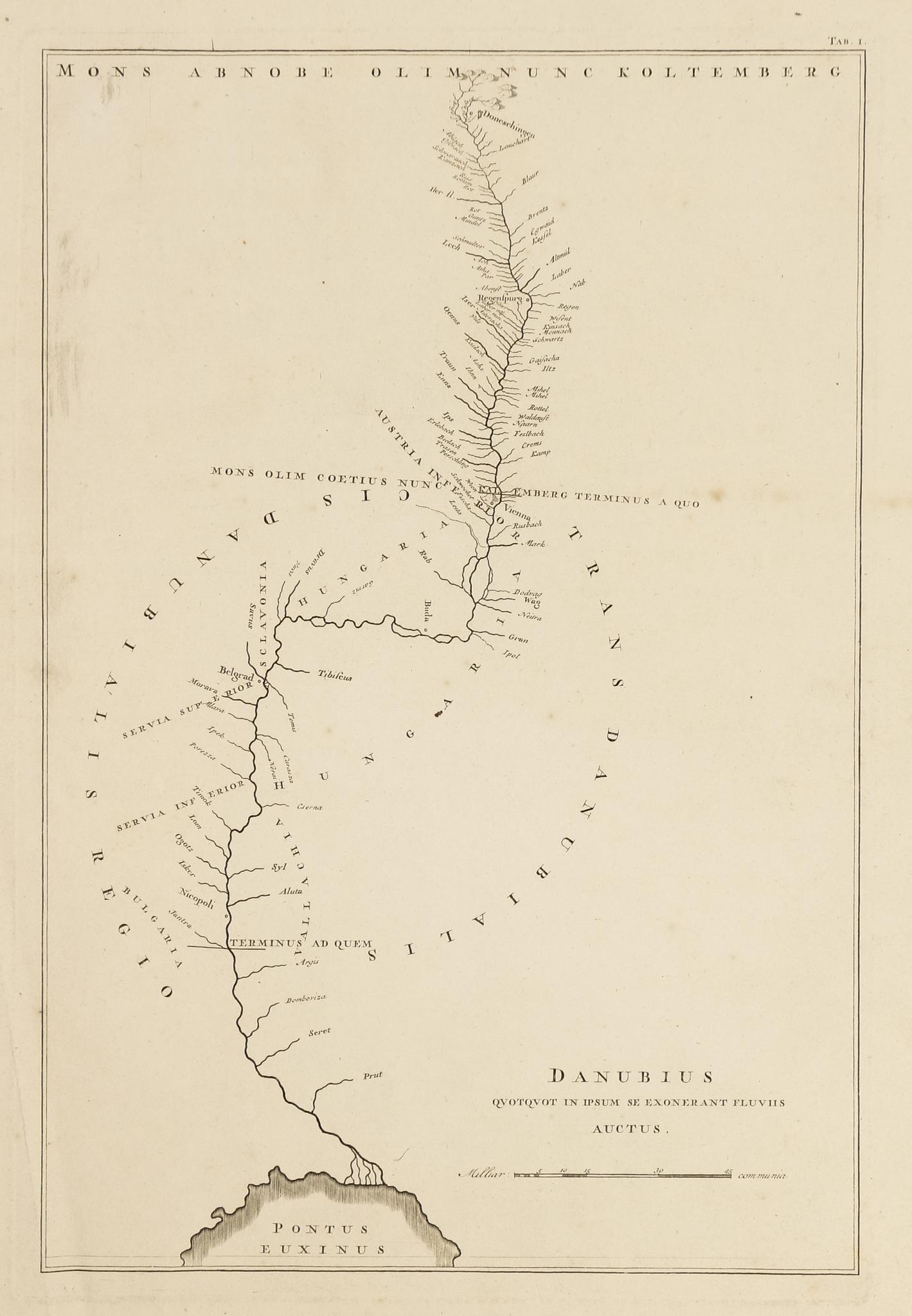
Danubius quotquot in ipsum se exonerant fluviis auctus
1726 AmsterdamA Duna folyását a forrástól a Fekete-tengerig bemutató ritka rézmétszetű térkép. Megjelent: Danubius Pannonico-Mysicus, Luigi Fernando Marsigli. 1726. Amsterdam.
"Az igazi Magyarországot tehát, miként korábban mondtuk, útja során folyónk Dunán inneni és Dunán túli részre osztja, természetesen Bécshez viszonyítva... A Dunán túl a tulajdonképpeni Magyarország határai: keleten Erdély és Oláhország. Északon a Kárpátok, délen a Duna"
Írja Luigi Fernando Marsigli a latin nyelven kiadott Danubius Pannonico-Mysicus című művében, melyhez e térképeket csatolta. Ez az áttekintő térkép a könyv elején található, és bár kevésbé idézik, figyelemre méltó a Duna és tájegységeinek viszonyát tekintve.
A térkép a Duna teljes folyásáról és a belé ömlő folyókról nyújt áttekintést a 17. és 18. század fordulóján. A folyóneveken kívüli névírás célja a Duna szakaszokra bontása. A forrásnál láthatjuk a Fekete-erdőt, Bécsnél pedig a Kahlenberget, amely Marsigli művének kezdő- és végpontját jelöli a bulgáriai Jantra folyóval együtt. E két végpont között találjuk a Trans Danubialis és a Cis Danubialis régiót, ami ellentmond annak, amit a Dunán innen és a Dunántúl földrajzi nevekről tudtunk.
A török korban a három részre szakadt Magyarország Habsburg uralom alatt álló része (Horvátországot és Szlavóniát most nem ideértve) két részre oszlott, Alsó- és Felső-Magyarországra. E kettő között a határ bizonytalan volt, de általánosságban elmondható, hogy Alsó-Magyarország vizei a Dunába ömlöttek, míg Felső-Magyarországé a Tiszába (és persze a Dunajecbe is). Ez egy ésszerű, hidrológiai alapon (is) álló felosztás volt. Ennek ellenére, még a török kiűzése előtt lassan tért hódított egy hasonlóan hidrológiai szempontú felosztás, a Dunán innen és a Dunán túl. Marsigli felosztása nem vált közismertté, de érdekes, hogy miért nem a Magyarországon már általánosan használt felosztást alkalmazta az áttekintő térképén.
Jó állapotban. A margón felül képmezőt nem érintő ázásnyom.
Képméret (Size of map): 26,5×40 cm Lapméret (Size of sheet): 36,5×52 cm
'The real Hungary, then, as we have said before, is divided by our river on its course into the Danube and the Danube beyond, in relation, of course, to Vienna... Beyond the Danube are the borders of Hungary proper: to the east, Transylvania and Wallachia. In the north the Carpathians, in the south the Danube.' writes Luigi Fernando Marsigli in his work Danubius Pannonico-Mysicus, written in latin. This overview map is at the beginning of the book and, although less quoted, is remarkable for the relationship between the Danube and its landscape.
The map provides an overview of the entire course of the Danube and the rivers flowing into it at the turn of the 17th and 18th centuries. The purpose of the naming of the Danube, other than river names, is to break it down into sections. The Black Forest at the source and the Kahlenberg at Vienna mark the beginning and end of Marsigli's work, together with the Jantra River in Bulgaria. Between these two endpoints we find the Trans Danubialis and Cis Danubialis regions, which contradicts what we know about the geographical names of the Danube and the Danube Basin.
In the Turkish period, the part of Hungary under Habsburg rule that had been divided into three parts (not including Croatia and Slavonia) was divided into two parts, Lower and Upper Hungary. The boundary between these two was uncertain, but in general Lower Hungary flowed into the Danube, while Upper Hungary was divided into two parts, the Lower and Upper Hungary.
Good condition. Waterstain at the edge of the top margin, not affecting the map.