

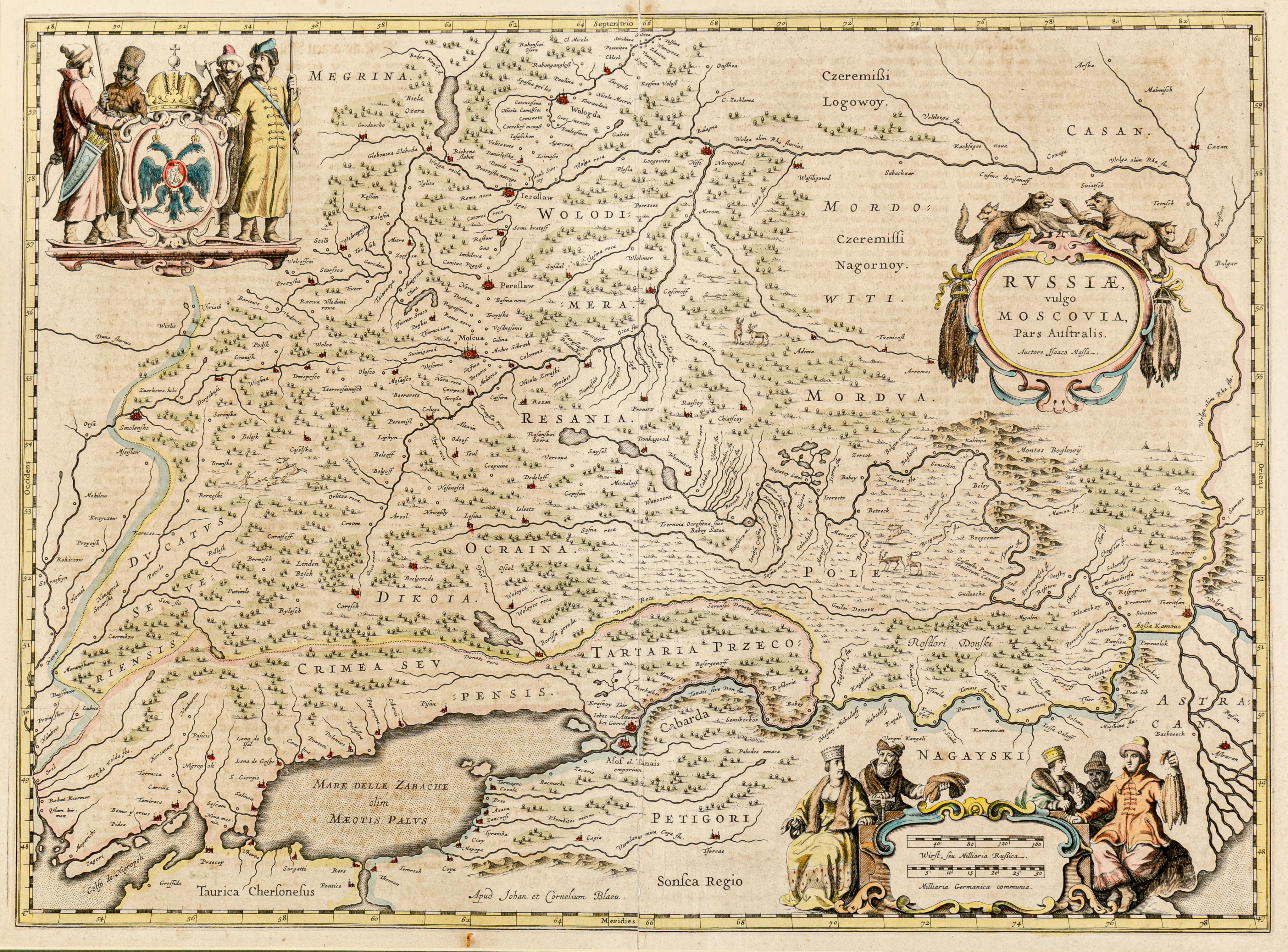
Russiae, vulgo Moscovia, Pars Australis. Auctore Isaaco Massa.
Amsterdam, ca. 1644Díszes, eredeti színezésű, rézmetszetű térkép Dél-Oroszországról és Ukrajnáról, három nagy dekoratív kartussal, széles margókkal.
A térkép a Volga, a Don, az Azovi-tenger és a Dnyeper közötti területet ábrázolja, Moszkva városával a középpontban. Érdekes részlet a Volga és a Don közötti, „Fossa Kamouz” nevű csatorna terve (jobb alsó sarokban). Ennek a tervnek az ötlete Nagy Pétertől származik, de csak 1952-ben valósították meg.
A térkép Isaac Massa utazásain alapul, aki Kelet-Európa és Szibéria térképeinek szerzőjeként ismert. Massa öt, Oroszországot és annak tartományait ábrázoló, kiadott térkép szerzője, amelyek közül az utolsó 1633-ban készült el. A térkép a Szuhona folyó felső szakaszától északon, egészen a Don torkolatáig, a Kercsi-szorosig és a Volga torkolatáig délen terjedő területet mutatja be. A Don és a Volga összefolyásánál Isaac Massa térképe elsőként ábrázolja a nem létező, Donból a Volgába vezető útvonalat, a Fossa Kamouz-t. Csak néhány 17. századi térképen szerepel ez az útvonal. Valószínűleg egy szállítási (hajóvontatási) útvonalra utalhatott. Később I. Péter dolgozott ki egy hasonló csatornaépítési tervet, amely azonban nem valósult meg.
A térképet három díszes, figurális kartus ékesíti. Az egyik kartusban a királyi sas látható, középen a moszkvai címerrel és a sztrelecek (orosz fegyveres testület tagjai) alakjával. A térkép nevét tartalmazó kartus illusztrációja Moszkva fő gazdagságát jeleníti meg: prémek, állati bőrök és különféle állatalakok formájában.
Méret: 38,5×52,5 cm
Valószínáleg Blaeu, Joan. Theatrum orbis terrarum, sive atlas novus művének latin kiadásából [Amsterdam : Joan Blaeu, 1644].
Nagyon jó állapotban, a hajtásnál fent alig látható szakadás. Latin szöveg a verzón, paszpartuban.
A neves holland térképész és kiadó, Joan Blaeu a világ több száz helyszínét ábrázolta. A Holland Kelet-indiai Társaság képviselőjeként Blaeu hozzáférhetett a közelmúltbeli felfedezésekről készült térképek és beszámolók kiterjedt gyűjteményéhez, amelyet saját alkotásaihoz használt fel.
Blaeu mesterműve, az először 1662-ben kiadott Atlas Major 594 térképből és több mint 4000 oldalból állt. Az atlasz Európa, Ázsia és Amerika területeit fedte le, és több nyelven készült: Holland (9 kötet), spanyol (10 kötet), latin (11 kötet) és francia (12 kötet) nyelven. Az Atlas Major rövid idő alatt a korabeli atlaszok meghatározó szabványává vált.
Isaac Abrahamszoon Massa (1586-1643) was a Dutch grain merchant, traveler, diplomat, and ambassador to Muscovy. He is known as the author of memoirs, maps of Eastern Europe and Siberia. Massa is the author of five published maps of Russia and its provinces, the last of which was completed in 1633. The map shows the territory between the upper reaches of the Sukhona River in the north and the mouth of the Don, the Kerch Strait and the mouth of the Volga in the south. At the confluence of the Don and Volga rivers, Isaac Massa's map first depicts the non-existent route from the Don to the Volga, Fossa Kamouz. Only a few maps from the 17th century are known to feature it. Probably, he meant a portage route. Only later did Peter I come up with a project for a canal, which was not implemented. The map is decorated with three figurative cartouches. One of them shows the royal eagle with the Moscow coat of arms in the center and the Streltsy. The cartouche with the name of the map is illustrated with the main wealth of Muscovy - fur, skins and animal figures.
Size: 38,5×52,5 cm
Possibly from: Blaeu, Joan. Theatrum orbis terrarum, sive atlas novus, Latin edition [Amsterdam : Joan Blaeu, 1644].
Very good condition in pastedown. Latin text on verso.
Renowned Dutch cartographer and publisher Joan Blaeu depicted hundreds of locations around the world. Operating from his studio near Amsterdam, Blaeu published a wide range of works, including religious and philosophical texts, as well as maps and atlases of various sizes. As a representative of the Dutch East India Company, Blaeu had access to an extensive collection of maps and accounts from recent explorations, which he used to inform his own creations.
Blaeu's masterpiece, 'Atlas Major', first published in 1662, consisted of 594 maps and over 4,000 pages. Covering regions across Europe, Asia, and the Americas, the atlas was produced in multiple languages: Dutch (9 volumes), Spanish (10 volumes), Latin (11 volumes), and French (12 volumes). After printing, Blaeu often entrusted the atlas to skilled local craftsmen for final embellishments. Artist Dirk Janszoon van Santen frequently added watercolor and gilding to the black-and-white prints, while bookbinder Albertus Magnus bound many of the volumes. Atlas Major, from which many prints in this collection originate, quickly became the definitive standard for atlases of its time.