

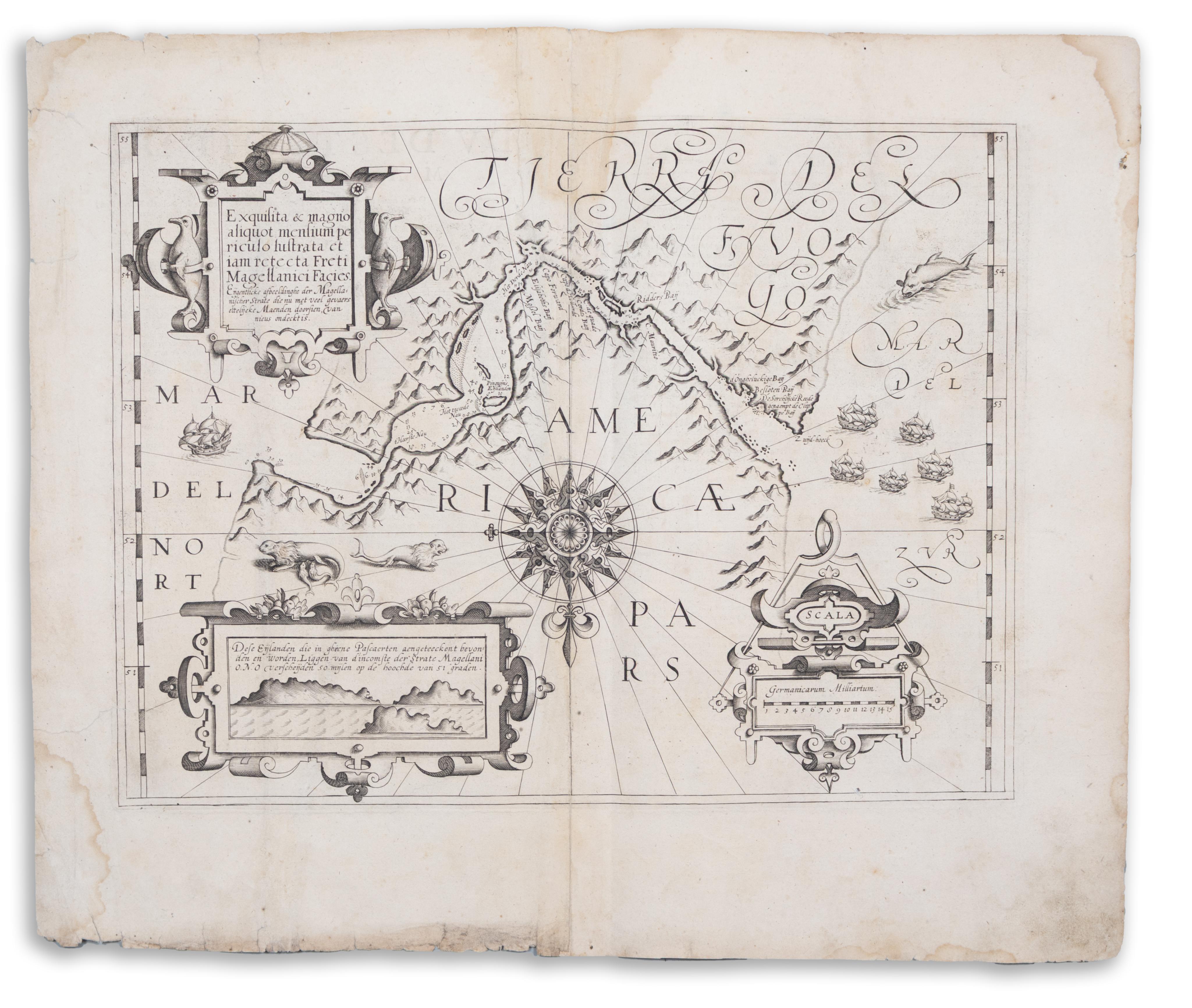
Exquisita & magno aliquot mensium periculo Lustrata et iam retecta Freti Magellanici Facies . . .
Amsterdam, 1619.Az egyik legkeresettebb Mercator atlasztérképei közül. Kivételes, korai térkép a Magellán-szorosról, amely még a Le Maire-szoros 1616-os felfedezése előtt készült
Ez a térkép a Magellán-szoros legelső, kereskedelmi forgalomban (atlaszban) kiadott ábrázolása. Igazi ritkaság, ugyanis a Mercator–Hondius-atlaszban kevés hasonló tengerészeti stílusú térkép szereplt. Képi világában és szerkezetében Lucas Waghenaer akkoriban frissen megjelent tengeri térképeinek hatása érződik, navigációs mélységjelzésekkel és látványos partvonalprofil-ábrázolással gazdagítva.
A térkép déli irányban van tájolva, és egy iránytűrózsával, valamint három gazdagon kidolgozott, szíjmotívumos kartussal van díszítve. Az egyik kartus a szoros bejáratának parti látképét mutatja be, Waghenaer és a 16. század végi holland hajózási kézikönyvek stílusát idézve. Az iránytűrózsa északot az alsó irányba mutatja, ami a valódi északi irányt jelöli.
A Csendes-óceán térségét hat vitorlás hajó, valamint számos szárazföldi és tengeri állat illusztrációja díszíti. A déli földrészt Tierra del Fuego-ként (Tűzföldként) azonosítja a térkép, a szoroson belül pedig mintegy 20 földrajzi helynevet és 30–40 mélységmérést tüntet fel. Az iránytűrózsából sugarasan kiinduló rhumb-vonalak segítik a tengeri tájékozódást.
Különösen figyelemre méltó, ahogyan a Tűzföld partvonala fokozatosan átmegy feltételezett, ismeretlen déli földrészekbe – így érzékeltetve a kor földrajzi ismereteinek határait. Ez a képzeletet is megmozgató, ugyanakkor gondosan szerkesztett térkép a felfedezések korának egyik fontos pillanatát örökíti meg – még a Horn-fok felfedezése (1616) előtt –, és a legragyogóbb és legérdekesebb korai térképek közé tartozik, amelyek az amerikai kontinensről és az Atlanti- és Csendes-óceánt összekötő tengeri útvonalakról készültek.
Lapméret: 49,5×56,5 cm
A hátoldalon francia nyelvű szöveg, oldalszám: 377, signum: Gggggggg. Széles margókkal. Restaurált, a hajtás mentén a verson megerősítve, a lapszéleken néhol foltokkal, szakadásokkal, melyek nem érintik a térképmezőt.
Van der Krogt (Vol. I) #9950:1A.
This map represents the earliest depiction of the Strait of Magellan to appear in a commercially published atlas. Notably rare, it is one of the few sea-chart-style maps included in the Mercator-Hondius Atlas, reflecting the influence of Lucas Waghenaer’s newly released nautical charts. It features navigational soundings and a scenic profile view, merging artistic detail with practical maritime information.
Oriented with south at the top, the map is adorned with a large compass rose and three richly embellished strapwork cartouches. One cartouche presents a coastal profile of the Strait’s entrance, echoing the style found in Waghenaer’s works and Dutch rutter books of the late 16th century. The compass rose itself points downward, indicating true north.
The surrounding Pacific Ocean teems with decorative sailing ships and illustrations of both terrestrial and marine animals. The southern landmass is labeled as *Tierra del Fuego*, and the map includes roughly 20 named locations within the Strait, along with 30–40 soundings. A web of rhumb lines fans out from the compass rose, guiding navigators across the depicted seas.
Of particular interest is the way the coastline of Tierra del Fuego gradually gives way to a conjectural southern continent, symbolizing the limits of known geography at the time. This imaginative yet meticulously detailed map captures a critical moment in the age of exploration—before Cape Horn was discovered—and remains one of the most fascinating and evocative early maps of the Americas and the sea route connecting the Atlantic and Pacific Oceans.
Sheet size: 49,5×56,5 cm
French text on verso, page number 377, signum: Gggggggg. Restored andr einforced along the fold on the verso. Some stains and tears along the edges, not affecting the map field.
Van der Krogt (Vol. I) #9950:1A.