

![Lenin, Vlagyimir Iljics - Ленин Николай: Левый" коммунизм. (Детская болезнь в коммунизме.) [Baloldaliság – a kommunizmus gyermekbetegsége] Kharkiv, 1920. All-Ukrainian State Publishing House.](http://kozpontiantikvarium.hu/sites/default/files/2026-01/lenin-kotes.jpg "Lenin, Vlagyimir Iljics - Ленин Николай: Левый\" коммунизм. (Детская болезнь в коммунизме.) [Baloldaliság – a kommunizmus gyermekbetegsége] Kharkiv, 1920. All-Ukrainian State Publishing House.")
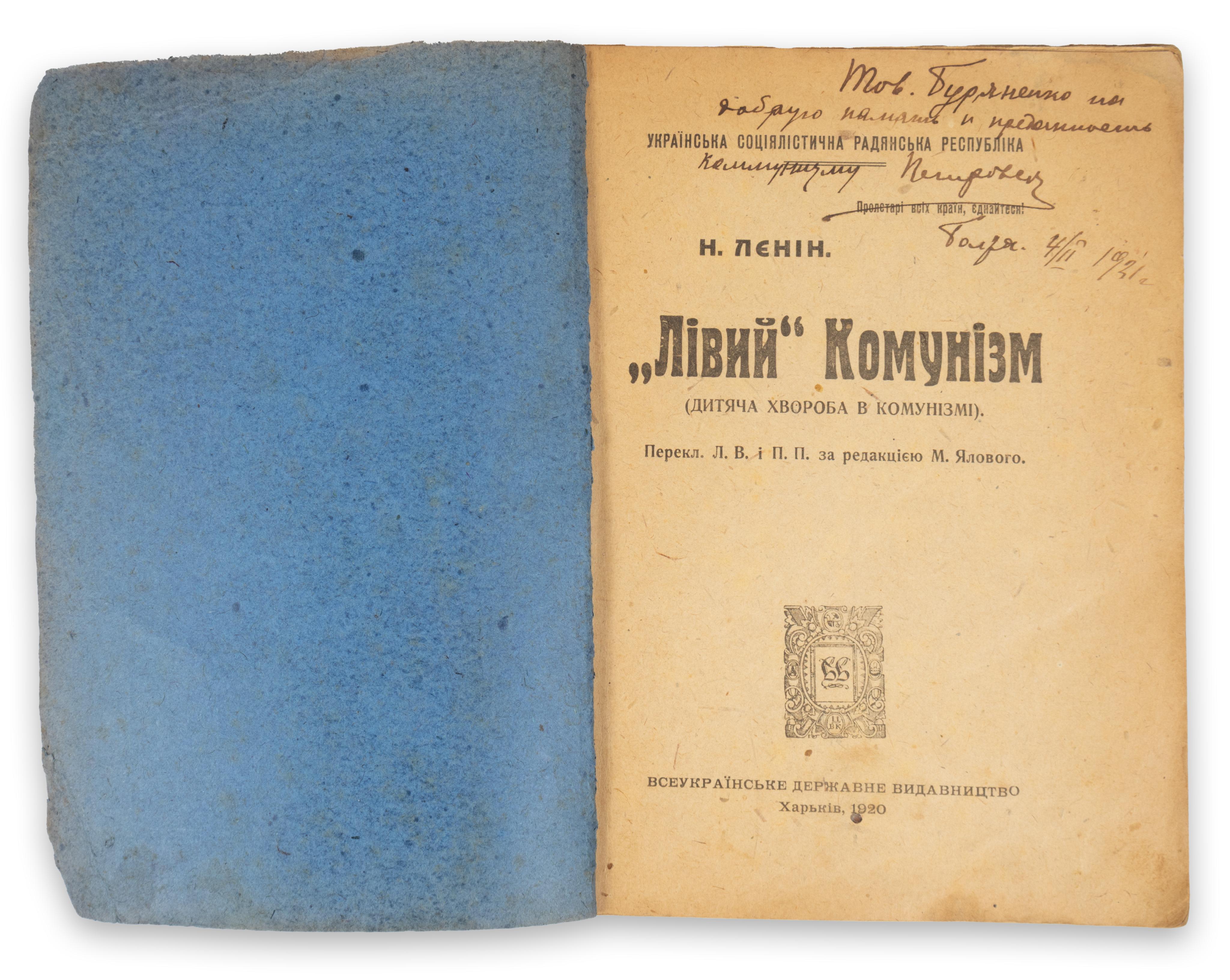
Левый" коммунизм. (Детская болезнь в коммунизме.) [Baloldaliság – a kommunizmus gyermekbetegsége]
Kharkiv, 1920. All-Ukrainian State Publishing House.88 p.
A "Baloldali kommunizmus..." Lenin műve, amely éles kritikát fogalmaz meg a bolsevizmus forradalmi szocialista táborból származó ellenfeleivel szemben. Ezen ellenfelek nézetei többnyire baloldali kommunizmusként definiálhatók. A könyv 1920-ban íródott, és oroszul, németül, angolul, franciául és (mint a példa mutatja) ukránul is kiadták. Lenin kézirata tartalmazza a „Kísérlet egy népszerű párbeszédre a marxista stratégiáról és taktikáról” alcímet, de ezt a könyv életében megjelent kiadásaiban nem használták. Az eredeti kézirat ironikus ajánlást is tartalmazott Lloyd George brit miniszterelnöknek: „Ezt a röpiratot a nagyra becsült Lloyd George úrnak ajánlom hálám kifejezéseként beszédéért, amely szinte marxista volt, és mindenesetre rendkívül hasznos a kommunisták és a bolsevikok számára szerte a világon.”
Magyarul előszőr: Baloldaliság, a kommunizmus gyermekbetegsége; ford. Szántó Rezső, előszó Kun Béla. (Munka és tudás könyvtára) Wien, 1926. Arbeiterbuchhandlung.
Kiadói fűzött papírkötésben, kissé foltos borítóval, gerincén kisebb hiány. Kivételesen ritka mű. M: 22,5 x 17,5 cm. Korabeli ajánló felirat a címlapon.
A scarce Ukrainian first edition of Lenin’s seminal treatise on revolutionary strategy. The original Russian edition was written in April 1920 and rush-printed in June to be distributed to delegates of the Second Congress of the Communist International (Comintern). An exceptionally rare work in publisher's illustrated paper, with a slightly spotted cover and minor loss to the spine. Dimensions: 22.5 x 17.5 cm. Dedicatory inscription on the title page. 88 p.
This work is Lenin’s most significant contribution to Marxist strategy after the October Revolution. Written to combat the "Left" wing of the communist movement – which he deemed "infantile" for its purism – the book argues that Western revolutionaries must not reject compromise, parliamentary work, or participation in reactionary trade unions. Lenin asserts that to isolate the party from the masses in the name of "purity" is to guarantee defeat; instead, Communists must work wherever the masses are found, maneuvering flexibly to expose reformist leaders and win the support of the proletariat.
Chapters V, VI, and VII is a direct polemic against the "Left Communists" in Germany (the KAPD) and the Netherlands. Lenin attacks their refusal to work within the "reactionary" trade unions and the bourgeois Reichstag. He mercilessly mocks their distinction between the "dictatorship of the party" and the "dictatorship of the class," arguing that the party is the vanguard essential for leading the class, and that their refusal to utilize parliamentary platforms deprives them of a vital tribune to reach backward workers.
The publication of this "Infantile Disorder" provoked an immediate and sophisticated theoretical counter-attack from the German-Dutch Left, most notably by Herman Gorter and Anton Pannekoek, who became the primary intellectual antagonists of this work. In his direct reply, Gorter argued that Lenin’s tactics were only applicable to Russia, a semi-feudal country where the proletariat could ally with a massive peasantry to overthrow a weak bourgeoisie. In Western Europe, Gorter countered, the bourgeoisie was powerful, united, and culturally dominant, and the proletariat stood alone without peasant allies. Therefore, the "Russian tactics" of compromise and parliamentary maneuvering would only confuse the workers; the West required a tactic of "pure" class struggle to shatter the democratic illusions of the masses.