

![Filmkockák az S.O.S Eisberg és az Igloo című filmekből [1932-1933]](https://kozpontiantikvarium.hu/sites/default/files/2026-02/sosiglokepkockak_1.jpg "Filmkockák az S.O.S Eisberg és az Igloo című filmekből [1932-1933]")
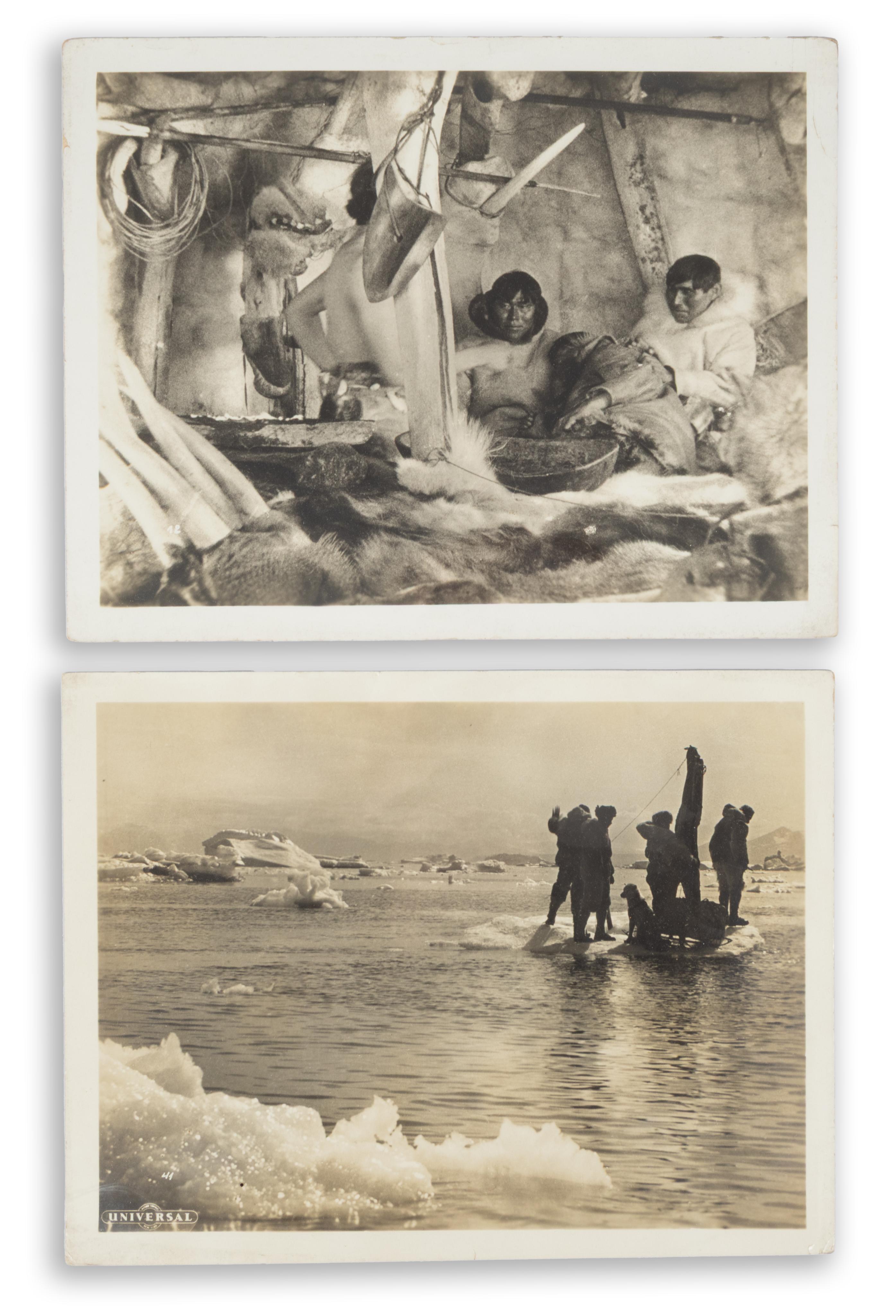
Filmkockák az S.O.S Eisberg és az Igloo című filmekből
[1932-1933]Ez az anyag négy ferrotypizált zselatinos ezüstnyomatos nagyítást tartalmaz negatívszámokkal, a verson szöveges címkével és az Universal Film bélyegzőjével:
"Jéghegy". A képen: 14. Universal Pictures Corporate New York, a verson Universal Film R.T.«SOS».
"Menekülés a jégtáblán". A képen: 41. Universal Pictures Corporate New York, a verson Universal Film R.T.«SOS».
"Takaró dobálás" [Nalukataq]. A verson Universal Film R.T. «Igló».
"Iglu belső". A verson Universal Film R.T. «Igló».
A "Jéghegy" és a "Menekülés a jégtáblán" az 1933-as S.O.S. Eisberg című hegyi filmből származó jelenetet ábrázol. A film német–amerikai koprodukció volt, amelyet a Universal Studios mutatott be, és a svájci Engadinban, valamint Grönlandon forgatták. Bemutatójára Berlinben került sor 1933. augusztus 30-án; a filmet egyidejűleg német és angol nyelven (S.O.S. Iceberg) vették fel. A német változat főszereplői Leni Riefenstahl, Gustav Diessl és Ernst Udet voltak, míg az angol verzióban Gibson Gowland és Rod La Rocque szerepelt. Egyes jeleneteket Ferd Vogel fényképezett. A film Alfred Wegener (1880–1930) sarki expedícióin alapul. A német klimatológus és geofizikus 1906 és 1930 között négy grönlandi expedíciót vezetett, amelyek célja sarkvidéki meteorológiai kutatások végzése és a grönlandi jégtakaró vastagságának mérése volt. A film Wegener utolsó, tragikus kimenetelű, 1930-as expedíciójára épít.
A "Takaró dobálás" és az "Iglu belső" az Igloo című 1932-es amerikai dokumentumfilmből származó jeleneteket ábrázol, amelyet szintén a Universal Studios mutatott be. 1931 februárjában Edward Small producer finanszírozott egy sarkvidéki expedíciót Ewing Scott vezetésével, Roy Klaffki operatőri közreműködésével. A csapathoz csatlakozott eszkimó–orosz származású Ray Wise is. A stáb hat hónapon át forgatott az Északi-sarkvidéken, ám egy ponton 32 napra eltűntek az alaszkai Icy Cape közelében, mielőtt bálnavadászok kimentették őket. A megpróbáltatások ellenére mintegy 100 000 lábnyi filmanyaggal tértek vissza.
Méret: 23,5×32 cm
Mindegyiken enyhe foltosodás, a Jéghegyen tűzés nyoma. Ezt leszámítva nagyon jó állapotban.
Iceberg. On the photo: 14. Universal Pictures Corporate New York, Universal Film R.T. «SOS» on verso.
Escape on the Ice floe. On the photo: 41. Universal Pictures Corporate New York, Universal Film R.T. «SOS» on verso.
Blanket Toss [Nalukataq]. Universal Film R.T. «Igló» on verso.
Inside of an Igloo. Universal Film R.T. «Igló» on verso.
The Iceberg and Escape on the Ice Lloe feature scenes from the 1933 mountain film S.O.S. Eisberg. The film was a German–U.S. co-production released by Universal Studios and filmed in the Engadin (Switzerland) and Greenland. Premiering in Berlin on August 30, 1933, the film was shot simultaneously in German and English (S.O.S. Iceberg). The German version starred Leni Riefenstahl, Gustav Diessl, and Ernst Udet, while the English version featured Gibson Gowland and Rod La Rocque. Some scenes were photographed by Ferd Vogel. S.O.S. Eisberg is based on the real-life polar expeditions of Alfred Wegener (1880–1930). Between 1906 and 1930, the German climatologist and geophysicist led four Greenland expeditions aimed at conducting meteorological research in the Arctic and measuring the thickness of the Greenland ice sheet. The film draws on Wegener’s last expeditions, the ill-fated 1930 mission.
Blanket Toss and Inside of an Igloo capture scenes from the 1932 American pre-Code documentary film Igloo released by Universal Studios. In February 1931, film producer Edward Small financed an Arctic expedition led by Ewing Scott, with Roy Klaffki serving as cinematographer. They were joined by Ray Wise of mixed Eskimo and Russian heritage. The team filmed for six months in the Arctic, but at one point disappeared for 32 days off Icy Cape, Alaska, before being rescued by whalers. Despite the ordeal, they returned with approximately 100,000 feet of film.
All show slight staining, on Iceberg trace of pinning. Otherwise, in very good condition.