

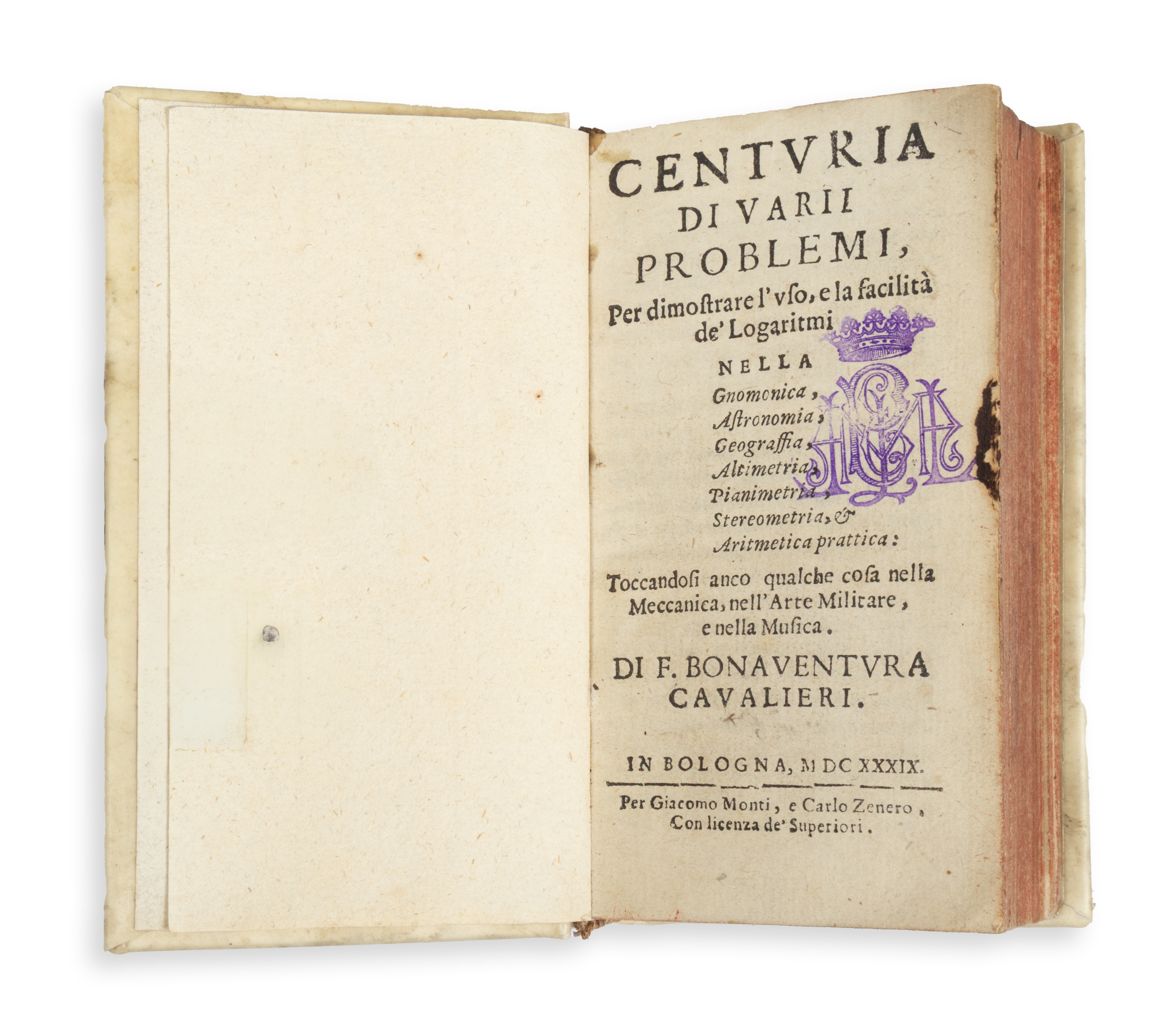
Centuria di varii problemi per dimostrare l'uso, e la facilità de' logaritmi nella gnomica, astronomia, geografia, altimetria, planimetria, stereometria, e aritmetica prattica.
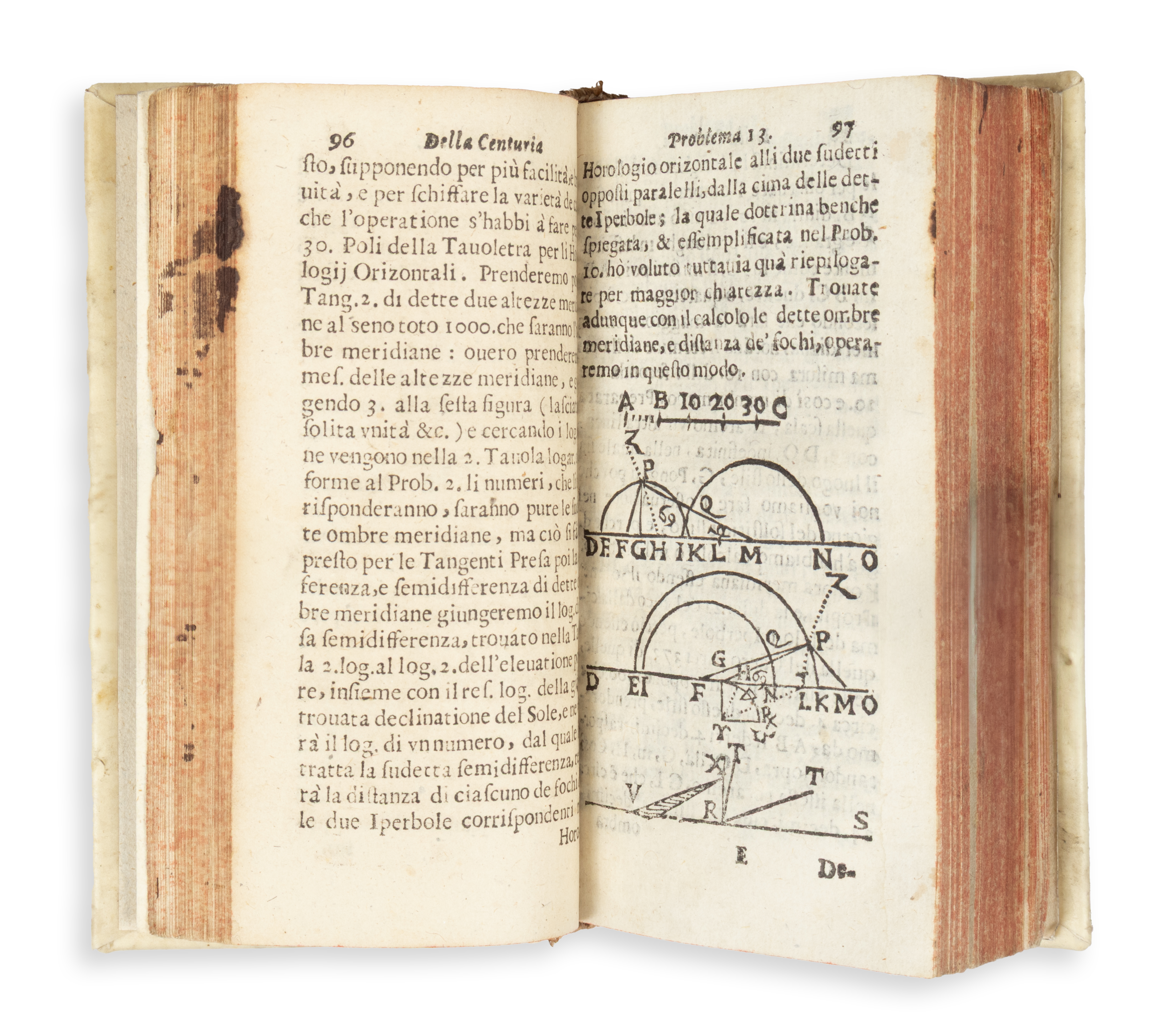
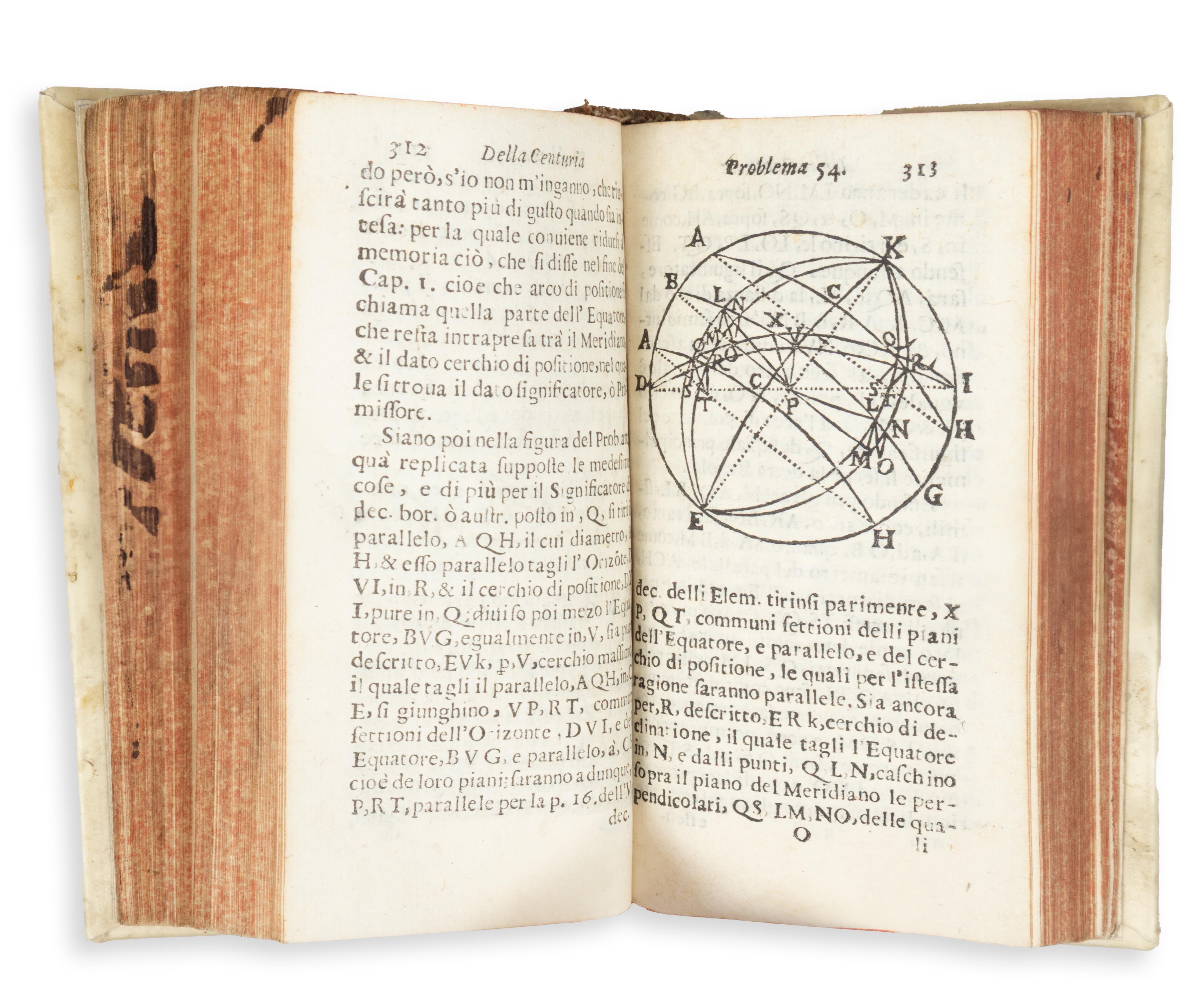
Bologna, 1639. Giacomo Monti e Carlo Zenero.526 + [1] p. 12º. Számos fametszetű diagrammal, köztük több egészoldalas.
Első kiadás. A logaritmust, amelyet Napier vezetett be a matematikába 1614-ben, Olaszországban Cavalieri honosította meg. Bonaventura Cavalieri atya (Milánó, kb. 1598 – Bologna, 1647) jezsuita és matematikus, 1629-től haláláig a Bolognai Egyetem matematika professzora volt. Galilei tanítványaként, valamint Mersenne, Torricelli és Viviani levelezőpartnereként a XVII. századi matematika egyik központi alakja. Ő a logaritmust jelentős trigonometriai fejlesztésekhez kapcsolta, és csillagászati alkalmazásokat is talált számára. Jelen, rendkívül ritka és matematikatörténetileg nagyon fontos, Centuria című művében száz feladatban többek között a következő témákkal foglalkozott: A hengeres és kúpos felületek általános meghatározása. Képletek egy hordó térfogatának és egy csúcsíves boltozat befogadóképességének kiszámítására. Csillagászat, földrajz és gyakorlati aritmetika. Magasságmérés (altimetria), síkmértan (planimetria) és térfogatmérés (sztereometria). Kisebb kitérők a mechanika, a hadművészet és a zene területére. De leginkább eredeti feladat annak módszere, hogyan kapható meg két szám logaritmusából az összegük vagy a különbségük logaritmusa (ezt a problémát később számos más matematikus is vizsgálta). Ebben a munkában mondja ki Cavalieri – sok más eredmény mellett – egy hatvány integráljának általános képletét, egy olyan eredményt, amelyet Fermat és Roberval 1636-ban egymástól függetlenül szintén felfedezett. Galilei kifejezetten és elismerően nyilatkozott erről a logaritmusokról szóló munkáról.
Munkája a nagyobb, Nuova prattica astrologica (Bologna, 1639) című kötet részeként is napvilágot látott.
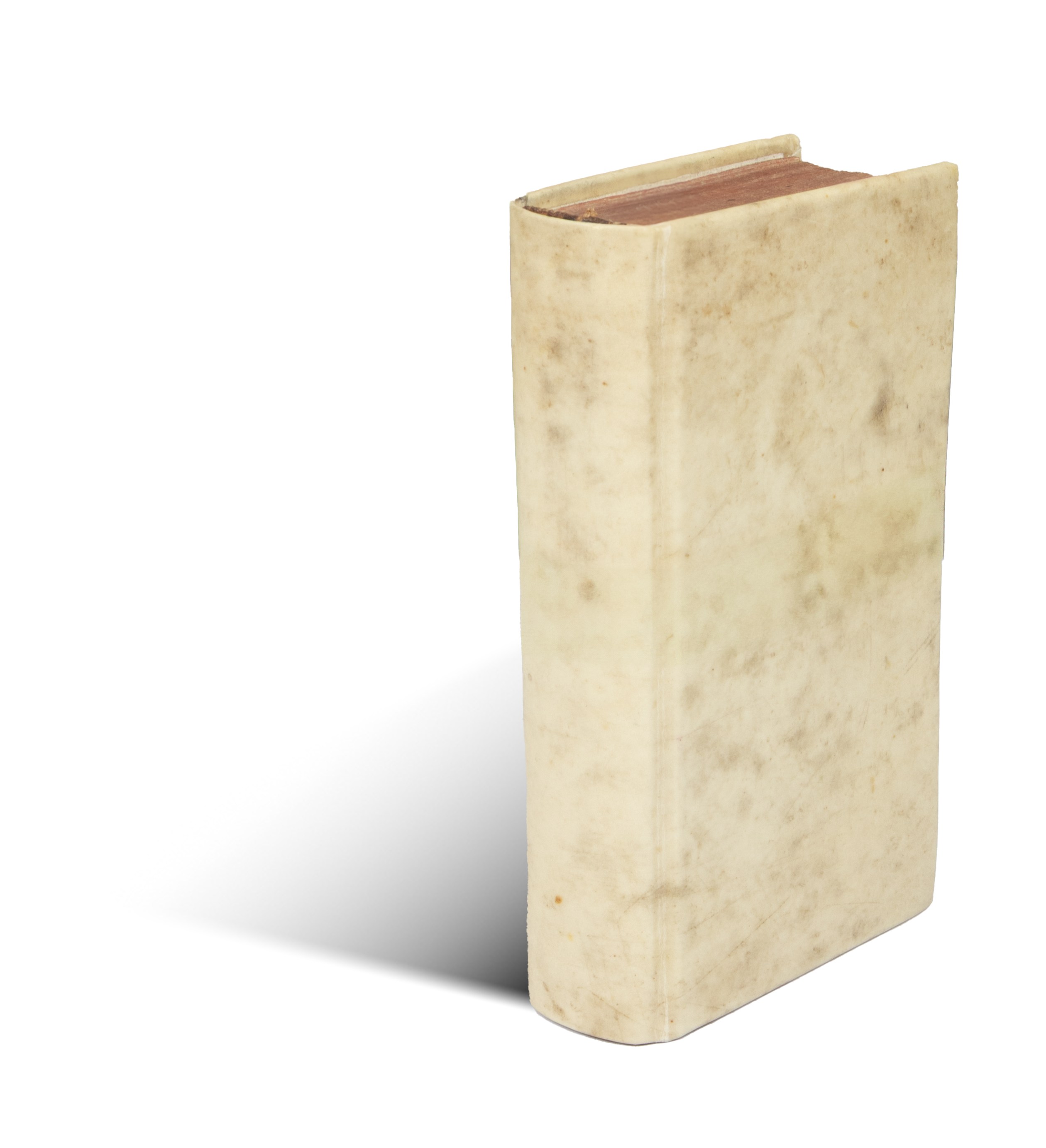
Modern, archaizáló pergamenkötésben, új előzéklapokkal, körül festett lapszélekkel. A címlapon nemesi címeres bélyegző. Pár levél szélén tintafolt. Nagyon jó példány. Ritka mű.
Gamba 1849; Riccardi I, 526; BL ∅.
This first edition marks a significant moment in the history of mathematics. Logarithms, introduced into mathematics by Napier in 1614, owed their introduction into Italy to Cavalieri. Fr. Bonaventura Cavalieri (Milan, c. 1598 – Bologna, 1647), a Jesuit and mathematician, served as a professor of mathematics at the University of Bologna from 1629 until his death. As a disciple of Galileo and a correspondent of Mersenne, Torricelli, and Viviani, he remains a central figure in 17th-century mathematics. He successfully linked logarithms to noteworthy developments in trigonometry and found practical applications for them in astronomy.
In the present, extremely rare and historically vital work entitled Centuria, Cavalieri addressed one hundred problems covering a wide array of topics. These include the general definition of cylindrical and conical surfaces, formulas to determine the volume of a barrel and the capacity of a vault with pointed arches, and the means of obtaining from the logarithms of two numbers the logarithm of their sum or difference—a problem subsequently taken up by various other mathematicians. It is also in this work that Cavalieri states, among many other findings, the general formula for the integral of a power, a result that Fermat and Roberval had independently obtained in 1636. Galileo explicitly praised this specific work on logarithms.
His work also appeared as part of the larger volume, Nuova prattica astrologica (Bologna, 1639).
Bound in a modern, period-style vellum binding with new endpapers and painted edges. It features an aristocratic armorial stamp on the title page. Despite ink stains on the margins of a few leaves, it remains a very good copy of a decidedly rare work.