

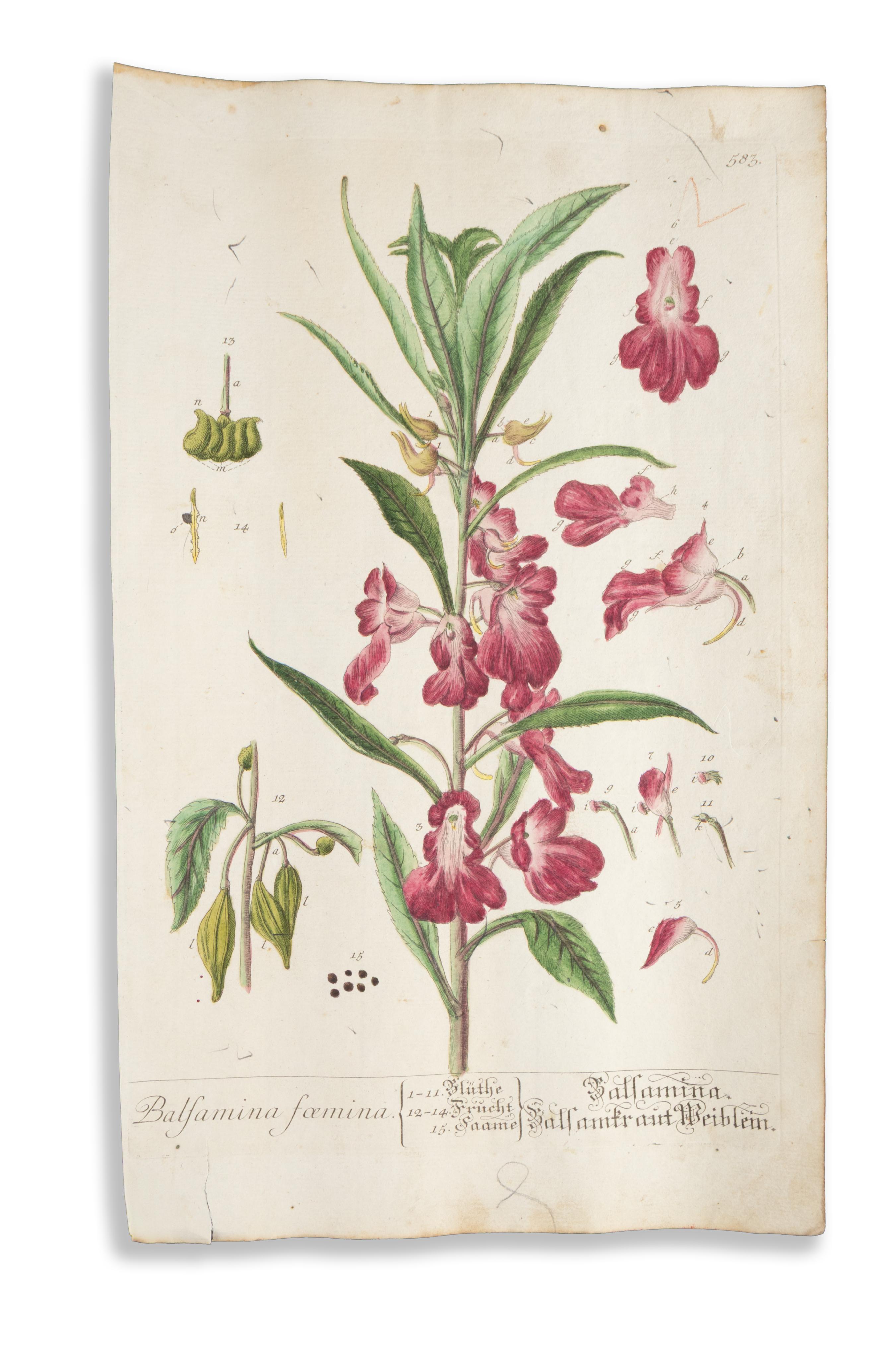
Balsamina foemina / Balsamkraut Weiblein
Nürnberg 1750-1773. FleischmannA kerti nebáncsvirágot ábrázoló páratlan illusztráció Christoph Jacob Trew Herbarium Blackwellianum emendatum et auctum, id est, Elisabethae Blackwell collectio stirpium quae in pharmacopoliis ad medicum usum asseruantur, quarum descriptio et vires ex Anglico idiomate in Latinum conversae sistuntur figurae maximam partem ad naturale exemplar emendantur floris fructusque partium repraesentatione augentur et probatis botanicorum nominibus illustrentur. / Vermehrtes und verbessertes Blackwellisches Kräuter-Buch das ist Elisabeth Blackwell Sammlung der Gewächse die zum Arzney-Gebrauch in den Apothecken aufbehalten werden deren Beschreibung und Kräfften aus dem Englischen übersetzt angezeiget die Abbildungen grossen Theils nach der Natur verbessert mit Beyfügung der Theile der Blume und Frucht vermehret wie auch mit bewährten Nahmen der Kräuter-Lehrer erläutert werden című munkájának 583. táblája.
A kézzel színezett, részletgazdag, szigorú botanikai morfológiával készített 1773-ban megjelent rézmetszet előképe a rajzolói és festői képzésben részesült skót Elizabeth Blackwell (1700 k.–1758) tudománytörténeti jelentőségű alapművében, az A Curious Herbal (London, 1737–1739) című kötetben látott napvilágot. Miután férje, Alexander Blackwell, fizetésképtelenné vált és az adósok börtönébe került, Elizabeth a Royal Society elnöke, Sir Hans Sloane, valamint a Society of Apothecaries támogatásával a Chelsea-i Botanikus Kertben kezdte meg e hiánypótló atlasz munkálatait. A két kötetben kiadott, 500 kézzel színezett rézmetszetes táblát tartalmazó mű úttörő módon nemcsak a klasszikus európai gyógynövényeket, hanem az Újvilágból származó flórát is feldolgozta. A korabeli könyvkiadásban páratlan teljesítményként Blackwell egymaga végezte el a növények élő modell utáni megrajzolását, rézbe metszését és a nyomatok kézi színezését. A Royal College of Physicians ajánlásával megjelent munka – a 18. századi gyógyszerészeti szakirodalom egyik legkiemelkedőbb alkotása – jelentős anyagi sikert hozott, és Blackwell kiválthatta férjét a börtönből.
A mű nemzetközi tudományos recepciójának csúcspontját a Christoph Jacob Trew (1695–1769) nürnbergi orvos és botanikus által gondozott Herbarium Blackwellianum (Nürnberg, 1750–1773, 6 kötet) jelentette, amely az angol eredeti szigorúan emendált, német–latin nyelvű kritikai kiadása. Trew, valamint a második kötettől közreműködő Christian Gottlieb Ludwig (1709–1773) lipcsei professzor, Blackwell alapművét a Carl von Linné-féle modern rendszertani elvek alapján dolgozták át. Az ikonográfiai anyagot a német metsző Nikolaus Friedrich Eisenberger (1707–1771) készítette. A monumentális kiadás posztumusz hatodik kötete további 100 új táblával egészült ki, így a mű összesen 600 egészoldalas, kézzel színezett rézmetszettel jelent meg – pótolva az angol eredeti hiányait és tévedéseit.
Kézzel színezett rézmeszet. Méret: 34,6×21,1 cm. A jobb szélen kisebb, alul egy kisebb és egy nagyobb szakadás. A széleken minimális foltosodás. Jó példány. Ritka.
It's original appeared in A Curious Herbal (London, 1737–1739)—a landmark achievement in the history of science by Elizabeth Blackwell (c. 1700–1758). Following the bankruptcy and imprisonment of her husband, Alexander Blackwell, Elizabeth undertook this ambitious project under the patronage of Sir Hans Sloane, President of the Royal Society, and the Society of Apothecaries, working directly at the Chelsea Physic Garden. The work stands out for encompassing not only traditional European medicinal plants but also newly introduced flora from the New World. In an unprecedented feat for contemporary book production, Blackwell executed the entire artistic and technical process herself—drawing from life (delineavit), engraving the copper plates (sculpsit), and hand-colouring the prints (pinxit). Endorsed with the official imprimatur of the Royal College of Physicians, the publication achieved major financial success, enabling her to secure her husband’s release from debtors' prison.
The international scientific reception of her work culminated in the Herbarium Blackwellianum (Nuremberg, 1750–1773, 6 vols., folio), edited by the renowned Nuremberg physician and botanist Christoph Jacob Trew (1695–1769). This expanded, bilingual German–Latin critical edition comprehensively revised Blackwell’s original text. Trew, alongside Leipzig professor Christian Gottlieb Ludwig (1709–1773), updated the botanical commentary to align with Carl Linnaeus’s newly established classification. The illustrations were redrawn and re-engraved by artist Nikolaus Friedrich Eisenberger (1707–1771), drastically improving their anatomical accuracy. The monumental sixth (posthumous) volume added 100 entirely new plates, bringing the complete work to 600 full-page, hand-coloured copperplates that corrected and supplemented the London edition.
Hand-colored copperplate engraving. Size: 34.6 × 21.1 cm. A small tear on the right edge; one small and one larger tear at the bottom. Minimal staining along the edges. A fine copy. Rare.