

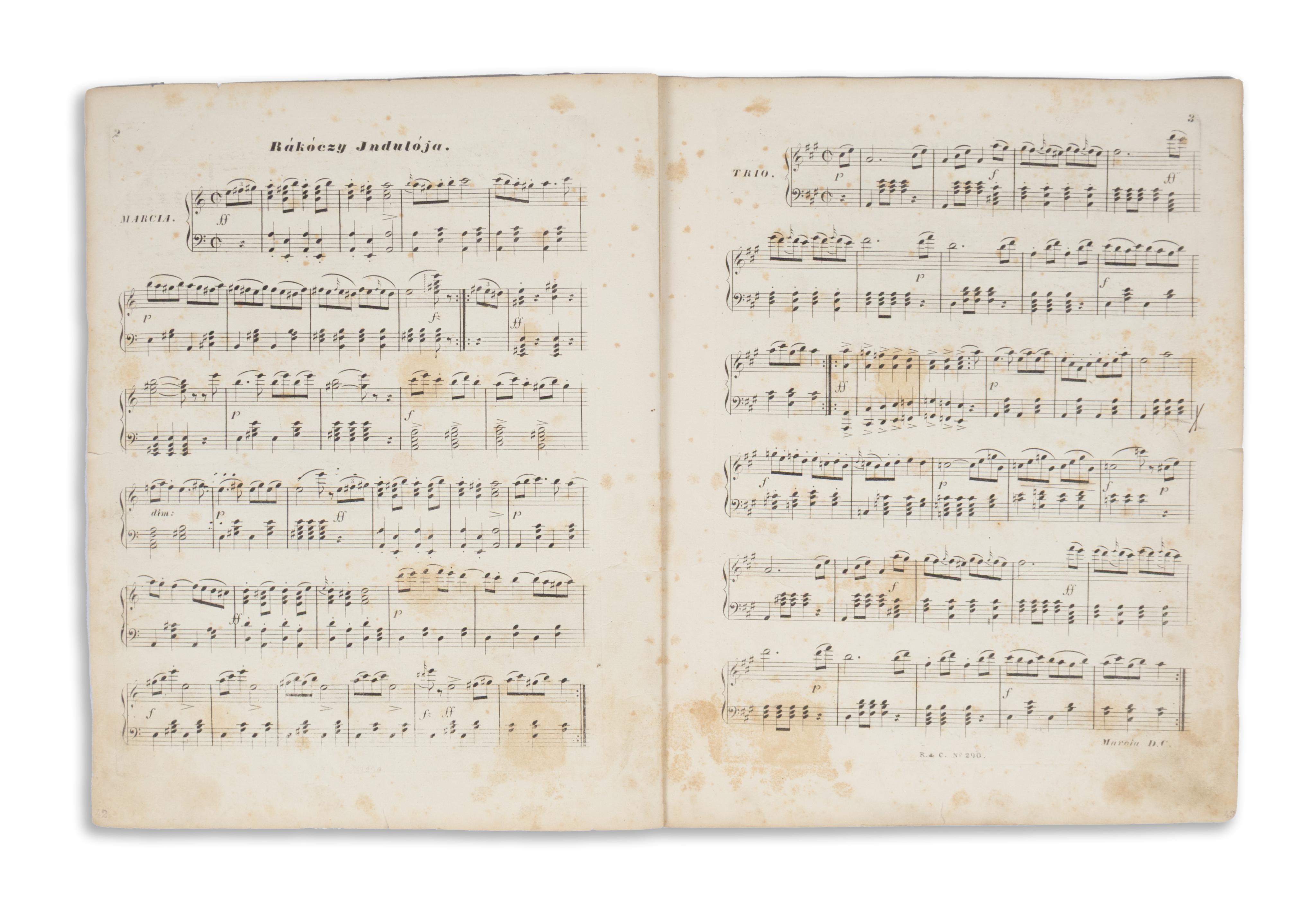
![Erkel Ferencz: Rákóczy indulója könnyű módszerben, zongorára és Bátori Mária indulója - -től. Pesten, [1857] Rózsavölgyi és társa](https://kozpontiantikvarium.hu/sites/default/files/2026-03/rakoczyinduloja_kotes.jpg "Erkel Ferencz: Rákóczy indulója könnyű módszerben, zongorára és Bátori Mária indulója - -től. Pesten, [1857] Rózsavölgyi és társa")
Szerző
Erkel Ferencz
Rákóczy indulója könnyű módszerben, zongorára és Bátori Mária indulója - -től.
Pesten, [1857] Rózsavölgyi és társaÁr
26 000 Ft
Azonosító
105503
Nagy mappa 4
3 levél metszett címlappal.
A Rákóczi-indulót Nikolaus Scholl, a k. u. k. hadsereg 32. számú ezredének karmestere írta 1820-ban. A Rákóczi-nóta hangszeres és énekelt változatainak motívumait használta fel. Bécsben adták ki 1820-ban 2 ill. 4 kezes zongorára hangszerelve. Az indulót sokan feldolgozták, közöttük Erkel Ferenc és Liszt Ferenc, a legismertebb azonban Hector Berlioz zenekari műve, ami az egész világon ismertté tette a Rákóczi-indulót. A kiegyezés után bekerült a Nemzet három dala című kiadványba a Himnusz és a Szózat mellé.
Kiadói, kissé foltos borítóban.
3 leaves with engraved title page.
The Rákóczi March was written by Nikolaus Scholl, the conductor of the 32nd Regiment of the K. U. K. Army in 1820. He used the motifs of the instrumental and sung versions of the Rákóczi-song. It was published in Vienna in 1820, arranged for piano 2 and 4 hands. The March was adapted by many, including Ferenc Erkel and Ferenc Liszt, but the best known is Hector Berlioz's orchestral work, which made the Rákóczi March known throughout the world. After the Compromise, it was included in the publication The Three Songs of the Nation, along with the Anthem and the Preface.
In publisher's, slightly stained cover.
The Rákóczi March was written by Nikolaus Scholl, the conductor of the 32nd Regiment of the K. U. K. Army in 1820. He used the motifs of the instrumental and sung versions of the Rákóczi-song. It was published in Vienna in 1820, arranged for piano 2 and 4 hands. The March was adapted by many, including Ferenc Erkel and Ferenc Liszt, but the best known is Hector Berlioz's orchestral work, which made the Rákóczi March known throughout the world. After the Compromise, it was included in the publication The Three Songs of the Nation, along with the Anthem and the Preface.
In publisher's, slightly stained cover.