

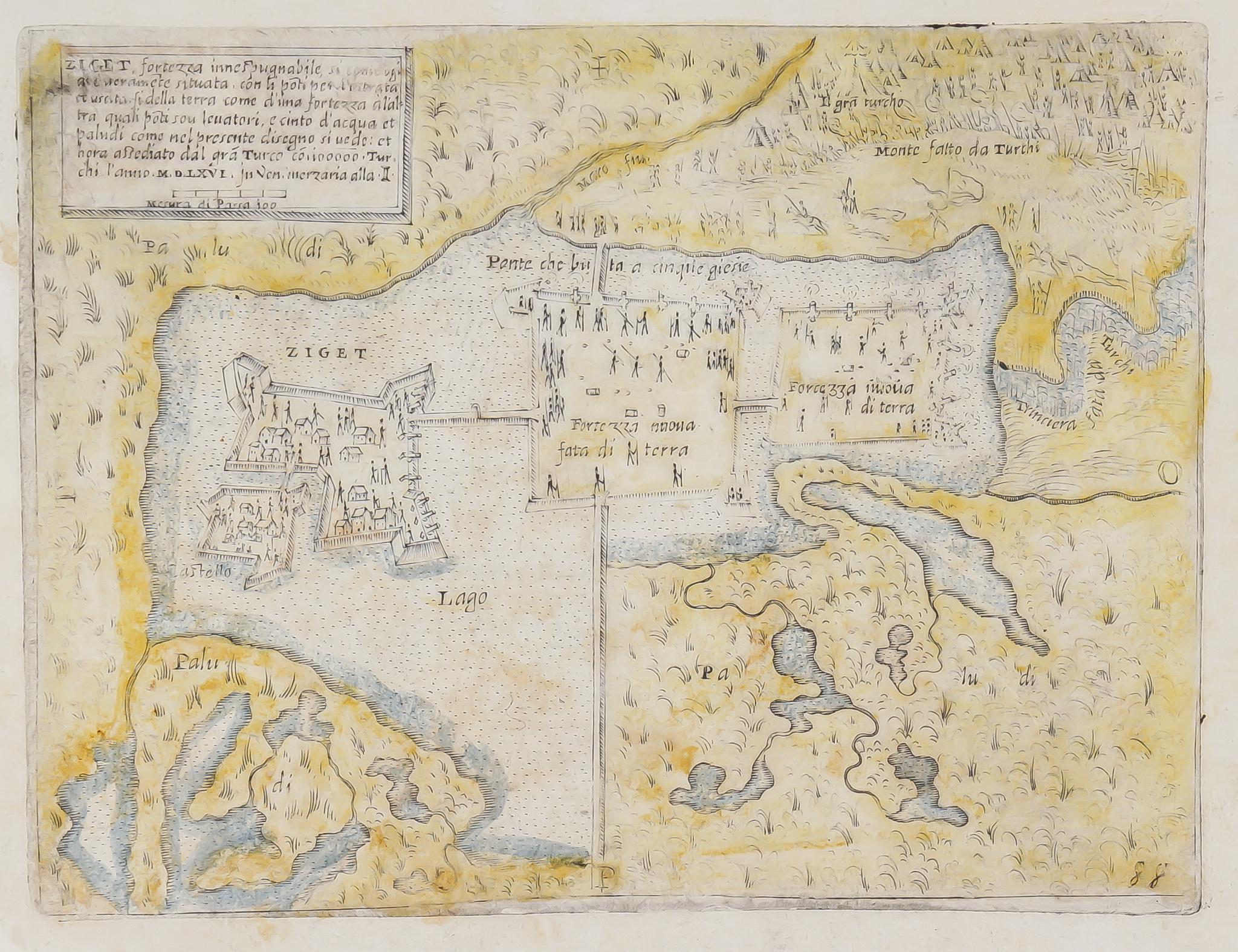
Szigetvár ostroma – Ziget, fortezza innespugnabile, si come ogi di è veramente situata . . . M.D. LXVI
1566 VeniceRitka, színezett rézmetszetű térkép Szigetvár 1566-os ostromáról.
Szigetvár fontos akadálynak számított, ugyanis Szulejmán szultán seregének Bécs felé tartó előrenyomulását akadályozta. Az összecsapásban a védekező Habsburg erők Zrínyi Miklós hadvezér vezetésével szembekerültek a Szulejmán szultán által vezetett oszmán sereggel. Ez az ostrom jelentette Szulejmán utolsó erőfeszítéseit, hogy erőit Bécs felé nyomja. A csata 1566. augusztus 5-től szeptember 8-ig tartott, és mint tudjuk, oszmán győzelemmel zárult, de mindkét fél számára súlyos áldozatokkal járt. A jelentős veszteségek között szerepelt Szulejmán halála az ostrom során. Richelieu bíboros állítólag úgy jellemezte, mint „a csata a mi megmentette a (nyugati) civilizációt”.
Jó állapotban, széles margókkal. A lap alja szakadtas, nem érinti a képmezőt.
The Siege of Szigetvár took place at the fortress of Szigetvár, located in the Kingdom of Hungary. It served as a crucial obstacle, halting the advance of Sultan Suleiman's army towards Vienna in 1566. The conflict saw the defending Habsburg forces, led by Nikola IV Zrinski, face off against the Ottoman army commanded by Sultan Suleiman the Magnificent. This siege marked Suleiman’s final effort to push his forces towards Vienna.
The battle extended from August 5 to September 8, 1566, resulting in an Ottoman victory, but at a heavy cost for both sides. Among the significant losses was the death of Suleiman during the siege.
Regarded as a pivotal event, the battle was reportedly described by the French statesman Cardinal Richelieu as “the battle that preserved (Western) civilization.” To this day, the siege remains renowned in Croatia and Hungary, inspiring cultural works such as the Hungarian epic poem.
Good condition, with wide margins. The lower margin is torn at the very edge, but this does not affect the image field.