

![Hondius, Jodocus: Virginiae Item et Floridae Americae Provinciarum, nova Descriptio [Amstelodami, 1619.]](http://kozpontiantikvarium.hu/sites/default/files/2025-06/virginaflorida_rec.jpg "Hondius, Jodocus: Virginiae Item et Floridae Americae Provinciarum, nova Descriptio [Amstelodami, 1619.]")
Virginiae Item et Floridae Americae Provinciarum, nova Descriptio
[Amstelodami, 1619.]Rendkívül ritka és gazdagon díszített rézmetszetű térkép.
Először megjelent: Gerardi Mercatoris - Atlas sive Cosmographicae Meditationes de Fabrica Mundi et Fabricati Figura. J. Hondius. 1613.
Lapméret: 57,5×47,5 cm
Térkép mérete: 50×37,5 cm
Hondius John White Virginia-térképét és Jacques Le Moyne Florida-térképét használta fel, a térkép megalkotása során. A térkép mélyreható hatást gyakorolt a régió ábrázolására a 17. század folyamán, és annak standard térképmintájává vált egészen az Ogilby–Moxon-féle Description of Carolina megjelenéséig (kb. 1672).
A Le Moyne-tól átvett részletek közé tartoznak az aranyban gazdag "Apalatcy" hegyek, a nagy vízesés által táplált tó, a part nélküli tó (Lake Sarrope), a francia nevek a folyókra, valamint a francia erőd elhelyezkedése Port Royalnál.
A korábbi térképek információ anyagán túl Hondius új földrajzi értelmezéseket is bevezetett. Például a nagy tó, melynek túlpartja láthatatlan – amely Le Moyne térképén a May-folyó torkolatától délnyugatra helyezkedik el –, északabbra, az Apalatcy Montes lábához került. Ezáltal a May-folyó délkeleti irányban folyik, szemben Le Moyne A-alakú folyásirányával. Ez a változás más források hatását tükrözi, mint például Mercator 1569-es világtérképe, Ortelius 1584-es Amerika-térképe, illetve Wytfliet 1597-ben megjelent délkeleti térképe, amelyen a Sola folyó szintén délkelet felé halad a hegyekből.
A térképet vadon élő állatok, tengeri szörnyek, őslakosok kenuja, vitorlás hajók és más dekoratív elemek gazdag metszetei díszítik. Két díszes kartust és két melléktérképet is tartalmaz, amelyek Floridai és Virginia városait ábrázolják.
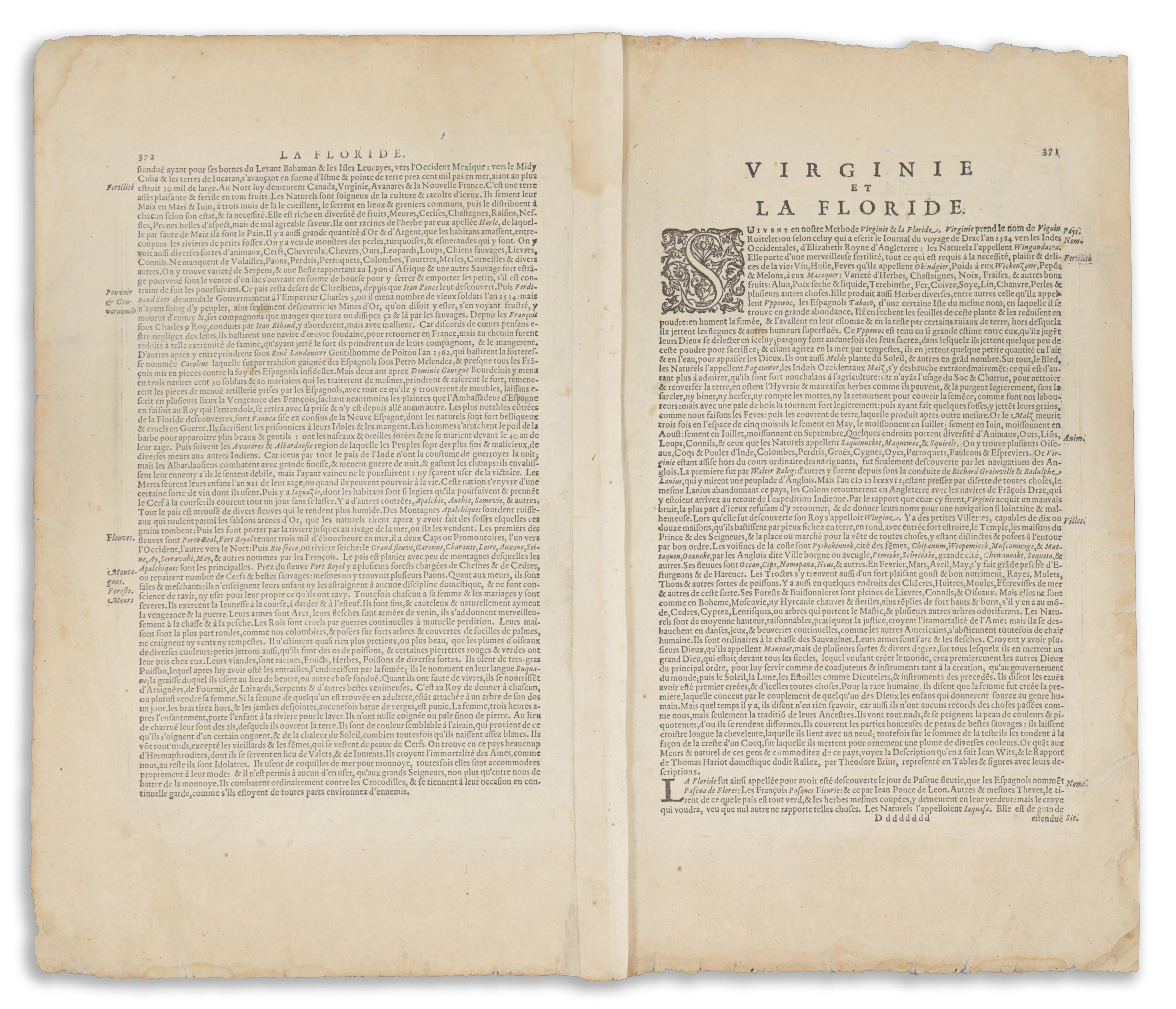
A verson 371-372es oldalszámok, "Dddddddd", francia magyarázó szöveg. Virginae et La Floride.
A lapszéleken halvány vízfolt, kisebb szakadások. A lap több helyütt, a képmezőt azonban pusztán egy helyen érintve és alig észrevehetően restaurált. A verson a hajtás mentén megerősítve.
Van der Krogt (1:113), Koeman, vol. 2, Entry Me26A, p. 330., Phillips "List of maps of America", vol. 2, p 977., Burden, Entry 151, p. 184-185.
First published in: Gerardi Mercatoris - Atlas sive Cosmographicae Meditationes de Fabrica Mundi et Fabricati Figura. J. Hondius. 1613.
Sheet size: 57,5×47,5 cm
Map size: 50×37,5 cm
Hondius drew on John White’s map of Virginia and Jacques Le Moyne’s map of Florida to produce what is essentially a composite of these two significant late 16th-century cartographic sources. This map had a lasting influence on the depiction of the region throughout the 17th century and served as the standard reference until the Ogilby-Moxon Description of Carolina around 1672.
Elements derived from Le Moyne’s work include the gold-rich "Apalatcy" mountains, the lake fed by a great waterfall, the mysterious lake with an unseen shore (Lake Sarrope), French names for local rivers, and the positioning of the French fort at Port Royal.
Beyond combining earlier maps, Hondius introduced new geographic interpretations. For instance, the large lake with the invisible far shore—originally placed southwest of the River May’s mouth by Le Moyne—is repositioned northward, near the Apalatcy Montes. This alteration makes the River May run southeastward, diverging from the A-shaped course depicted by Le Moyne. This shift reflects the integration of other cartographic sources, such as Mercator’s 1569 world map, the 1584 second edition of Ortelius’ map of America, and Wytfliet’s 1597 map of the Southeast, where the River Sola also flows southeast from the mountains.
The map is adorned with detailed engravings of turkeys, wild game, sea monsters, Indigenous canoes, sailing ships, and other decorative flourishes. It also features two elaborate cartouches and inset maps of cities in Florida and Virginia.
Verso Text: Pages 371, 372, Dddddddd. Virginae et La Floride. French description.
Faint water stains and minor tears along the edges. The sheet has been restored in several places, though the image field is affected only in one spot and barely noticeably. The verso has been reinforced along the fold.
Van der Krogt (1:113), Koeman, vol. 2, Entry Me26A, p. 330., Phillips "List of maps of America", vol. 2, p 977., Burden, Entry 151, p. 184-185.