

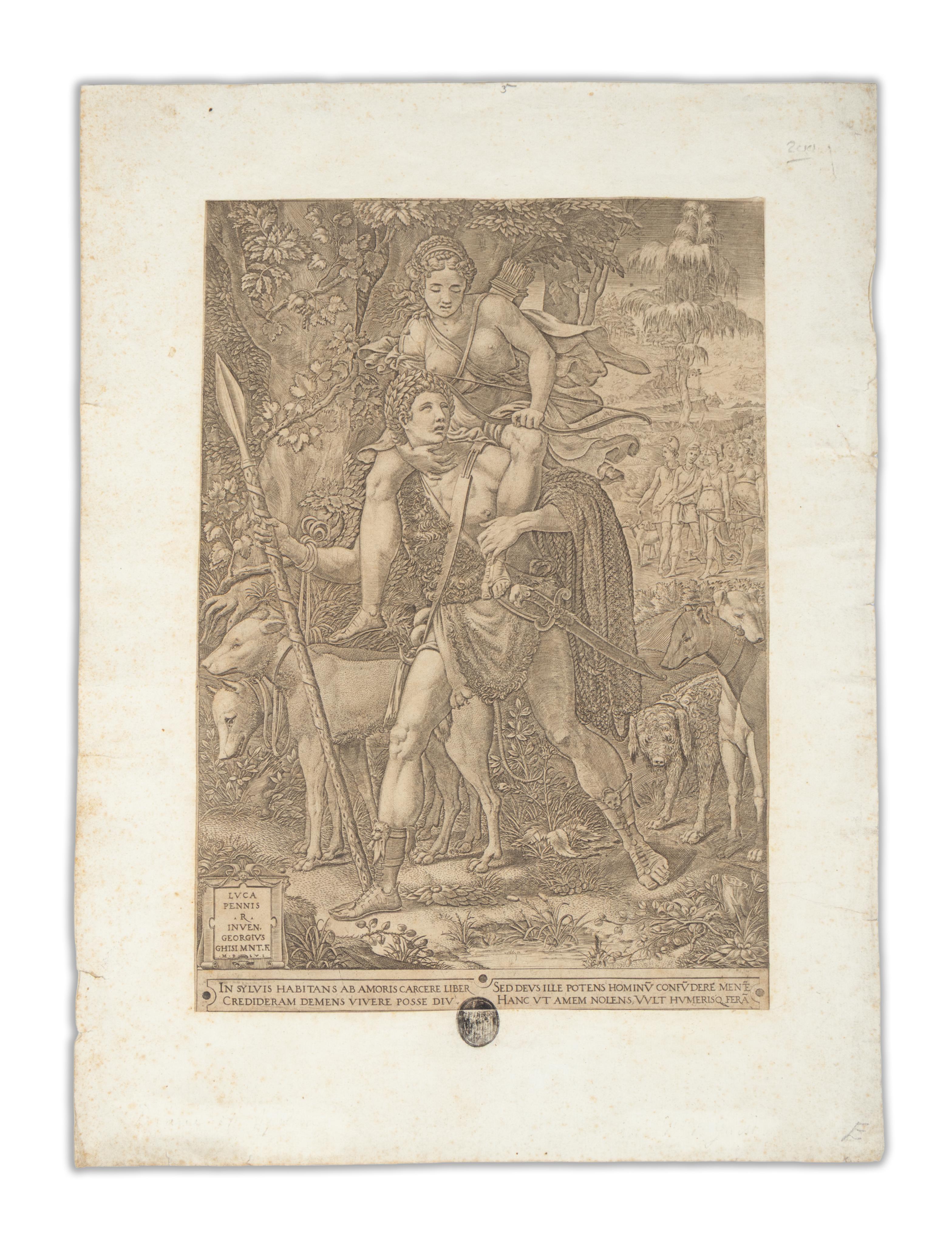
Allegoria della Caccia
1540-1560Luca Penni (c. 1500/1504-1556) után metszette Giorgio Ghisi (1520-1582). Rézmetszet merített papíron. Ritka.
A mitológiai jelenet figuráinak kiléte kérdéses: a metszet egy babérkoszorús fiatal vadászt ábrázol, amint bal felé lépdel, miközben egy nőt visz a hátán, aki íjat tart a kezében, és tegezt visel a hátán. Körülöttük vadászkutyák, a háttérben szüzekből álló vadászkíséret. Míg az istennő azonosítása az attribútumok és a jelenet alapján nem okoz problémát, addig a férfi alak kilétére több hipotézist is ismer a szakirodalom; egyesek Endümiónként azonosítják, azonban Endümiónról nem szól olyan mítosz, hogy álmából felébredt volna, és olyan ábrázolása sem ismert, ahol az őt esténként meglátogató istennőt a vállán hordozta volna. Egy másik feltételezés szerint a férfi Órión, és ez valószínűbbnek is tűnhetne, ugyanis a hősröl több mítosz szól, ahol az istennővel közösen vadásznak, igaz, szerelem nincs köztük. A jelenet persze lehet allegorikus is: Dianát nem egy konkrét mitologikus alak, hanem a vadászat egy névtelen szerelmese hordozza vállain. Mintha talán erre utalna a kartus szövege is:
IN SYLVIS HABITANS AB AMORIS CARCERE LIBER / CREDIDERAM DEMENS VIVERE POSSE DIV. // SED DEVS ILLE POTENS HOMINVM CONFVDERE MENTEM / HANC VT AMEM NOLENS, VVLT HVMERISQVE FERAM
Balgán azt hittem, sokáig élhetek az erdőkben, szabadon a szerelem börtönétől. De az az isten [Cupido vagy Ámor?], aki képes megzavarni az emberek elméjét, azt akarja, bár én nem kívánom, hogy szeressem őt, és a vállamon hordozzam.
Érdekes módon a források nem említik Aktaiónt, pedig ha valakire, hát rá igazán illene a tragikus szerelmes vadász szerepe: talán azt látjuk a képen, ahol Diana, miután rajtakapta Aktaiónt, ahogy a vadász megleste őt és nimfáit fürdés közben, épp szarvassá készül változtatni a vadászt, és saját kutyáival szétmarcangoltatni őt.
Élete során a rézmetsző (Ghisi) Penni, Michelangelo, Giulio Romano, Raffaello, Correggio és mások műveit is reprodukálta. Nemcsak Rómában tartózkodott, hanem Antwerpenben, Párizsban és Fontainebleau-ban is. Luca Penni 1537 és 1540 között Fontainebleau-ban dolgozott Rosso Fiorentinóval az I. Ferenc-galéria (Galleria Francesco I) díszítésén. Feltételezhetően Ghisinek így lehetősége nyílt Penni egyik eredeti rajzát rézlemezre átültetni (metszetként kidolgozni).
Ghisi metszetének egy másik rejtélyes eleme az a kereszt, amely a próbanyomaton jól látható, és amelyet valójában tökéletlenül távolítottak el, így még mindig látható a metszet azon lenyomatain, amelyek addig készültek, amíg a lemez Claudio Duchetti kezébe nem került (jobb felül, a fa alsó ágai alatt a dombon). A keresztény utalás teljesen oda nem illőnek tűnik ebben a klasszikus jelenetben, és a próbanyomaton való szerepeltetése továbbra is megmagyarázatlan marad.
A bal alsó sarokban lévő kis kartuson "Luca Pennis R Inven Georgius Ghisi M.N. T. AE. MDLVI". A metszetnek a befejezetlen próba nyomaton kívül három állapota van, ez a második. A harmadik és negyedik verzión szerepel az adott kiadó (Claudio Duchetti, majd Iacobus de Rubeis) és címe.
Egyenletes sárgulás, a margók a képi ábrázolás határáig visszavágva. A lap XVIII. századi papírra van felkasírozva; összességében jól megkímélt. Egy apró bélyegző minimális mértékben érinti a metszetet.
Lap mérete: 25,5×36 cm
Mariette, p. 376; Bartsch 43; d'Arco, p. 102, no. 17; Nagler, p. 139; Heller-Andresen 14; LeBlanc 34; Fontainebleau 349; Massan 208
Lásd még: Boorsch, Suzanne: The Engravings of Giorgio Ghisi. The Metropolitan Museum of Art, New York, 1985. 91-94. o.
The identity of the figures in the mythological scene is in question: the engraving depicts a young hunter with a laurel wreath stepping to the left while carrying a woman on his back who holds a bow in her hand and wears a quiver on her back. They are surrounded by hunting dogs, with a hunting entourage of virgins in the background. While the identification of the goddess poses no problem based on her attributes and the scene, the literature offers several hypotheses regarding the identity of the male figure; some identify him as Endymion. However, there is no myth about Endymion waking from his sleep, nor is there any known depiction where he carries the goddess who visits him nightly on his shoulders. According to another assumption, the man is Orion, and this might seem more probable, as there are several myths about the hero hunting together with the goddess, although there is no romance between them. The scene could of course also be allegorical: Diana is not carried by a specific mythological figure but by an anonymous lover of hunting.
This seems to be suggested by the text of the cartouche as well:
'IN SYLVIS HABITANS AB AMORIS CARCERE LIBER / CREDIDERAM DEMENS VIVERE POSSE DIV. // SED DEVS ILLE POTENS HOMINVM CONFVDERE MENTEM / HANC VT AMEM NOLENS, VVLT HVMERISQVE FERAM'
'Foolishly I had believed that I could live for long in the woods free from the prison of love. But that god who is able to confuse the mind of men wants me to love her, though I do not wish to, and carry her on my shoulders'
Interestingly, the sources do not mention Actaeon, even though the role of the tragic hunter in love would really suit him: perhaps what we see in the picture is Diana, after catching Actaeon spying on her and her nymphs while bathing, preparing to turn the hunter into a stag and have him torn apart by his own dogs.
As Boorsch notes: 'Until the figures can be identified with certainty, it seems preferable to use the indefinite title we have chosen. Another puzzling element of Ghisi's print is the cross that is clearly visible in the proof state (see illustration) and that in fact was imperfectly erased and is still seen in impressions of the print made until the plate came into the hands of Claudio Duchetti. The Christian reference seems totally incongruous in this classical scene, and its inclusion in the unfinished state remains unexplained.'
During his life, the engraver Ghisi also reproduced the works of Penni, Michelangelo, Giulio Romano, Raphael, Correggio, and others. He stayed not only in Rome but also in Antwerp, Paris, and Fontainebleau. Luca Penni worked in Fontainebleau with Rosso Fiorentino between 1537 and 1540 on the decoration of the Gallery of Francis I or Galleria Francesco I. Presumably, this gave Ghisi the opportunity to transfer one of Penni's original drawings onto a copper plate and develop it as an engraving.
The following inscription can be read on the small cartouche in the lower left corner: "Luca Pennis R Inven Georgius Ghisi M.N. T. AE. MDLVI". In addition to the unfinished proof state, the engraving has three states, this is the second. The third and fourth versions include the respective publisher (Claudio Duchetti, and later Iacobus de Rubeis) and their address.
Even yellowing, the margins are trimmed to the border of the pictorial representation. Mounted on 18th-century paper; overall well-preserved. A smaller stamp affects the engraving to a minimal extent.
Sheet size: 25.5 x 36 cm.
Mariette, p. 376; Bartsch 43; d'Arco, p. 102, no. 17; Nagler, p. 139; Heller-Andresen 14; LeBlanc 34; Fontainebleau 349; Massan 208.
Further reading: Boorsch, Suzanne: The Engravings of Giorgio Ghisi. The Metropolitan Museum of Art, New York, 1985. pp. 91-94.