

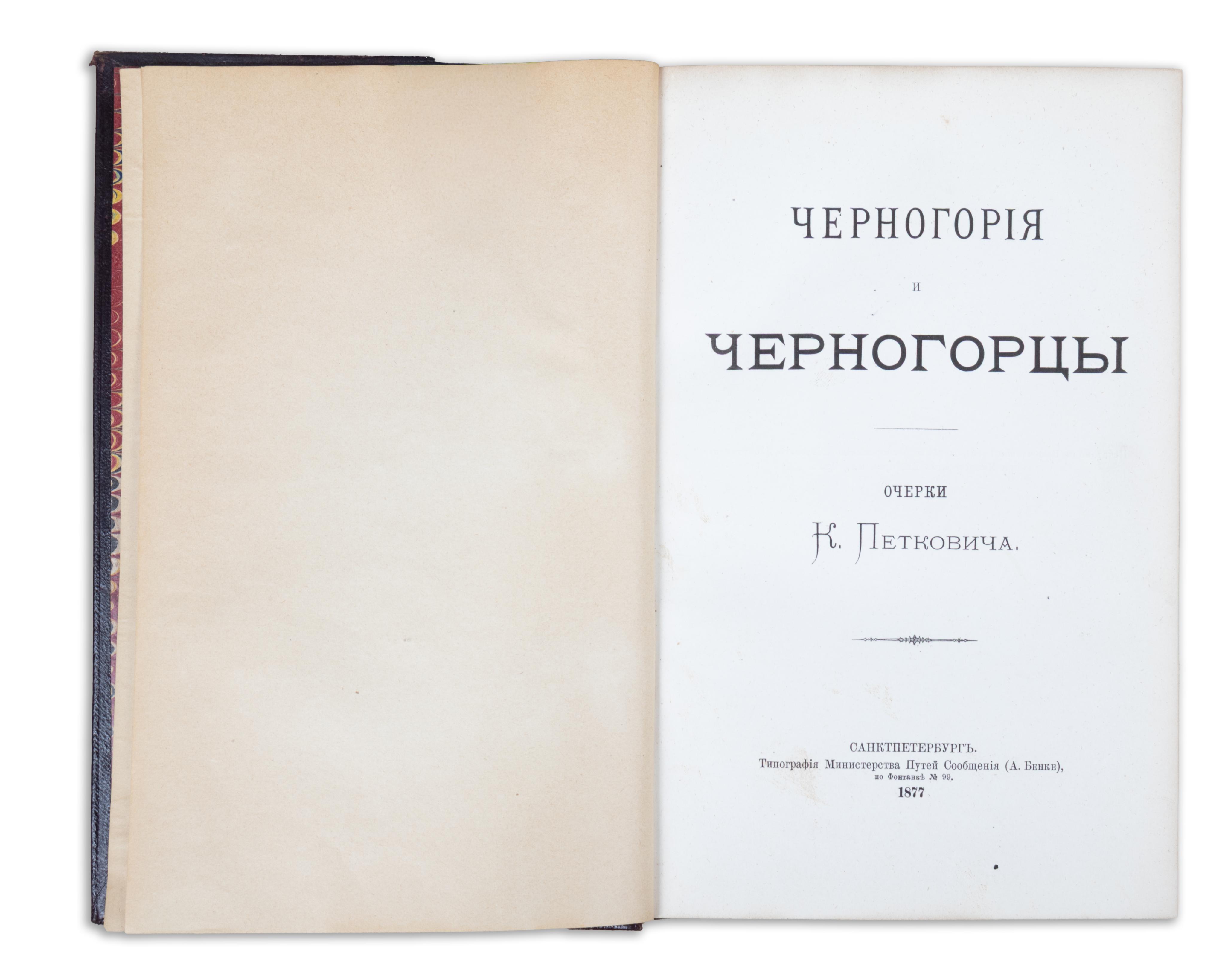
Черногория и черногорцы - Montenegro and the Montenegrins
St. Petersburg, 1877. A. Benke. (Санктпетербургъ, 1877. Типографія Министерства Путей Сообщенія (А. Бенке), по Фонтанкѣ № 99.118p.
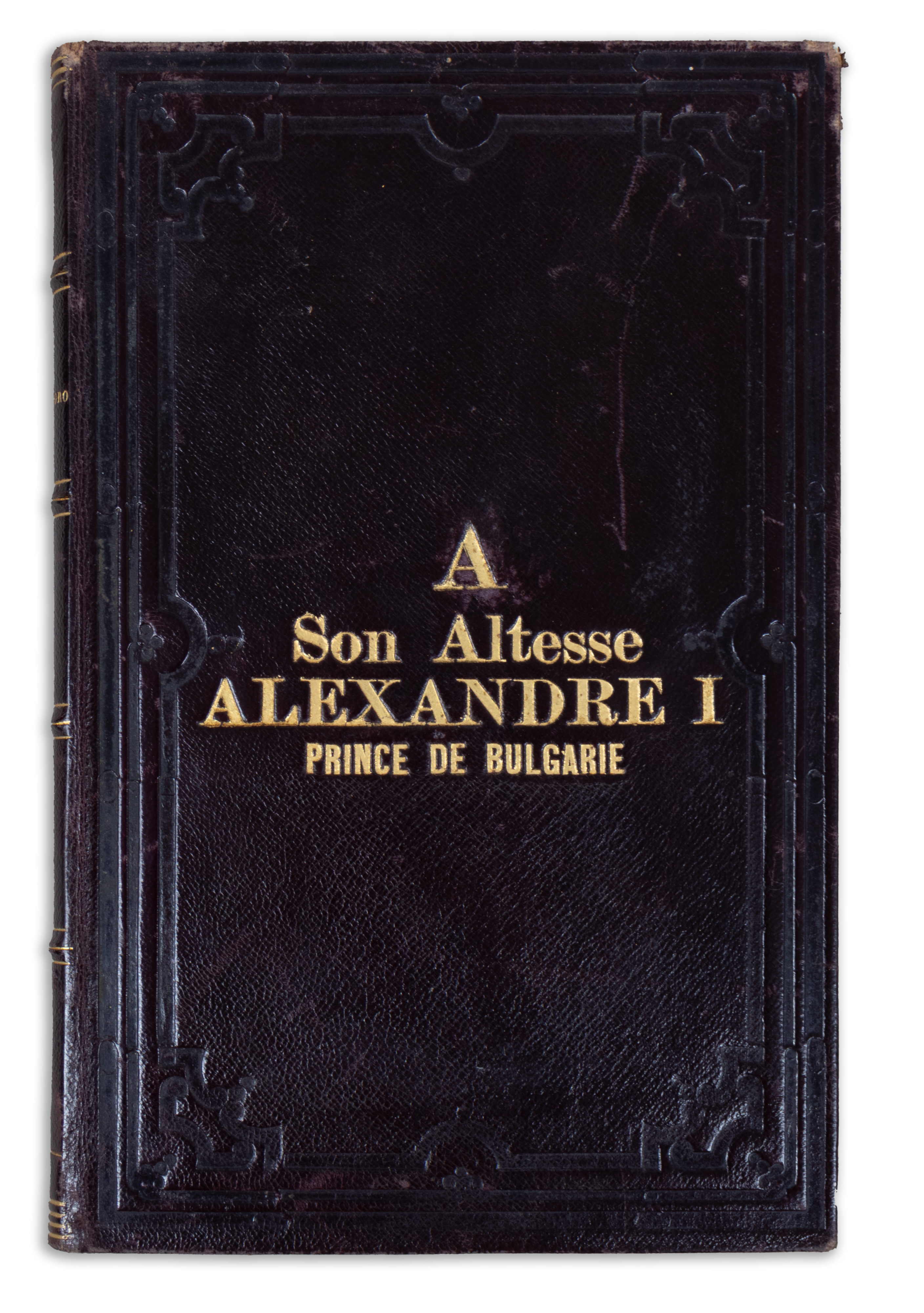
Dedikációs kötés, kivételes provenienciával: Alexander Joseph von Battenberg herceg (1857–1893), I. Sándor bolgár fejedelem könyvtárából. I. Sándor (bolgárul: Алекса̀ндър I Български, 1857–1893), született Alexander Joseph von Battenberg herceg, 1879–1886 között Bulgária megválasztott fejedelme, II. Sándor orosz cár unokaöccse volt. 1878-ban Bulgáriából önálló, autonóm fejedelemség lett az Oszmán Birodalom fennhatósága alatt, II. Sándor pedig unokaöccsét, a bolgár koronára pályázó herceget ajánlotta az újonnan megalakult ország uralkodójául. Sándor abszolutisztikus törekvései nem jártak sikerrel, a zavaros belpolitikai helyzet, külső támadás és saját tisztjeinek puccsa után 1886-ban kénytelen volt lemondani.
A bolgár származású Petkovich (1824–1898) Bashinoban született. Zaharij Knjazseszki bolgár tudós közbenjárásával jutott be a szentpétervári egyetemre, ahol ő lett az első bolgár, aki a neves orosz szlavista, Izmail Szreznevszkij (1812-1880) tanítványa lehetett. Honfitársával, Natanail Zografszkival közösen megkísérelték egy „Bolgár Matica” nevű közművelődési szervezet és egy saját nyomda létrehozását, de ezek a tervek sajnos nem valósultak meg. Petkovich volt a legelső bolgár kutató, aki lehetőséget kapott az Athosz-hegyi kolostorok könyvtáraiban lévő kéziratok tanulmányozására. Később orosz állampolgárságot felvéve kiemelkedő diplomáciai karriert futott be; konzulként szolgált Vidinben, Dubrovnikban és Bejrútban is, munkásságát pedig számos elismeréssel, köztük a francia Becsületrenddel jutalmazták. Szoros kapcsolatot ápolt a montenegrói és hercegovinai vezetőkkel, támogatva a szláv felszabadítótörekvéseket. Sokéves munkájának összegzése a Черногория и черногорцы (Montenegró és a montenegróiak).
Életművével, sokrétű tudományos kutatásaival és diplomáciai szolgálatával a szláv népek közötti megértést segítette elő, így a bolgár folklórkutatás és nyelvészet egyik legfontosabb úttörőjeként vonult be a történelembe.
Egyedi, aranyozott bibliofil egészbőrkötésben, az első kötéstáblán aranyozott francia felirat: "A son Altesse Alexandre I Prince de Bulgarie." Aranyozott gerinccel, lapélekkel, pillangós festésű előzéklapokkal. A hátsó kötéstáblán kisebb kopásnyomokkal.
Exceptional copy in a presentation binding from the library of Prince Alexander Joseph of Battenberg (1857–1893), Prince Alexander I of Bulgaria.
Alexander I (Bulgarian: Алекса̀ндър I Български, 1857–1893), born Prince Alexander Joseph of Battenberg, was the elected Prince of Bulgaria from 1879 to 1886 and the nephew of Russian Tsar Alexander II. In 1878, Bulgaria became an independent, autonomous principality under the suzerainty of the Ottoman Empire, and Alexander II recommended his nephew—a claimant to the Bulgarian crown—as the ruler of the newly formed country. Alexander's absolutist ambitions were unsuccessful; following a turbulent domestic political situation, external attacks, and a coup by his own officers, he was forced to abdicate in 1886.
The Bulgarian-born Konstantin Petkovich (1824–1898) was born in Bashino. Through the intervention of the Bulgarian scholar Zahariy Knyazheski, he was admitted to St. Petersburg University, where he became the first Bulgarian to study under the renowned Russian Slavist Izmail Sreznevsky (1812–1880). Together with his compatriot Nathanael Zografski, they attempted to establish a public educational organization called the "Bulgarian Matica" and their own printing house, but unfortunately, these plans did not materialize.
Petkovich was the very first Bulgarian researcher granted the opportunity to study the manuscripts in the libraries of the Mount Athos monasteries. Later, after acquiring Russian citizenship, he had an outstanding diplomatic career. He served as a consul in Vidin, Dubrovnik, and Beirut, and his work was rewarded with numerous accolades, including the French Legion of Honour. He maintained close ties with the leaders of Montenegro and Herzegovina, supporting Slavic liberation movements. The culmination of his many years of work is the book Черногория и черногорцы (Montenegro and the Montenegrins).
Through his life's work, diverse scientific research, and diplomatic service, he promoted mutual understanding among the Slavic peoples, thus going down in history as one of the most important pioneers of Bulgarian folklore research and linguistics.
Bound in a unique, gilt bibliophile full-leather binding. French inscription on the front board: "A son Altesse Alexandre I Prince de Bulgarie." (To His Highness Alexander I, Prince of Bulgaria). Filt spine, gilt edges, and butterfly-marbled endpapers. Minor damage to the back board.