

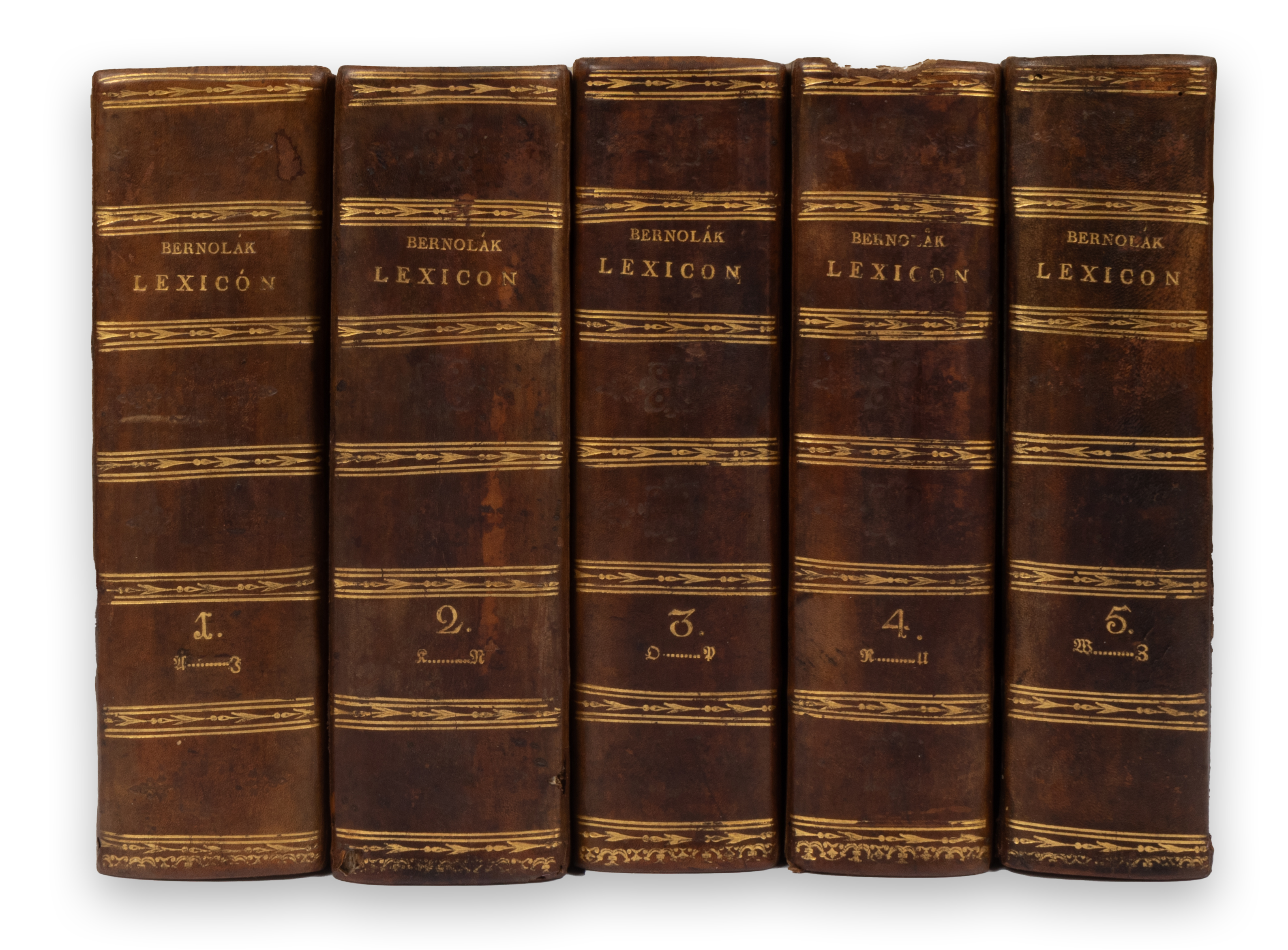
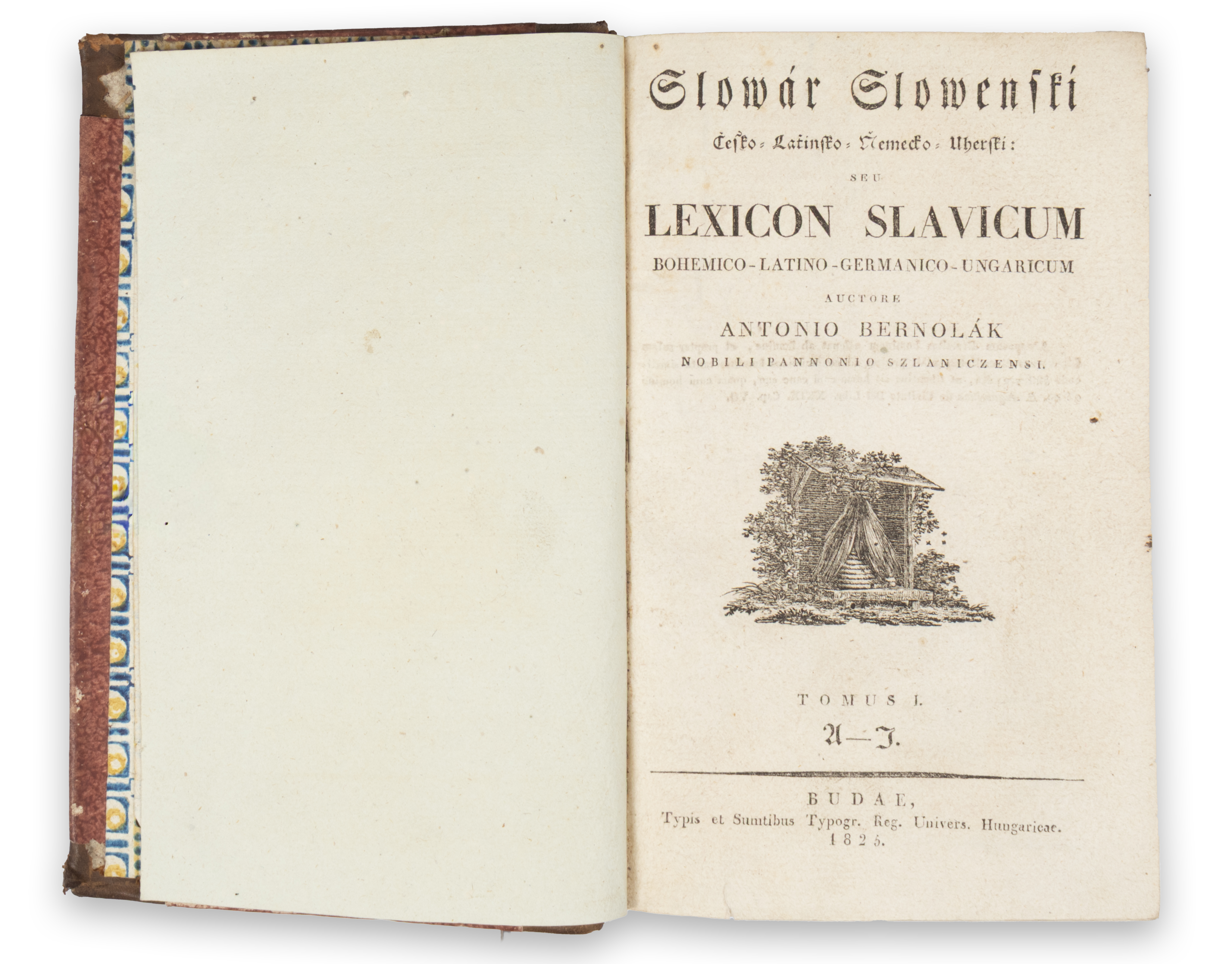
Slowár slowenski cesko - latinsko - ňemecko-uherski seu Lexicon slavicum bohemico-latino-germanico-ungaricum. I-V. köt.
Budae, 1825–1827. Typogr. Reg. Universitatis.I. A–I. XVI + [2] + 848 p.
II. K–N. (849)-1762. p.
III. O–P. (1763)-2680. p.
IV. R–U. (2681)-3558. p.
IV. W–Z. (3559)-4446. p.
A VI. kötet, a Repertorium hiányzik.
A szolvák író és nyelvész, Anton Bernolák (1762-1813) 1780-as évektől kezdődően tudatosan szembehelyezkedett a domináns cseh irodalmi hagyománnyal. Munkásságának köszönhetően egyre szélesebb körben vert gyökeret az a meggyőződés, hogy a szlovák nem a cseh nyelv egyfajta "durvább" dialektusa, hanem a szláv nyelvcsalád önálló, egyenrangú tagja – miként maga a szlovákság sem a cseh nemzet periférikus töredéke, hanem önálló identitással bíró nép. Legfőbb célja az volt, hogy a korabeli szlovákság körében még domináns cseh irodalmi nyelvet egy saját, nemzeti nyelvváltozattal váltsa fel, ezáltal téve hozzáférhetőbbé az irodalmat a szélesebb rétegek számára. Nyelvi bázisul a csehhez leginkább hasonlító nagyszombati (trnavai) dialektust választotta. Ahol a népi szókészlet hiányosnak bizonyult az összetettebb fogalmak kifejezésére, ott bátran élt a szóalkotás eszközével, és saját neologizmusokat vezetett be.
Törekvéseinek és életművének csúcspontja az 1825 és 1827 között, posztumusz kiadásban megjelent, monumentális, hatkötetes szlovák(tót)–cseh–latin–magyar szótár
Bár a később véglegesített, modern szlovák irodalmi norma végül más utat járt be – a keményebb hangzású turóc-liptói nyelvjárást véve alapul, így Bernolák mesterségesen alkotott szavainak jelentős része kikopott a használatból –, életműve elengedhetetlen híd a cseh és az önálló szlovák irodalom között.
Korszakalkotó fellépése indította el azt a folyamatot, amely végső soron a szlovák irodalmi autonómiához és a cseh befolyástól való elszakadáshoz vezetett. Szellemiségét egy egész írói generáció, a nyelvújító mesterüket hűen követő „bernolákisták” vitték tovább.
Korabeli, egységes félbőr kötésben, aranyozott gerincdíszítéssel és felirattal. A kötéstáblák sarkai, élei helyenként sérültek, kopottak. II-V. kötet bőrborításán kisebb hiány. Ezek ellenére is szép sorozat.
His primary goal was to replace the Czech literary language, which was still dominant among the Slovaks of the time, with a distinct national language variant, thereby making literature more accessible to the broader public. As a linguistic base, he chose the Trnava dialect, which was the closest to Czech. Wherever the vernacular vocabulary proved insufficient to express more complex concepts, he boldly employed word creation and introduced his own neologisms.
The culmination of his endeavors and his life's work is the monumental six-volume Slovak (Tót)–Czech–Latin–Hungarian dictionary, published posthumously between 1825 and 1827.
Although the subsequently finalized, modern Slovak literary norm ultimately took a different path - basing itself on the harsher-sounding Turiec-Liptov dialect, which led to a significant portion of Bernolák's coined words falling into disuse - his oeuvre remains an indispensable bridge between Czech literature and independent Slovak literature. His epoch-making emergence initiated the process that ultimately led to Slovak literary autonomy and divergence from Czech influence. His intellectual legacy was carried forward by an entire generation of writers, the "Bernolákists," who faithfully adhered to the teachings of their language-reforming master.
Contemporary, uniform half-leather binding with gilt spine decoration and lettering. Corners and edges of the boards worn and slightly damaged in places. There is minor loss to the leather covering on volumes II–V. Despite these minor flaws, a handsome and fine set.