

![Horae Intemerate Virginis Marie Secundum Verum Usum Romanum Cum Pluribus Orationibus Tam In Gallico Et In Latino. Paris, 1501 május 8. Thielman Kerver [et] Gilles Remacle.](http://kozpontiantikvarium.hu/sites/default/files/2024-11/175%20Hora%20B%2001%20m%C3%A1solat.jpg "Horae Intemerate Virginis Marie Secundum Verum Usum Romanum Cum Pluribus Orationibus Tam In Gallico Et In Latino. Paris, 1501 május 8. Thielman Kerver [et] Gilles Remacle.")
Horae Intemerate Virginis Marie Secundum Verum Usum Romanum Cum Pluribus Orationibus Tam In Gallico Et In Latino.
Paris, 1501 május 8. Thielman Kerver [et] Gilles Remacle.Luxorious 16th Century Book of Hours, Printed on Vellum
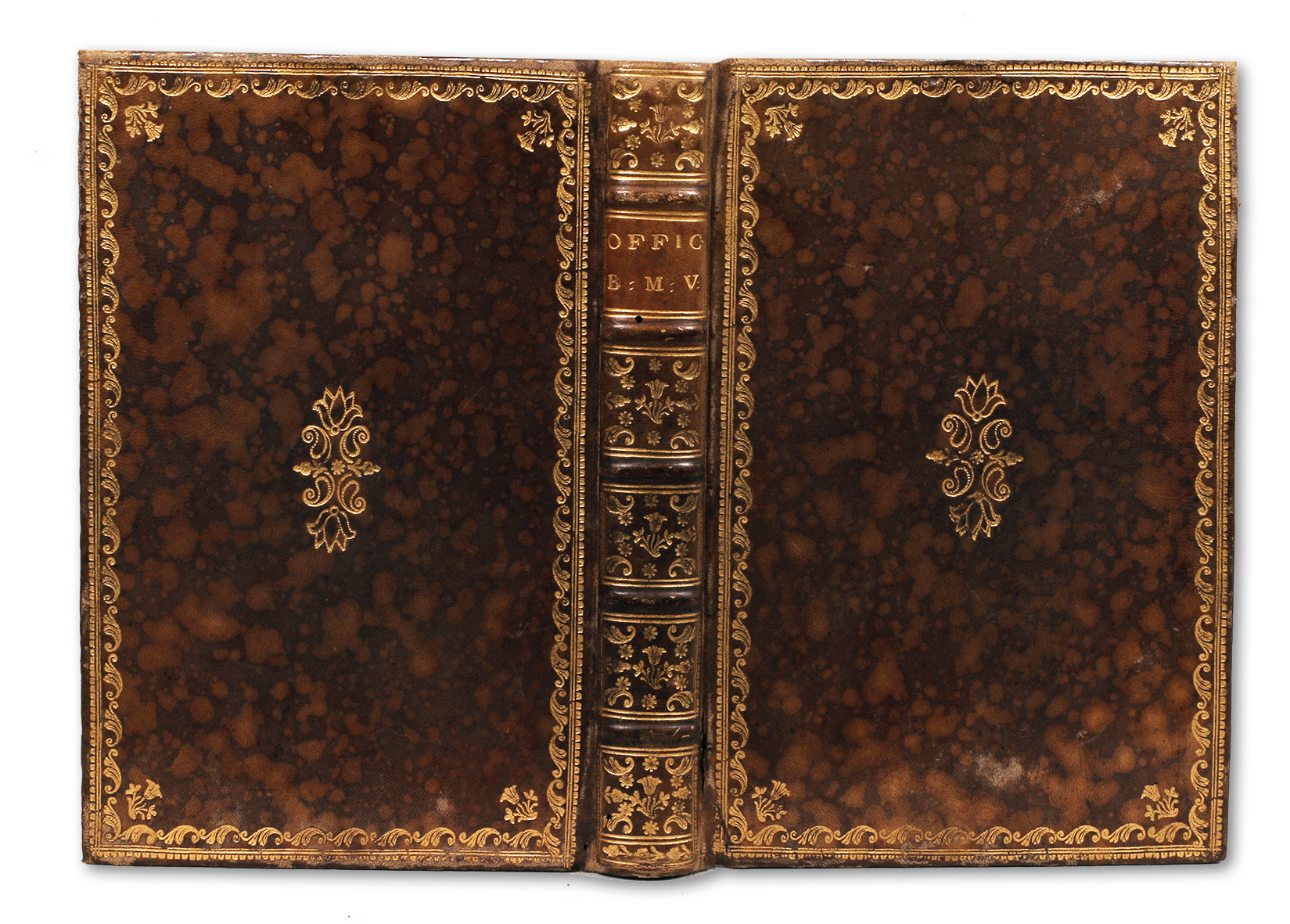
96 unnumb. leaves. (A8-M8). In a richly gilt, French-style 18th-century leather binding.
A prayer book designed for private devotion—primarily for women—printed on vellum. The name refers to the "Hours" (canonical hours), prayers to be recited at three-hour intervals (Matins, Lauds, Vespers, etc.). Based on the clerical breviary, the Book of Hours is more secular in content, more diverse, and more richly decorated. Its core is the Little Office of the Blessed Virgin Mary, supplemented by the Penitential Psalms, litanies, the Office of the Dead, and suffrages to the saints. It invariably includes a calendar listing feasts and saints' days.
The genre reached its zenith in the 15th-century French-speaking territories. The most ornate, representative examples were printed on vellum (parchment). These works belong to a transitional era; they imitate illuminated parchment codices and their luxury features (gilding, illumination), yet reached a wider audience through the higher print runs enabled by the press. To emulate hand-painted manuscripts, the status of these printed works was elevated through hand-illumination and gilding.
Thielman Kerver, a printer originally from Koblenz, took over a bookshop on the Rue Saint-Jacques in Paris in 1478. By 1497, he possessed his own press, operated jointly with Georg Wolf. A few years later, he sold the business to Gillet Remacle, subsequently working largely for him. Books of Hours emerging from the Kerver workshop were among the highest quality examples of the genre, both in artistic merit and typographical execution. The workshop printed its first Book of Hours in 1497, initially using woodcuts, which were replaced by metalcuts from 1499 onwards. Their extraordinary popularity is evidenced by the numerous editions published until Kerver's death in 1522, after which his widow, Yolande Bonhomme, and their sons continued the work. A distinct characteristic of the workshop was the imaginative variation of illustrations, ensuring that no two editions are exactly alike.
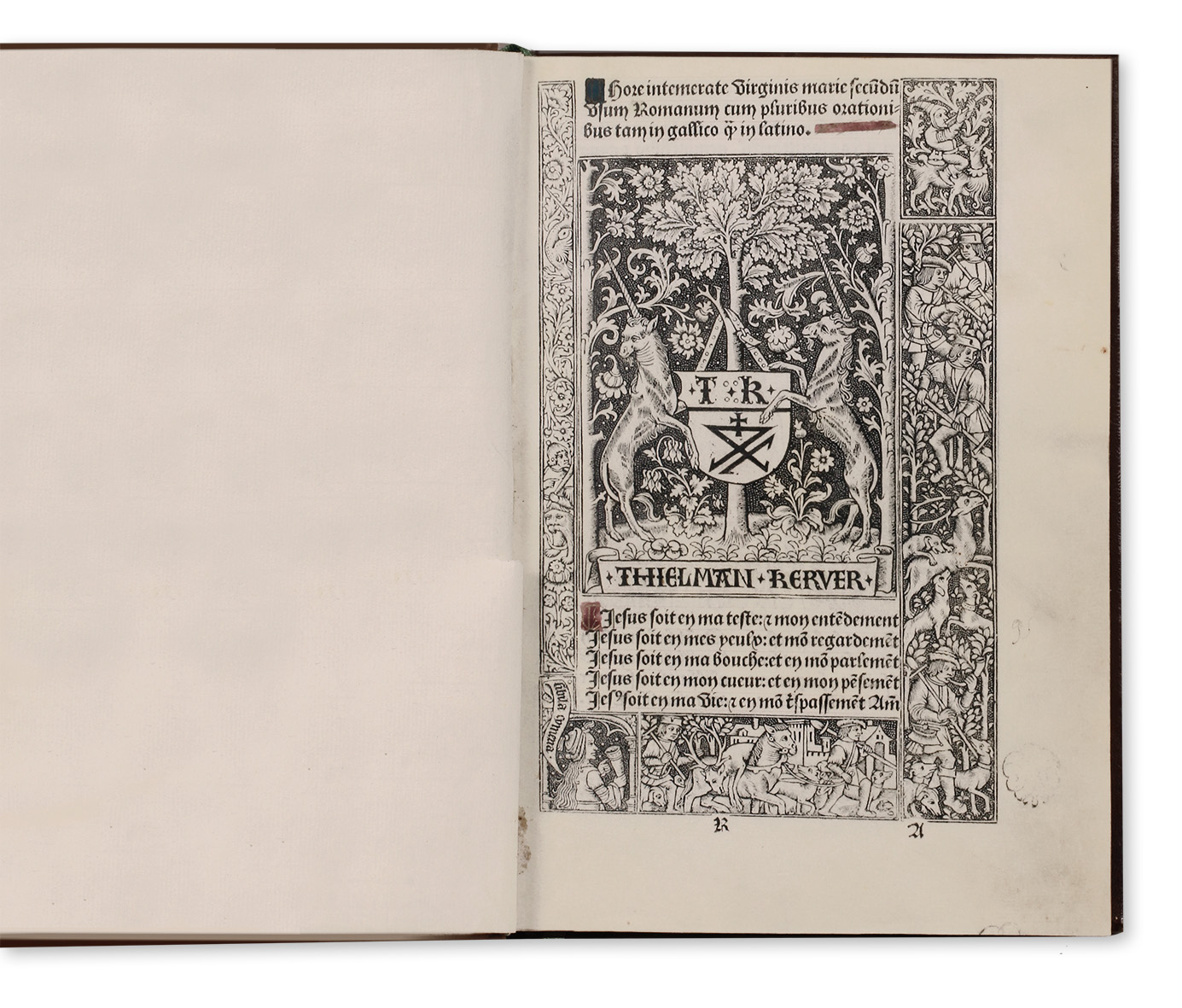
The metalcut appeared in Paris and Cologne in the mid-15th century, parallel to the woodcut. A complex process (as metal is harder to work than wood), it remained rare, mostly reserved for small-run luxury editions. A specific, rare variant appearing here is the dotted manner (criblé). The preliminary drawings were created by a defining artist of the French Flamboyant Gothic, known as the "Master of the Apocalypse Rose of the Sainte-Chapelle," whose refined drawings heavily influenced Parisian printing. The designs were likely engraved – first in wood, then metal – by Kerver's partner, Georg Wolf. Influences of masters like Schongauer and Dürer are also evident.
The title page is adorned with Kerver's printer's device: a shield bearing the monogram "T.K." hanging from an oak tree between two rampant unicorns. The large metalcut on the verso features an anatomical illustration showing the influence of the planets and zodiac signs on specific human organs. The following leaf contains a table of the major movable feasts for the years between 1497 and 1520.
This is followed by the calendar section. Here, the pages are framed by scenes drawn from the lives of the significant saints of the respective month. These are complemented by lush floral ornamentation and so-called droleries (grotesque-comic depictions of human figures, animals, and mythical creatures). Next come the Gospel sequences: the Martyrdom of Saint John and the Betrayal of Jesus, followed by the Hours of the Virgin: the Annunciation, the Visitation, the Nativity, the Annunciation to the Shepherds, the Adoration of the Magi, the Presentation, the Flight into Egypt, and the Coronation of the Virgin, each illustrated with a full-page plate. Subsequently, the Penitential Psalms appear with the Litany of Saints (decorated with a full-length metalcut depicting Bathsheba in her bath).
The Office of the Dead is illustrated by a scene from the life of Job, the prayers to the Holy Cross by the figure of the Crucified Jesus, and the prayers to the Holy Spirit by the scene of Pentecost. This is followed by a depiction of the Holy Trinity (a trifrons image, with a visual explanation of the Trinity below), then 28 short prayers, each with a text-cut. The book concludes with the Mass of Saint Gregory, featuring a full-page image of Jesus and the instruments of the Passion. Modeled on the Biblia Pauperum, the images of the extremely rich and varied marginal borders – together with the very brief citations accompanying them – served to aid meditation and contemplation.
In our copy, every paragraph begins with a hand-painted initial in gold on a red or blue opaque ground (ranging from small to larger, two-line height). This method of decoration is a significantly more expensive and time-consuming technique compared to traditional pen-drawn illumination. Specialized workshops existed for this purpose. The printer left the spaces for the decorated parts blank.
A Book of Hours printed on vellum has appeared at a domestic auction only once in the last half-century: this very copy (Central Auction 115/16, with a different description). Three copies of this edition are known: the Bibliothèque Sainte-Geneviève (Paris) holds two, and the Trinity College Library (Cambridge) holds one.
Reference: USTC 3842.; Pettegree-Walsby-Wilkinson 29464.
_____________________________________________________________________________
96 számozatlan levél. (A8-M8) . Pergamenre nyomtatva.
A hóráskönyv magánájtatosságra — elsősorban nők számára — készült imádságoskönyv. Az elnevezés a háromóránként elvégzendő imádságokra, a „hórák”-ra (matutinum, laudes, vesperás stb.) utal. A papi breviáriumra épül, de tartalmában annál világiasabb, sokszínűbb, gazdagabban díszített. Magvát Szűz Mária ún. kis zsolozsmája adja, amit bűnbánati zsoltárok, litánia, halotti könyörgések, szentekhez szóló imádságok egészítenek ki. Mindig tartalmaz — az ünnepeket és a szentek emléknapjait föltüntető — kalendáriumot is. A műfaj virágkorát a 15. századi francia nyelvterületen élte meg. A legdíszesebb, reprezentatív darabokat pergamenre nyomtatták. Ezek egy átmeneti korszak darabjai, utánozzák a pergamenre festett kódexeket, azok luxusjegyeit (aranyozás, illuminálás), de a nyomtatásnak köszönhetően már nagyobb példányszámban, szélesebb réteghez juthattak el. A kézzel festett darabokat utánozva itt is igyekeztek a darabok rangját illuminálással és aranyozással emelni. A koblenzi származású nyomdász, Thielman Kerver 1478-ban vette át a párizsi Rue Saint-Jacques-on működő könyvkereskedést. 1497-ben már saját nyomdával rendelkezett, amelyet Georg Wolffal együtt működtetett. Néhány év múlva eladta üzletét Gillet Remacle-nak, ettől kezdve nagyrészt neki dolgozott. A műhelyéből kikerült hóráskönyvek mind művészi kvalitásban, mind nyomdai kivitelben a műfaj legszínvonalasabb darabjai közé tartoztak. Az első hóráskönyvet 1497-ben nyomtatta a Kerver-műhely, ekkor még fametszetű illusztrációkkal, amelyeket 1499-től fémmetszetek váltottak fel. Rendkívüli népszerűségüket mutatja, hogy Kerver 1522-ben bekövetkezett haláláig számos kiadást értek meg, ezt követően pedig az özvegy, Yolande Bonhomme és fiai is folytatták nyomtatásukat. A műhelyre különösen jellemző volt, hogy az illusztrációkat fantáziadúsan variálta. Ennek köszönhető, hogy nincs két teljesen egyforma kiadása. A fémmetszet a 15. század derekán tűnt fel a fametszettel párhuzamosan Párizsban és Kölnben. Bonyolult eljárás (mivel a fémet sokkal nehezebb megmunkálni), ezért nem terjedt el olyan széles körben, mint a fametszet, inkább kis példányszámú, luxuscélokat szolgáló kiadványokban tűnik fel. Sajátos és ritka válfaja az ún. poncolt fémmetszet, amely itt is felbukkan. A rajz körvonalait puha fémbe (ólomba) vésik, a formákon belül pedig apró mintázatokat vernek a fémbe. A technika 1454-ben tűnik fel először, és a század végére már teljesen feledésbe is merül. Az előrajzokat a francia érett (ún. flamboyant) gótika egyik meghatározó művésze készítette, akit az „Apokalipszis-rózsaablak mestere”-ként ismer a szakirodalom, és aki ebben az időben kifinomult rajzaival rendkívül nagy hatással volt a párizsi könyvnyomtatásra. A rajzokat valószínűleg Kerver társa, Georg Wolf metszette először fába, majd fémbe. Az illusztrációkon felfedezhető a korszak legnevesebb mestereinek (Schongauer, Dürer) hatása is.
A címlapot Kerver nyomdászjelvénye díszíti: két ágaskodó unikornis között egy tölgyfa, rajta címer „T. K.” monogrammal. A verzóján lévő nagy metszeten egy anatómiai ábrázolás látható, amely a bolygók és csillagjegyek egyes emberi szervekre való hatását mutatja be. A következő lapon a nagyobb változó ünnepek táblázata olvasható az 1497 és 1520 közötti évekre. Ezt követi a kalendárium-rész. Itt a lapokat az adott hónap jelentősebb szentjei életéből vett jelenetek keretezik. Ezeket dús növényi ornamentika és ún. drolerie-k (emberi alakok, állatok, mesebeli lények groteszk-komikus ábrázolásai) egészítik ki. Ezután evangéliumi részletek: Szent János megkínzatása, Jézus elfogatása, majd az ún. Mária-hórák: az Angyali üdvözlet, Mária látogatása Erzsébetnél, Jézus születése, a Jézus születésének hírét vivő angyal és a pásztorok, a Háromkirályok hódolata, Jézus bemutatása, menekülés Egyiptomba és Mária megkoronázása következnek egy-egy egész oldalas képpel. A továbbiakban a bűnbánati zsoltárok olvashatók a Mindenszentek-litániájával (ezt a fürdő Betsabét ábrázoló egész alakos metszet díszíti). A halotti officiumot egy Jób életéből vett jelenet, a szent kereszthez szóló imádságokat a keresztre feszített Jézus alakja, a Szentlélekhez intézett imákat pedig a Pünkösd jelenete illusztrálja. Ezt a Szentháromság ábrázolása (ún. trifrons-ábrázolás, alatta a Szentháromság képi magyarázata), majd 28 rövid ima követi, egy-egy szövegközti metszettel. A könyvet Szent Gergely látomása zárja, az egész oldalas képen Jézus alakjával és a szenvedéstörténethez köthető tárgyak ábrázolásával. A Biblia Pauperumok mintájára a rendkívül gazdag és változatos lapszéli keretdíszek képei — a mellettük olvasható igen rövid idézetekkel együtt — az elmélkedést, elmélyülést szolgálták. Példányunkban minden bekezdés fedőfestékkel készült, piros vagy kék alapon arany — kisebb és nagyobb (kétsoros) — iniciálékkal kezdődik. Ez a díszítési mód egy sokkal drágább és időigényesebb technika a hagyományos, tollal rajzolt illumináláshoz képest. Erre külön szakosodott műhelyek is léteztek. A nyomdász a díszítendő részek helyét kihagyta. Hazai árverésen az elmúlt mintegy fél évszázadban pergamenre nyomtatott hóráskönyv egyszer bukkant fel, ugyanez a példány. (Központi: 115/16., eltérő leírással). Kötetünkből három példány ismert: Bibliotheque Sainte Genevieve (Paris) őriz kettőt, illetve a Trinity College Library (Cambridge) egyet. Díszesen aranyozott, francia stílusú, 18. századi bőrkötésben.