

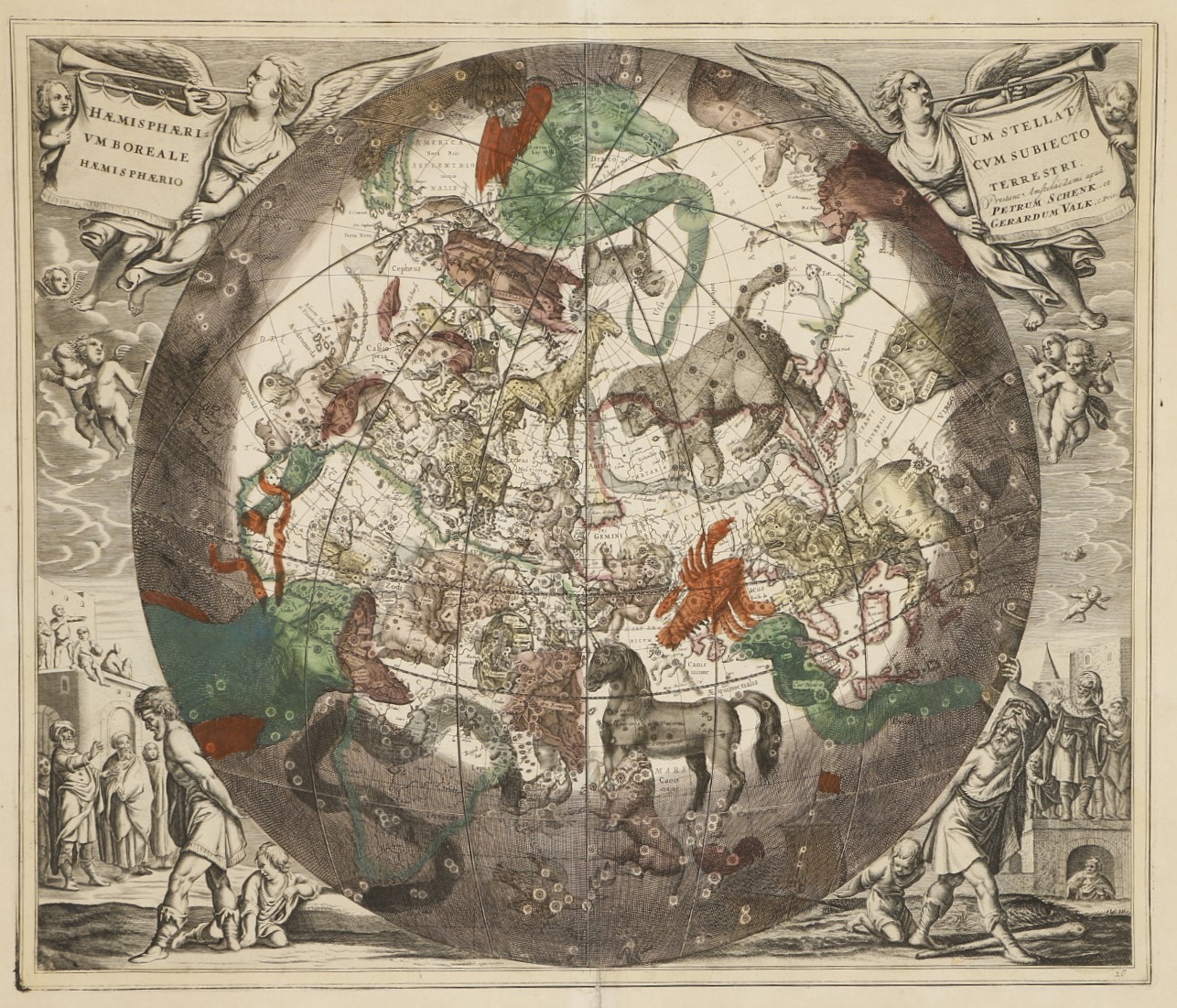
Haemisphaerium Stellatum Boreale Cum Subiecto Hemisphaerio Terrestri
1708 Amsterdam Valk & SchenkElőször megjelent/ First published in: Andreas Cellarius; Harmonia Macrocosmica (1660, Amsterdam)
Tételünk a 26-os számú lemez (a lemez első, 1660-as változatáról hiányzik a jobb alsó sarokban a lemezszám, és Valk & Schenk impresszuma a kartuson.)
Méret/Size (margók nélkül/without margins): 43×51 cm
Gyönyörűen színezett, az északi égboltot ábrázoló térkép, amely a déli félteke csillagképeit mutatja be a Föld déli féltekéje fölé helyezve.
A térkép lenyűgöző perspektívát nyújt a csillagokról, úgy rajzolva, mintha az űrből néznénk őket. Ez az egyedülálló vetítés a csillagképeket a Földről nézve fordítva jeleníti meg. Ez a kialakítás Petrus Plancius által javasolt elméletet tükrözi, amely szerint a csillagok gömbszerű elrendezésben léteznek a Föld körül, és harmóniában mozognak vele. Ez az elmélet ihlette az atlasz címét: Harmonia Macrocosmica.
A Harmonia különböző, ma már nem létező kozmológiai elméleteket vizsgál. Ez a kép az utolsó szakasz része, míg a korábbi szakaszok Brahe és Ptolemaiosz modelljeit hasonlítják össze Kopernikuszéval, és a legújabb csillagászati fejleményekre világítanak rá. Míg a korabeli csillagászok kritizálták az atlaszt tudományos pontatlanságok miatt, a későbbi generációk csodálták a bonyolult részleteket és a vizuális vonzerőt.
Nagyon jó állapotban, hordozó papírra kasírozva, kis, a térképet nem érintő szakadás a hajtás mentén, javítva.
Our lot is plate number 26 (the first 1660-version of the plate is missing the plate number in the lower right corner and Valk & Schenk's imprint on the cartouche.)
The map offers a stunning perspective of the stars, drawn as if viewed from deep space. This unique projection causes the constellations to appear reversed from how they would be seen from Earth. This design reflects a theory proposed by Petrus Plancius, suggesting that stars existed in a sphere-like arrangement around the Earth, moving in harmony with it. This theory inspired the title of the atlas, Harmonia Macrocosmica.
The Harmonia explores various now-defunct cosmological theories. This image is part of the final section, while earlier sections compare Brahe's and Ptolemy's models to Copernicus's and highlight the latest astronomical developments. While contemporary astronomers criticized the atlas for scientific inaccuracies, later generations admired its intricate details and visual appeal.
The superimposition of constellations directly onto a map of the world creates a captivating and evocative image. The intricately illustrated constellations enhance the map’s aesthetic appeal. Celestial lines such as the tropics, polar circles, the ecliptic ("Zodi"), and the equinoctial are also depicted, symbolically linking the heavens with the Earth.
Surrounding the central image are richly detailed earthly and celestial scenes. Children frolic around the base of the globe, while knights and scholars observe it intently. Above, cherubs and angels drift through a serene blue sky.
This intricate and visually stunning composition is both a celestial marvel and a testament to the artistic brilliance of its era.
In very good condition, small tear along the edge not affecting the map, repaired