

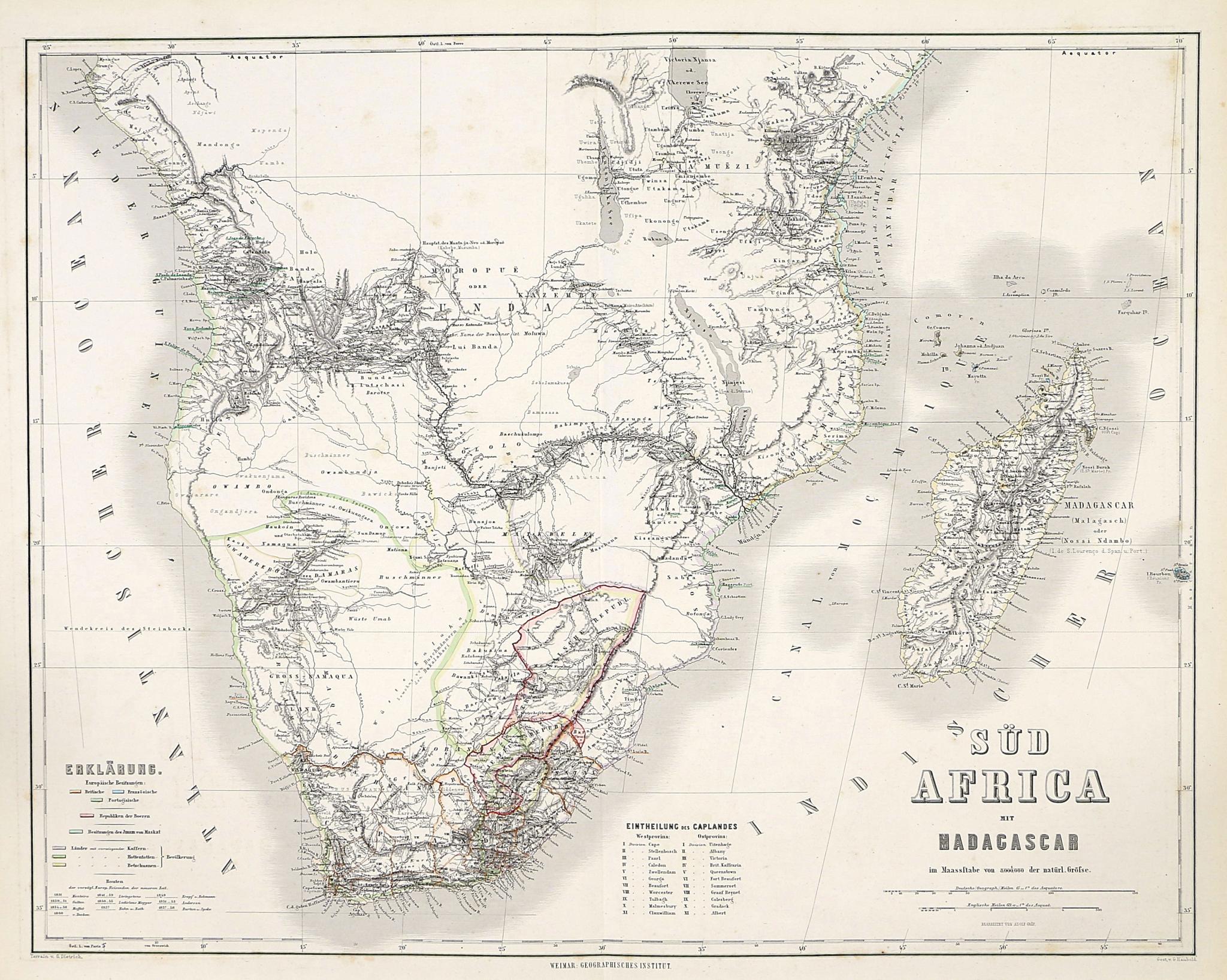
Először megjelent/First published in: Allgemeiner Hand-Atlas der Erde und des Himmels nach den besten astronomischen Bestimmungen, neuesten Entdeckungen und kritischen Untersuchungen entworfen. Geographisches Institut in Weimar. (186?)
Méret/Size (margók nélkül/without margins): 50×63 cm
Egy későbbi, részletesebb térkép, amelyet a weimari Földrajzi Intézet adott ki. Kiepert, aki több éven át vezette az intézetet, a berlini egyetem földrajzprofesszora és az ókori történelmi térképészet szakértője volt. Bár különös hangsúlyt fektetett Kis-Ázsiára, oktatási céllal jelentős számú, más régiókat lefedő térképet is készített. Ez az Adolf Gräf által szerkesztett Dél-Afrika atlasztérkép a nagy európai felfedezők 1860-ig tartó, az Egyenlítőig északra húzódó útvonalait mutatja be. Az Oranje Szabad Állam és a Transvaal Köztársaság, a britek által az 1850-es években független nemzetként elismert két búr állam rózsaszínnel van jelölve.
Madagaszkár és a környező szigetek pontos helymeghatározást kaptak, a partvonalakat pedig jelentősen javították, W. F. W. Owen kapitány és legénysége által az 1820-as években a HMS Leven és a HMS Barracouta fedélzetén végzett kiterjedt földmérési munkára építve. Részletes térképeik a 19. század nagy részében a szabványos referenciák közé tartoztak. David Livingstone korai utazásai (1849-1856), köztük a Zambezi folyó mentén és az Atlanti-óceánon São Paulo de Loandáig tartó transzkontinentális útja, a térkép közepén található részletes ábrázolás nagy részét a térképen található részletes ábrázolás adja. Szintén kiemelt helyen szerepelnek Burton és Speke felfedezései (1857-1859) Kelet-Afrika központi tóvidékén.
Kitűnő állapotban, a verson a hajtás mentén megerősítve. Az alsó margó alján a térképet nem érintő néhány folt.
Madagascar and the surrounding islands are accurately placed, and the coastlines have been significantly improved, building on the extensive surveying work of Captain W. F. W. Owen and his crews aboard HMS Leven and HMS Barracouta in the 1820s. Their detailed charts became the standard reference for much of the 19th century. The early travels (1849-1856) of David Livingstone, including his transcontinental journey along the Zambezi River and overland to São Paulo de Loanda on the Atlantic Ocean, account for much of the detailed depiction in the center of the map. Also prominently featured are the discoveries (1857-1859) of Burton and Speke in the central lake region of eastern Africa.
Excellent condition, reinforced along the fold on the verso. Some stains at the bottom of the lower margin not affecting the map.