

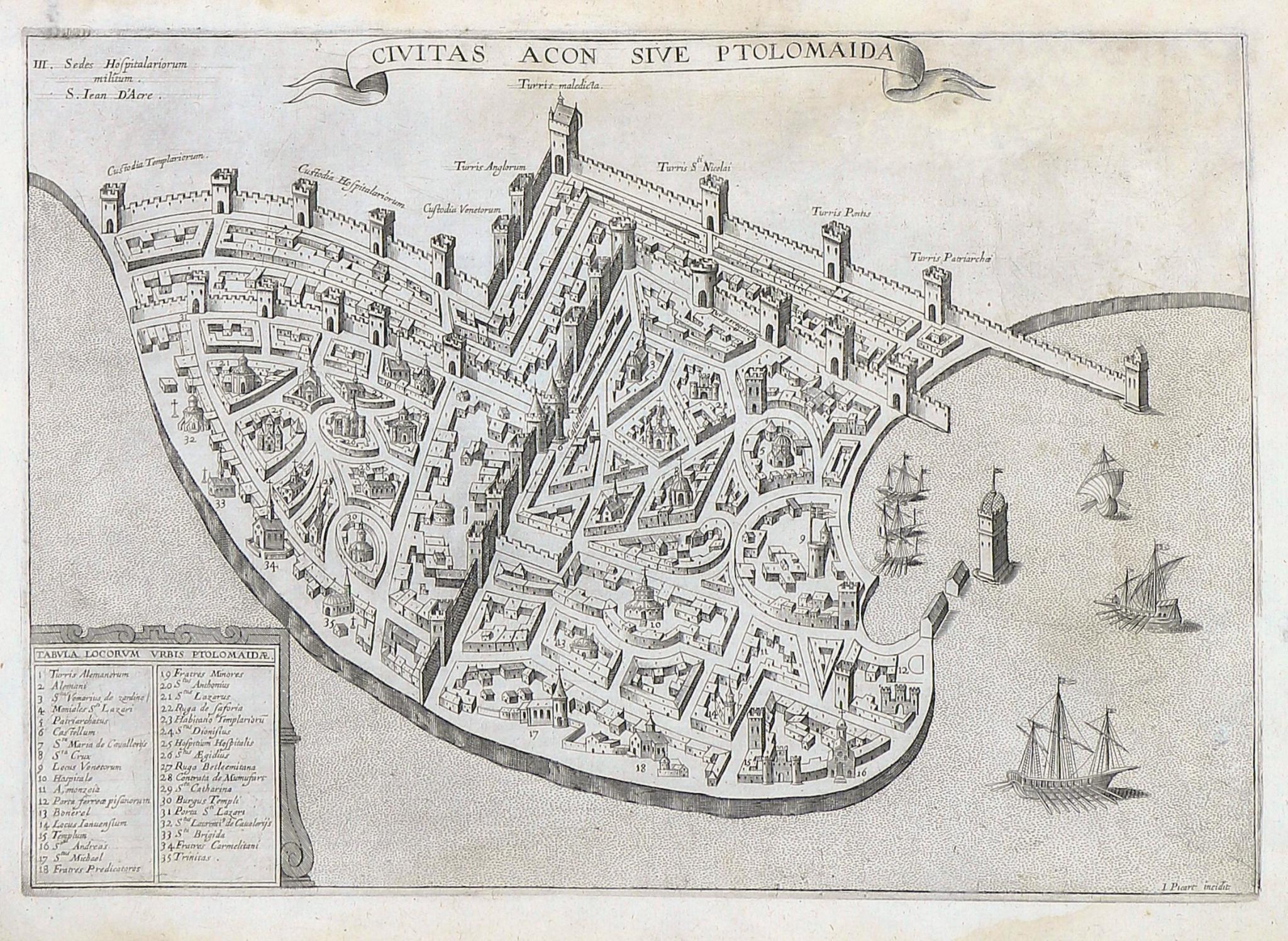
Civitas Acon sive Ptolomaida
1630 ParisA Vesconte-Sanuto terv alapján készült, rendkívül ritka tervrajz Akkóról, amely azt az időszakot hivatott szemléltetni, amikor a város a Szent János lovagok ellenőrzése alatt állt. Kiterjedt erődítményeket, városrajzot, épületeket és a jelentős nevezetességeket azonosító kulcsot tartalmaz.
Megjelent: Histoire des Chevaliers de l'orde de S. Jean de Hierusalem, contenant leur admirable Institution & Police... Paris, Jacques d'Allin, 1659.
Méret(margók nélkül)/Size (without margins): 23,5×34 cm
A könyvben egy sor tábla mutatja be azokat a városokat, amelyekben a Johannita Lovagrend a legaktívabb volt (Jeruzsálem, Akkó, Rodosz, Ciprus és Málta). A táblák a korabeli térképészeti művekben és útleírásokban már megjelent illusztrációk változatai.
Akkó vagy Akko a világ egyik legrégebbi folyamatosan lakott városa. A város története III. Thutmose fáraóig (Kr. e. 1504-1450) nyúlik vissza. A maga idejében a Közel-Kelet egyik legfontosabb kikötője volt, Alexandriával és Konstantinápollyal egyenrangú. Nagy Sándor Kr. e. 332-ben csatolta Akkót birodalmához, a Kr. e. 2. században pedig II. Ptolemaiosz egyiptomi király átnevezte Ptolemaisra. Ez a név egészen addig fennmaradt, amíg a város a Kr. u. 7. században a muszlim erők kezére nem került.
1104-ben a Máltai Lovagok elfoglalták, és átnevezték St Jean d'Akkra. A város keresztes korszaka 1291-ben ért véget, amikor a mamlúk megszállták, lerombolták Akkot. Évszázadokkal később, a 18. század közepén Daher el-Omar sejk újjáélesztette a várost, és egy kis királyságot hozott létre az Oszmán Birodalmon belül. Akkót később Ahmad pasa al-Jazzar oszmán kormányzó (1775-1804) megerősítette. 1799-ben Napóleon megpróbálta elfoglalni, de nem járt sikerrel.
A város oszmán ellenőrzés alatt maradt, amíg 1918-ban, az első világháború idején a britek el nem foglalták. Akkó a brit palesztinai mandátum része lett, és a modern Izrael megalapításáig brit fennhatóság alatt maradt.
Kiváló állapotban, restaurált.
(Szentföld)
The book 'Histoire des Chevaliers de l'orde de S. Jean de Hierusalem...' features a series of plates depicting the key cities where the Knights Hospitaller were most active, including Jerusalem, Saint John of Acre, Rhodes, Cyprus, and Malta. These plates are adapted from illustrations previously published in contemporary cartographic works and travel narratives.
Acre, or Akko, is one of the world’s oldest continuously inhabited cities, with roots tracing back to Pharaoh Thutmose III (1504–1450 BC). Once a major port on par with Alexandria and Constantinople, its history spans numerous empires and rulers. Alexander the Great incorporated Acre into his empire in 332 BC, and in the 2nd century BC, the Egyptian King Ptolemy II renamed it Ptolemais. This name endured until the city fell to Muslim forces in the 7th century AD.
In 1104, the Knights of Malta captured Acre, renaming it St. Jean d'Acre. The city’s Crusader era ended in 1291 when the Mamluks invaded, destroying Acre and killing the remaining Crusaders. Centuries later, in the mid-18th century, Sheikh Daher el-Omar revived the city, creating a small kingdom within the Ottoman Empire. Acre was subsequently fortified by Ahmad Pasha al-Jazzar, the Ottoman governor (1775–1804). In 1799, Napoleon attempted to capture Acre but failed.
The city remained under Ottoman control until it was taken by the British in 1918 during World War I. Acre became part of the British Mandate of Palestine, remaining under British rule until the establishment of modern Israel. In May 1947, Acre gained historical significance again as the site of a dramatic Irgun attack and rescue operation.
Map shows Holy Land.
In excellent condition, restored.