

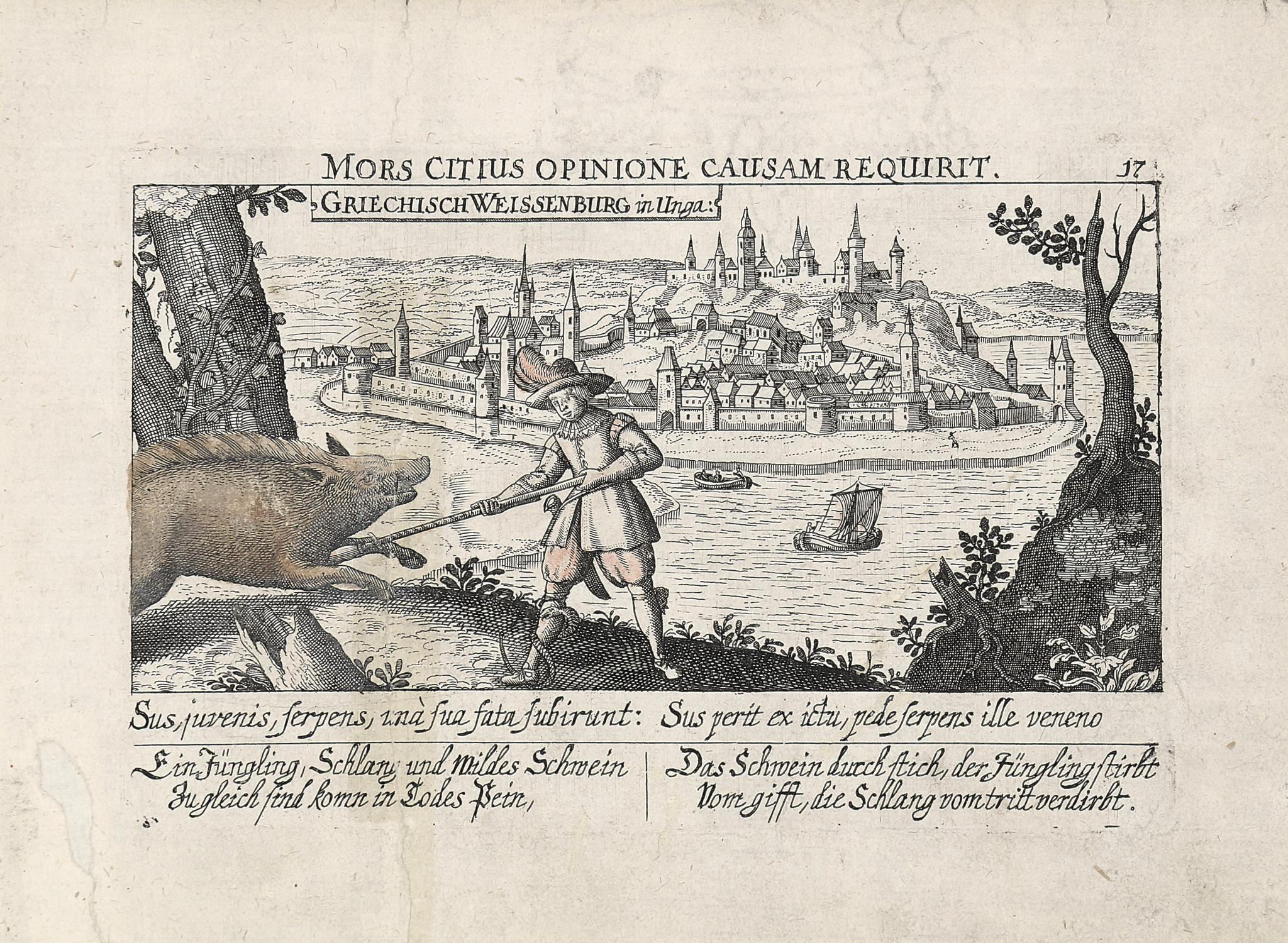
Meisner, Daniel – Kieser, Eberhard – Grieschisch Weissenburg in Unga:
Frankfurt am Main, 1623-1631.Belgrád (Fehérvár, Nándorfehérvár, a 16. és a 19. század között gyakran Lándorfejérvár) 17. századi, rézmetszetű, részben színezett látképe.
Cím az illusztráció felső részén, közepén. A veduta felett az "Mors Citius Opinione Causam Requirit" felirattal. A kép alatt egy erkölcsi mondás olvasható latin és német nyelven. Gyönyörű összkép allegorikus ábrázolással az előtérben.
Erős, jó lenyomat, jó állapotban, restaurálva. Vízjellel.
Megjelent: Meisner, Daniel: Thesaurus Philopoliticus. Hoc est: Emblemata Sive Moralia Politica. Politisches Schatzkästlein guter Herren und bestendiger Freund. (Frankfurt am Main: Kieser 1623-1631)
Képméret szöveggel/Size of emblem with text: 10×14,5 cm
A Thesaurus philopoliticus (más néven Thesaurus Philo-Politicus, németül Politisches Schatzkästlein, majd 1638 után Sciographia cosmica) koncepciója és a mű kiadására irányuló kezdeményezés Daniel Meisnertől (1585-1625), egy csehországi Poeta Laureatus Caesareus titulusú költőtől származik. Meisner fogalmazta meg az ötletet, írta meg a szövegeket, tervezte meg az emblémákat, és határozta meg a mű vizuális és tematikus irányelveit. Az első kötet előszavában Meisner kifejtette, hogy több telet töltött több mint 50 embléma és politikai morál összeállításával azzal a szándékkal, hogy egy családi és emlékkönyvet hozzon létre. Az egyes emblémák mellé „a Német Nemzet Szent Római Birodalmán belüli és kívüli kiemelkedő városok pontos ellenpéldányos leírását” is elkezdte megfogalmazni. Meisner 1625-ben hunyt el, nem sokkal az első kötet ötödik részének kinyomtatása után. Valószínűleg ez magyarázza, hogy portréja, Sebastian Furck kiváló minőségű rézmetszete miért került be a posztumusz kiadott hatodik részbe. Társa, a kiadó Eberhard Kieser azonban folytathatta a publikálást, mert még volt készlete Meisner szövegeiből. Amikor ez a készlet kimerült, megbízta Johann Ludwig Gottfried Offenbach am Main-i lelkészt, hogy írja meg a latin és német verseket. A második könyvhöz Kieser sógorát, Heinrich Kornmann ügyvédet is felkérte segítségül.
Meisner korai halála ellenére a sorozat továbbra is az ő nevét viselte. A későbbi kiadásokban szerzőként is szerepelt. A Thesaurus philopoliticus lenyomatait még ma is kényelmesen neki, mint szellemi atyának tulajdonítják, bár a metszetek közül egyiket sem, és a szövegek közül sem az összes köthető az ő nevéhez.
A mű kiadása 1623 tavaszán kezdődött, amikor megjelent egy első kötet, amely 52 nyomtatványt tartalmazott a Frankfurti Vásárra. A sorozat azonnali kereskedelmi sikert ért el, ami arra késztette a szerkesztőket, hogy rendszeresen adjanak ki további köteteket, amelyek mindegyike 52 nyomatot tartalmaz (kivéve egyet, ahol csak 50). Az 1623 és 1626 között kiadott első nyolc kötetből az I. könyv lett. Ezt követte a II. könyv, amely további nyolc, 1627 és 1631 között hat hónapos időközönként megjelent részből áll. 1625-ben a német változatok mellett latin kiadást is kezdeményeztek.
A Thesaurus összesen nem kevesebb, mint 830 lenyomatból áll. Minden rész egy illusztrált címlappal, egy-egy nevezetes alaknak szóló dedikációval, valamint a városok és emblémák magyarázatával kezdődik. A nagyjából 10×15 cm-es lapok szabványos formátumot követnek, egy illusztrációt és szövegezést ötvöznek. A szöveg a kép fölött (jellemzően latinul) egy mottót, alatta egy kétsoros latin disztich-et és egy megfelelő német fordítást tartalmaz, négysoros versszakban. Ezek a versek tisztázzák a mottó és a jelkép jelentését. Az illusztrációk két fő elemből állnak: egy előtérből, amely szimbolikus alakokat vagy tárgyakat ábrázol, amelyek a témát (a mottót) képviselik, és egy háttérből, amely általában egy várost, kastélyt vagy kolostort ábrázol. Ez a kettős fókusz a kor népszerű városképi gyűjteményeit idézi, mint például Sebastian Münster Cosmographiaját (1544, Bázel).
Title in the upper part of the illustration, in the middle. Above the view with the inscription "Mors Citius Opinione Causam Requirit". Below the image is a moral saying in Latin and German. Beautiful overall picture with allegorical representation in the foreground.
Strong, good impression, in good condition, restored. With watermark.
The concept of the "Thesaurus philopoliticus" (or "Political Treasure Chest") and the initiative to publish the work came from Daniel Meisner (1585-1625), a poet with the title title of Poeta Laureatus Caesareus (PLC) from Bohemia. Meisner conceived the idea, wrote the texts, designed the emblems, and established the visual and thematic guidelines for the work. In the preface to the first volume, Meisner explained how he had spent several winters compiling over 50 emblems and political morals with the intention of creating a family and memorial book. He also began drafting "accurate counterfactual descriptions of prominent cities within and beyond the Holy Roman Empire of the German Nation" to accompany each emblem. Meisner passed away in 1625, shortly after the fifth part of the first volume was printed. This likely explains why his portrait, a high-quality copper engraving by Sebastian Furck, was included in the sixth part published posthumously.
After Meisner's death, the publication was continued by his collaborator, the publisher Eberhard Kieser (1583–1631), who still had access to Meisner's texts. When these texts were exhausted, Kieser commissioned Johann Ludwig Gottfried, a pastor in Offenbach am Main, to compose the Latin and German verses. For the second volume, Kieser also enlisted the assistance of his brother-in-law, Heinrich Kornmann, a lawyer.
Despite Meisner’s early death, his name remained closely associated with the series. Later editions continued to credit him as the author, and even today, the prints from the Thesaurus are commonly attributed to him as their conceptual originator, although he neither engraved the illustrations nor wrote all the texts.
The publication of the Thesaurus philopoliticus began in the spring of 1623 with the release of a first volume containing 52 prints for the Frankfurt Fair. The series achieved immediate commercial success, prompting the editors to publish additional volumes regularly, each containing 52 prints (except for one with only 50). The first eight volumes, published between 1623 and 1626, were compiled into what became known as Book I. Book II followed, comprising another eight parts published between 1627 and 1631 at six-month intervals. A Latin edition was also initiated in 1625 alongside the German versions.
In total, the Thesaurus consists of no fewer than 830 prints. Each part begins with an illustrated title page, a dedication to a notable figure, and explanations of the cities and emblems included. The roughly 10×15 cm sheets of the Thesaurus philopoliticus follow a standardized format, combining illustration and text. The text includes a motto (typically in Latin) above the image, a two-line Latin distich, and a corresponding German translation in a four-line stanza beneath. These verses clarify the meaning of the motto and emblem. The illustrations consist of two main components: a foreground featuring symbolic figures or objects that represent the theme (the motto) and a background usually depicting a city, castle, or monastery. This dual focus recalls the popular cityscape collections of the time, such as Sebastian Münster’s Cosmographia (1544, Basel).