

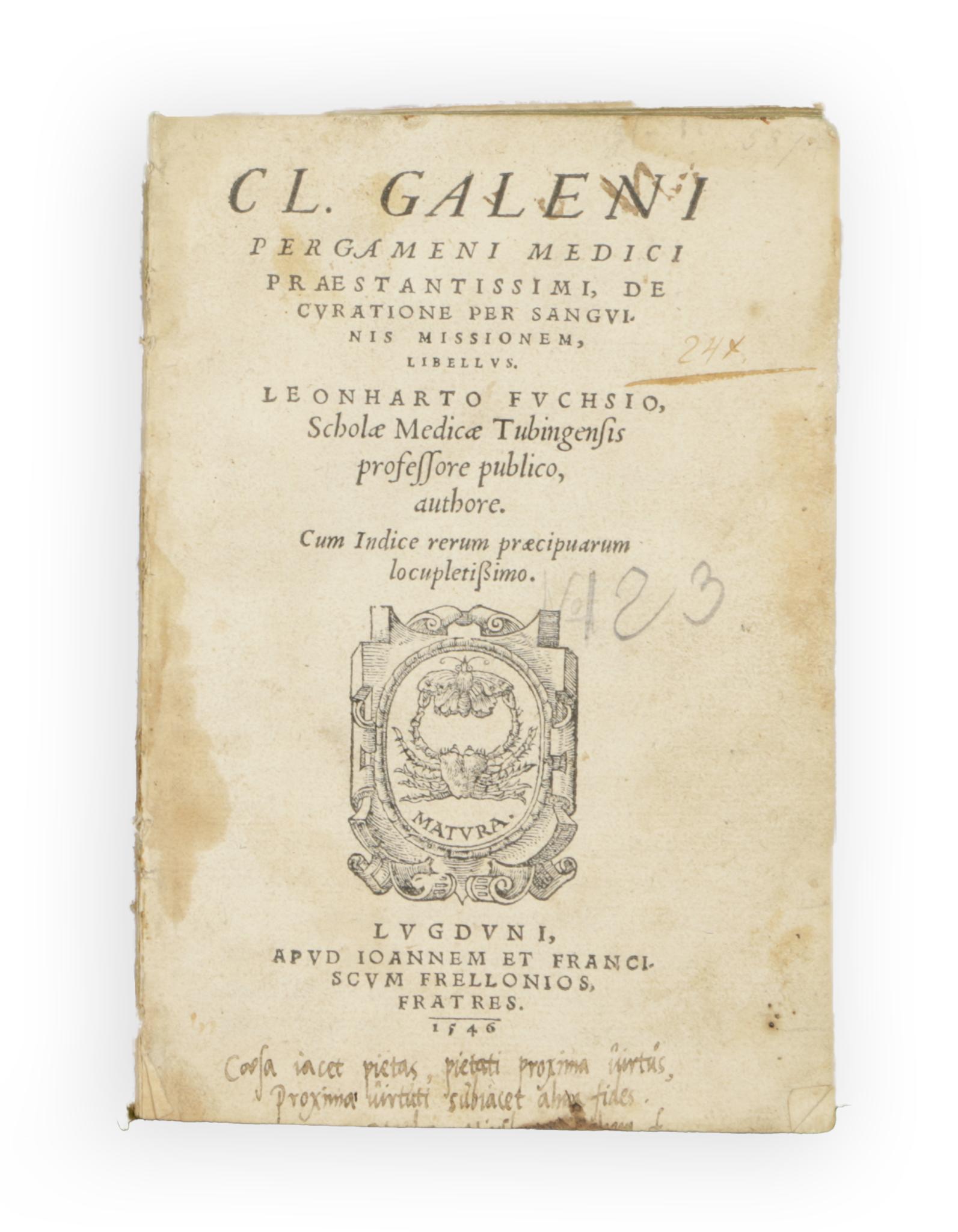

Cl. Galeni Pergameni medici præstantissimi, de curatione per sanguinis missionem, libellus.
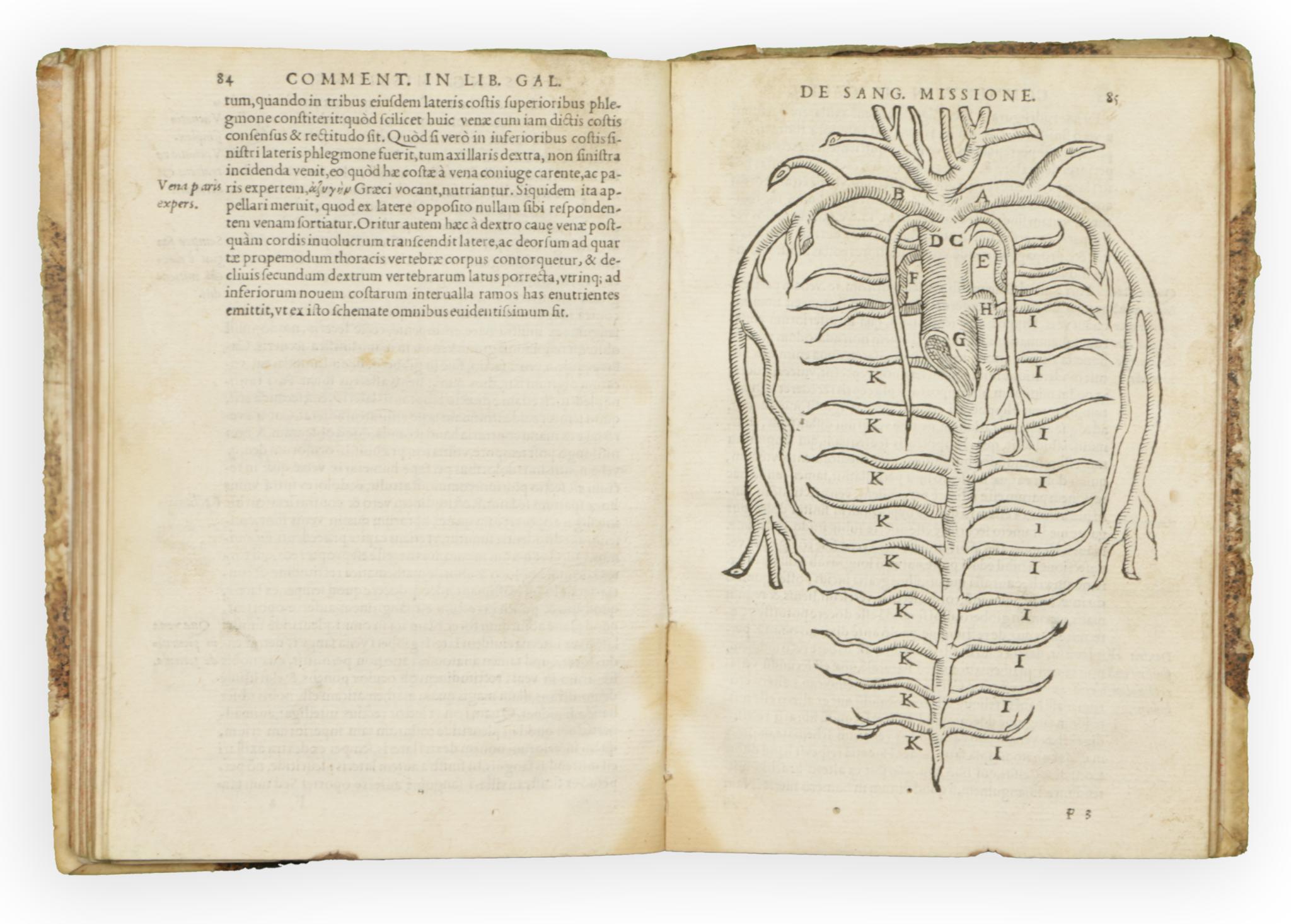
Lyon, 1546. J. & Fr. Frellon.8vo, [40]+131+[1]p. Woodcut decorative title-page, Latin text with Greek vocabulary; first preliminary leaves with dedicatory letter from Leonhart Fuchs to Ulrich of Württemberg on front end-papers; historiated woodcut initials, full-page woodcut illustration of the vascular system of the human body on p. 85, blank leaf b2, colophon on verso of last leaf. FIRST EDITION!
Exceptionally rare edition by Leonhard Fuchs, containing the teachings of Galen on the circulation of the blood. Galen's anatomical and medical understanding was fundamentally influenced by the then current theory of humorism (also known as the four temperaments -- black bile, yellow bile, blood and phlegm) developed by ancient Greek physicians such as Hippocrates. For more than 1300 years, Galen's teachings and theories dominated and influenced Western medicine. Galen believed that each part of the tripartite soul controls specific functions within the body and that the soul as a whole contributes to the health of the whole body, enhancing "the natural ability of a given organ or organs to function".
The "rational soul" (which controlled the higher cognitive functions of the body - such as making decisions or perceiving the world and transmitting these signals to the brain) was where "imagination, memory and recollection, consciousness and thought, deliberation, voluntary movement and perception" were located.
The "spirited soul" was responsible for "growth or survival" and controlled the passions. These passions were considered stronger than ordinary emotions and therefore more dangerous.
The third part of the soul, the "appetitive spirit", controlled the living forces in our bodies, most importantly blood.
Galen's anatomical reports were based mainly on dissections of monkeys, especially the Barbary macaque, and his findings remained unchallenged until the publication of Andreas Vesalius' 'De humani corporis fabrica' in 1543. Perhaps Galen's most significant contribution to medicine was his work on the circulatory system. He was the first to recognise the distinct differences between venous (dark) and arterial (bright) blood. His anatomical experiments on animals led to a more complete understanding of the circulatory, nervous and respiratory systems, although his work contained some rather serious errors: for example, he believed that the circulatory system consisted of two independent distributive structures: venous blood was produced in the liver and arterial blood in the heart.
Appropriate condition for its age, in a later half-vellum binding with inscribed spine, lightly damaged at top. Occasional signs of water stains and worm holes at the margins. Marginal notes and undernotations in ink. Autograph lines in ink at the bottom of the title page, in Latin.
______________________
Leonhard Fuchs kivételesen ritka kiadása, mely Galénosz vérkeringésről szóló tanításait tartalmazza. Galénosz anatómiai és orvosi felfogására alapvetően az ókori görög orvosok, például Hippokratész által kidolgozott, akkoriban aktuális humorizmus-elmélet (más néven a négy temperamentum -- fekete epe, sárga epe, vér és flegma) volt hatással. Galénusz tanai és elméletei több mint 1300 éven át uralták és befolyásolták a nyugati orvostudományt. Galénosz úgy vélte, hogy a hármas tagolású lélek minden egyes része meghatározott funkciókat irányít a testen belül, és hogy a lélek egésze hozzájárul a test egészségének egészségéhez, erősítve „az adott szerv vagy szervek természetes működési képességét”.
A „racionális lélek” (amely a szervezet magasabb szintű kognitív működését irányította - például a döntések meghozatalát vagy a világ érzékelését, és e jelek továbbítását az agyba) volt az a hely, ahol „a képzelet, az emlékek és emlékezet, a tudat és a gondolkodás, a megfontolás, az akaratlagos mozgás és az érzékelés” megtalálható volt.
A „lelkes lélek” volt felelős a „növekedésért vagy életben maradásért”, és irányította a szenvedélyeket. Ezeket a szenvedélyeket erősebbnek tartották, mint a rendes érzelmeket, és így veszélyesebbnek is.
A lélek harmadik része, az „éhes szellem” irányította a testünkben lévő élő erőket, mindenekelőtt a vért.
Galénosz anatómiai jelentései elsősorban majmok, különösen a barbár makákó boncolásán alapultak, és megállapításai Andreas Vesalius De humani corporis fabrica című művének 1543-as megjelenéséig megkérdőjelezhetetlenek maradtak. Galénosz legjelentősebb hozzájárulása az orvostudományhoz talán a keringési rendszerrel kapcsolatos munkája volt. Ő volt az első, aki felismerte a vénás (sötét) és az artériás (világos) vér közötti határozott különbségeket. Állatokon végzett anatómiai kísérletei a keringési, ideg- és légzőrendszer teljesebb megértéséhez vezettek, bár munkája tartalmazott néhány meglehetősen súlyos hibát: például úgy vélte, hogy a keringési rendszer két független elosztószerkezetből áll: a vénás vér a májban, az artériás vér pedig a szívben keletkezik.
Korának megfelelő állapotban, későbbi félpergamen-kötésben, feliratozott gerinccel, mely felül enyhén sérült. Szöveg kevés egyenletes barnulással, helyenként lapszéli ázás- és szúrágás nyomaival. Tintás széljegyzetekkel, aláhúzásokkal. Tintás autográf sorok a címlap alján, latinul.
Pettegree (FB) 71373; USTC 149548; nincs az Adams, NLM/Durling vagy Wellcome adatbázisában.