

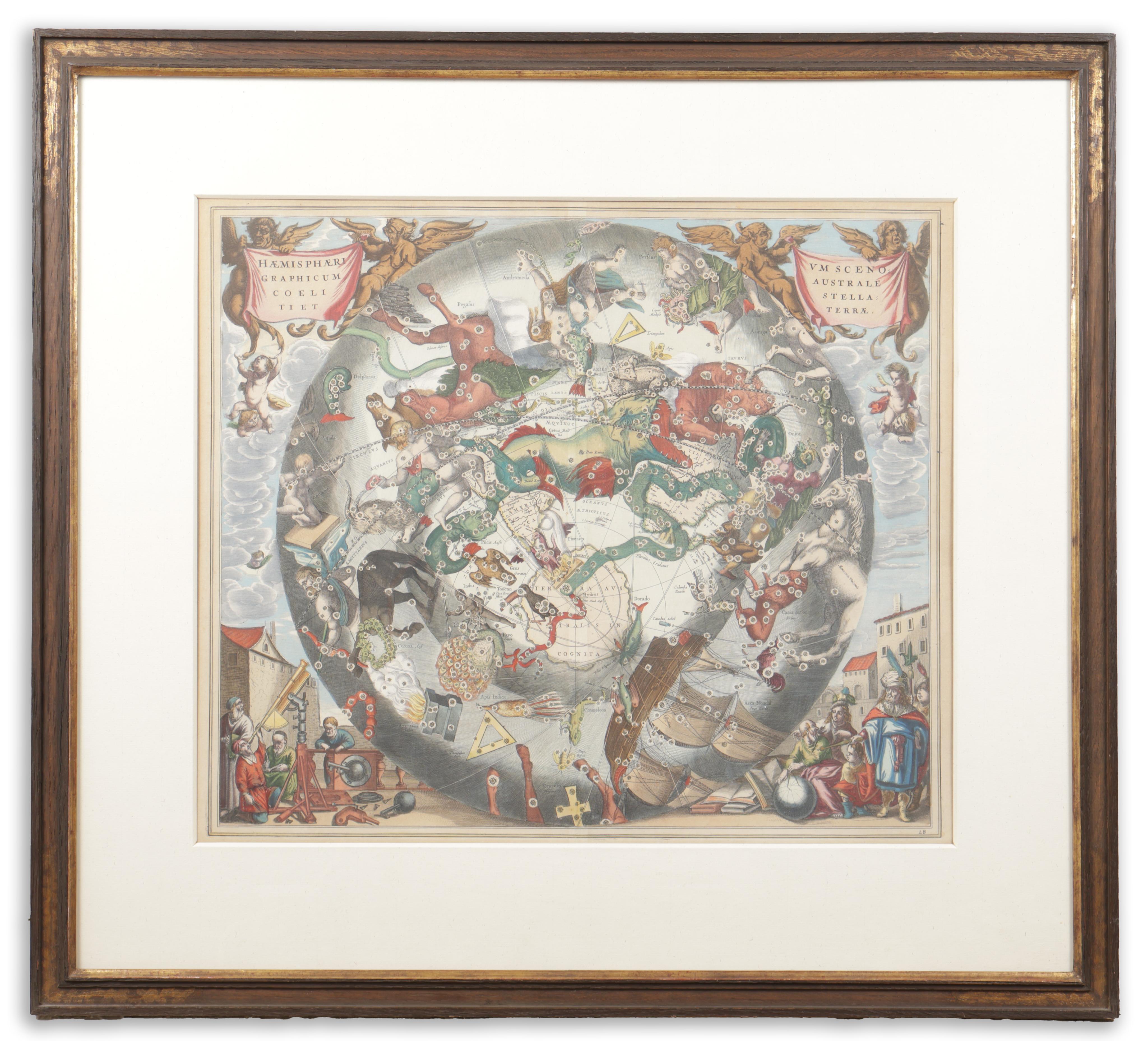
Haemisphaerium Scenographicum Australe Coeli Stellati Et Terrae
Amsterdam, 1708.Cellarius lenyűgöző vetülete a déli félteke égboltjáról újszerű formában jelenik meg, amelyben a csillagképek a földgömbre vannak rávetítve. A kép Andreas Cellarius Harmonia Cosmographica című művében jelent meg, amelyet a valaha kiadott legnagyobb csillagászati atlasznak tartanak.
Ez a szokatlan égi nézőpont, amelyet Cellarius „szcenografikusnak” nevezett, úgy ábrázolja az égboltot, mintha azt a csillagok fölötti mennyből szemlélnénk – egyfajta „isteni nézőpontból”, a csillagképeket a Föld felé tekintve. Ebben a nézetben minden csillagkép tükörképe annak, ahogyan a Földről látszana. Ez a vetítési mód Petrus Plancius elméletét tükrözi, miszerint a csillagok gömbszerű formációban helyezkednek el a Föld fölött, és annak mozgásával összehangoltan mozognak.
Cellarius összesen négy szcenografikus vetületet készített. Ezek közül kettő a csillagképekre összpontosít, és kisebb földgömböt ábrázol, míg a másik kettő áttetsző csillagképeket mutat, és inkább a csillagok alatti földrajzi részletekre helyezi a hangsúlyt. A déli félteke vetülete a Terra Australis Incognita-ra, azaz az ismeretlen déli földrész feltételezett területére van középpontozva. Az északi féltekés térkép Európát és Ázsiát ábrázolja.
A déli égboltról készült lapon tizenhárom, kizárólag a déli féltekéről látható, újonnan felfedezett csillagkép szerepel, amelyeket Petrus Plancius 1592 és 1598 között határozott meg. Ezek közül sok olyan állatokról kapta a nevét, amelyek az európai felfedezők által nemrégiben bejárt területeken élnek, mint például a Pavo (páva) vagy a Pis Indica (feltehetően a pulyka).
A szcenografikus térképek mellett csillagászokat és tudósokat láthatunk, amint távcsöveket és más, a csillagok megfigyelésére szolgáló eszközöket használnak. A Harmonia Macrocosmica számos ábrájához hasonlóan ezek a szegélydíszítések is korábbi csillagászati művekből származnak. Az itt látható csillagász csoportok Johannes Hevelius 1647-es Selenographia sive Lunae Descriptio című művének két, csaknem azonos jelenetéből lettek átvéve.
Térkép mérete: 50×44 cm
Keret mérete: 74×67,5 cm
Kiváló állapotban, aranyozott fakeretben.
Cellariuis's stunning projection of the Southern Hemispheric skies, depicted in a novel format in which the constellations are superimposed over the globe, from Andrea Cellarius's Harmonia Cosmograhpica, considered the greatest celestial atlas ever published.
This unusual celestial perspective, which Cellarius termed "scenographic," shows the celestial sky as if seen from the firmament (above the stars themselves), a sort of god's eye view of the constellation, looking toward earth. In the views, each constellation is a mirror image of the way each constellation would be seen from earth. This projection reflects a theory that originated with Petrus Plancius that the stars remained in a sphere-like configuration above the earth and moved in coordination with the earth.
Cellarius produced a total of four scenographic projections. Two of them, presented here, focus on the constellations, and show a diminished globe, while the other two show transparent constellations and instead focus to a larger extent on the terrestrial/geographical details below the stars. Here, the Southern Hemisphere projection is centered on the "Terra Australis Incognita," a representation of the unknown great southern continent. The Northern Hemisphere projection shows the European and Asian continents.
The stars in the Southern Hemisphere plate show thirteen newly of the newly discovered constellations that can be seen solely from the Southern Hemisphere, which were laid out by Petrus Plancius between 1592 and '98. Many of them are given names that correspond to animals that inhabit regions recently explored by Europeans, such as Pavo (the peacock) and the Pis Indica (apparently the turkey).
Next to the scenographs are images of scientists and scholars using telescopes and other instruments meant for studying the stars. As with much of the imagery in the Harmonia Macrocosmica, the images in the borders are derived from earlier celestial books. Here the groups of astronomers are copied from two almost identical scenes in Johannes Hevelius's 1647 Selenographia sive lunae descriptio.
This is a truly spectacular example of this decorative mapping of the southern skies.
Map size: 50×43 cm
Frame size: 74×66,5 cm
Excellent condition, in gilt wooden frame.