

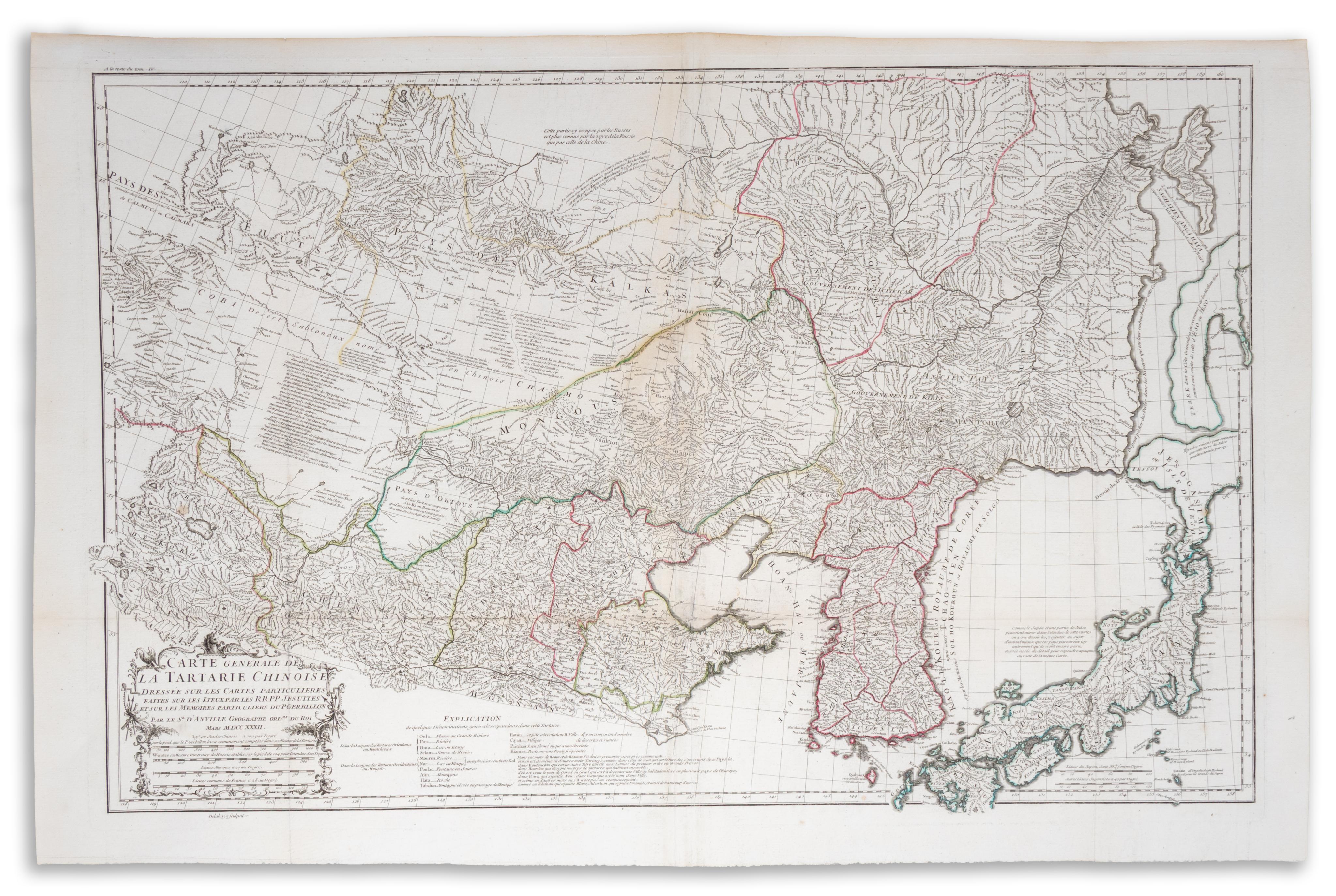
Carte Generale De La Tartarie Chinoise Dressee sur les Cartes Particulieres Faits Sur Les Lieux Par Les R.R. P.P. Jesuites . . . .MDCCXXXII
Paris, 1732.D’Anville Atlas of China című művéből származó, rendkívül részletes térkép Japántól a Góbi-sivatagig terjedő vidékről, középpontban Mongóliával és Koreával. Az Atlasz a második nagy európai Kína-atlasz, a Martini/Blaeu Novus Atlas Sinensis (1655) után.
A térkép Kína hatalmas kiterjedését, valamint a szomszédos területeket ábrázolja, amelyeket az európaiak a 19. századig összefoglalóan Tatáriának neveztek – ez a kifejezés a Kaszpi-tengertől és az Urál-hegységtől a Csendes-óceánig húzódó óriási földrészt jelölte, amelyet nagyrészt türk és mongol népek laktak.
D’Anville a jezsuita misszionáriusok által készített térképeket használta, amelyeket Kang-hszi császár megbízásából 1708 és 1716 között végzett birodalmi felmérés alapján állítottak össze. Jean-Baptiste Régis (1664–1738) készítette el azt a térképet, amely bekerült a Kang-hszi-atlaszba; ezt dolgozta fel és egészítette ki D’Anville, majd 1735-ben du Halde Description de la Chine című művében jelent meg.
Különösen fontos, hogy a térkép Tokto-szigetcsoportot (ismertebb nevén a Liancourt-szirteket) „Tchian-chan-tao” néven tünteti fel – ez a „Usando” korai elnevezés kínai átírása, amely Tokto régi neve –, az Ullung-szigetet pedig „Fan-ling-tao” néven ábrázolja. Korea több névváltozatban is szerepel: „Kaoli Koue” (Goryeo országa), „Royaume de Corée” (Korea Királysága), valamint „Tchao-Sien”.
Mérete: 89×57,5 cm
Erős lenyomat, nagyon szép állapotú térkép, a verson középen megerősítve.
The map depicts the vast extent of China and its neighboring territories then collectively referred to by Europeans as ‘Tartary’ – a term, used until the 19th century, for the immense lands stretching from the Caspian Sea and the Ural Mountains to the Pacific Ocean, largely inhabited by Turkic and Mongol peoples.
D’Anville drew upon maps prepared by Jesuit missionaries at the commission of Emperor Kangxi, who between 1708 and 1716 ordered a comprehensive survey of his empire. Jean-Baptiste Régis (1664–1738) produced a map included in the Kangxi Atlas, which D’Anville subsequently adapted and published in 1735 within du Halde’s Description de la Chine.
Of particular note, the map records Dokdo (or Liancourt Rocks) as ‘Tchian-chan-tao’ – a Chinese rendering of ‘Usando,’ an old name for the island—alongside ‘Fan-ling-tao,’ the Chinese name for Ulleungdo. Korea itself appears under several designations, including ‘Kaoli Koue’ (Country of Goryeo), ‘Royaume de Corée’ (Kingdom of Korea), and ‘Tchao-Sien.
Sheet size: 89×57,5 cm
Strong impression, excellent condition, reinforced on the verso in the middle.