

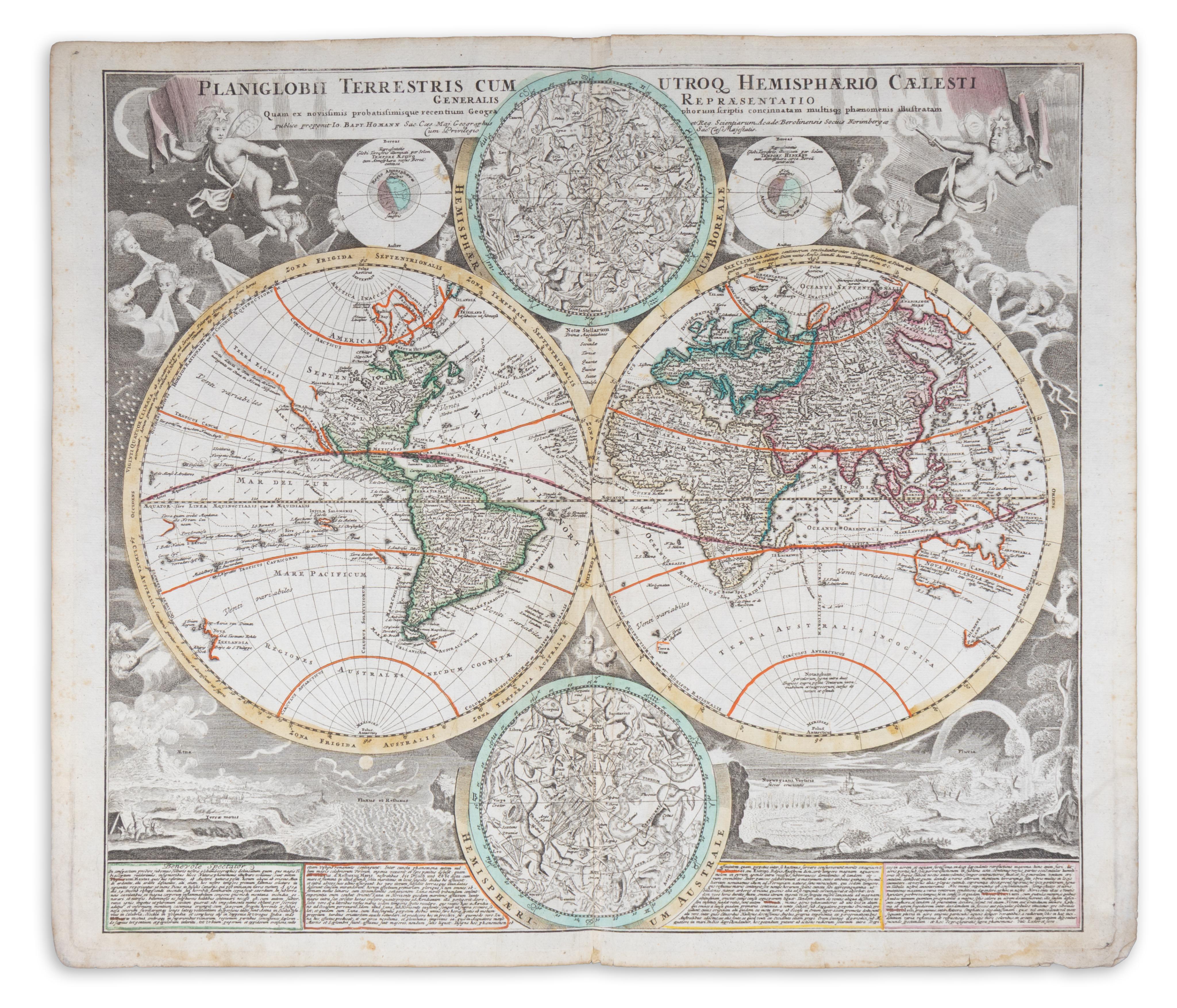
Planiglobii Terrestris cum Utroq Hemisphaerio Caelesti Generalis Repraesentatio...
Nuremberg, ca. 1720.Ez a gyönyörű, kézzel színezett rézmetszetű kettős-félgömb térkép kiváló példája a 18. század eleji térképészet gyakorlatának és esztétikai érzékenységének. A világtérkép nemcsak földrajzi ábrázolása miatt figyelemre méltó – amely a korszakra jellemző, jól ismert pontatlanságokat mutat, például a hiányos Ausztráliát –, hanem gazdag művészi díszítései révén is. Ezek közé tartoznak a csillagászati ábrázolások az északi és déli féltekéről, az allegorikus jelenetek, melyek a tudományt és a fantáziát ötvözik, valamint a természeti jelenségek részletes bemutatása, mint a vulkánok működése vagy a rejtélyes örvények.
A 18. század elején a térképészet már túlmutatott a puszta navigációs célokon, és a világ földrajzi és tudományos megismerésének közvetítő eszközévé vált. A térképen látható földrajzi pontatlanságok azt jelzik, hogy egyes térségekről még korlátozott ismeretekkel rendelkeztek ebben az időszakban. A Délkelet-Ázsia, Japán vagy Észak-Amerika nyugati partvidéke körüli ábrázolások betekintést nyújtanak abba, milyen kartográfiai forrásokat és technikákat alkalmaztak a térkép készítői.
A térképet szegélyező allegorikus jelenetek az empirikus megfigyelést ötvözik a spekulatív tudománnyal és a mitológiával. Különösen figyelemre méltók a csillagászati félgömbök, amelyek Homann korának égbolt-képét ábrázolják, tudományos adatokat és művészi ábrázolást egyesítve. Különösen kifejező például a Norvégia közelében ábrázolt „Maelstrom” – egy tengeri örvény, amely erős áramlásáról és hajósokra leselkedő veszélyeiről volt ismert.
A térkép alatti szöveg, amely a „Kedves Szemlélőhöz” szól, egyszerre szolgál esztétikai díszítésként és informatív kommentárként a bemutatott természeti jelenségekről. Ismerteti a vulkánok titokzatos világát – némelyek a világ kezdete óta égnek, mások csak nemrégiben aktiválódtak –, a földrengések rejtélyes okait, valamint a tudósok előtt álló kihívásokat az árapályok és a Hold mozgása közötti kapcsolat megértésében. Részletesen tárgyalja az örvény jelenségét is, különösen a norvég partoknál találhatót, amely hatalmas erővel szippantja be és veti ki a közeli tárgyakat. A szelek mint a levegő jelentős mozgatói is terítékre kerülnek, megvizsgálva, hogyan befolyásolja őket a Föld forgása és egyéb tényezők, amelyek különféle időjárási jelenségekhez vezetnek. A szöveg meteorológiai megfigyelésekkel zárul – eső, hó, jégeső és a szivárvány varázslatos megjelenése –, végül jókívánságokat tolmácsol az olvasónak, hangsúlyozva a térkép célját: megvilágítani a rajta ábrázolt természeti csodákat.
Először megjelent: Homann, Johann: Atlas Novus Terrarum Orbis Imperia. Nuremberg, 1707.
Lap mérete: 59×51 cm
A hajtás mentén a verson megerősítve, nagyon jó állapotban.
During the early 18th century, cartography was transitioning from being solely a tool for navigation to a medium for conveying a broader understanding of the world, both geographically and scientifically. The map's inclusion of cartographic inaccuracies speaks to the limited knowledge of certain regions during this time. The treatment of areas like Southeast Asia, Japan, and the Northwest Coast of America sheds light on the cartographic techniques and sources that informed this work.
The allegorical scenes framing the map blend empirical observation with speculative science and myth. Notably, the celestial hemispheres present a view of the skies that would have been understood in Homann’s time, combining astronomical data with artistic rendition. One particularly evocative depiction is that of the "Maelstrom" near Norway—a marine whirlpool known for its powerful currents and the peril it posed to seafarers. The descriptive text below the map, addressing the "Benevole Spectator," serves as both an artistic embellishment and an informative commentary on the natural phenomena illustrated, ranging from the behavior of volcanic mountains to the formation of rainbows.
In the accompanying text, the creators have put forth an extensive exposition that seeks to illuminate various natural phenomena depicted on the map. The passage sheds light on several subjects: the mysteries of volcanoes, some of which have been burning since the world's inception, while others have recently sprung to life; the perplexing causes behind earthquakes, and the challenges faced by scholars in understanding the ebb and flow of tides, especially its relationship with the moon's movements. The text further delves into the phenomenon of "Maelstrom" or whirlpools, highlighting the most famed one near Norway, which draws in and expels everything in its vicinity with immense force. Winds are discussed in their role as significant movers of air, influenced by the Earth's rotation and other factors, leading to various climatic events. The text culminates in a discussion on meteorological conditions and phenomena like rain, snow, hail, and the captivating appearance of rainbows. The sign-off wishes the reader well, emphasizing the map's role in elucidating the depicted phenomena.
In: Homann, Johann: Atlas Novus Terrarum Orbis Imperia. Nuremberg, 1707.
Sheet size: 59×51 cm
Reinforced along the fold on the verso, in very good condition.