

![Besler, Basilius: Veronica recta carnlea [et] Sultan Zambach Martagon Constantinopolitanum flore albo [et] Bulbus Sultan Zambach cuminfeunipartecaulis [Nürnberg, ca. 1613.]](http://kozpontiantikvarium.hu/sites/default/files/2026-01/Veronicarectacarnlea_recto.jpg "Besler, Basilius: Veronica recta carnlea [et] Sultan Zambach Martagon Constantinopolitanum flore albo [et] Bulbus Sultan Zambach cuminfeunipartecaulis [Nürnberg, ca. 1613.]")
Veronica recta carnlea [et] Sultan Zambach Martagon Constantinopolitanum flore albo [et] Bulbus Sultan Zambach cuminfeunipartecaulis
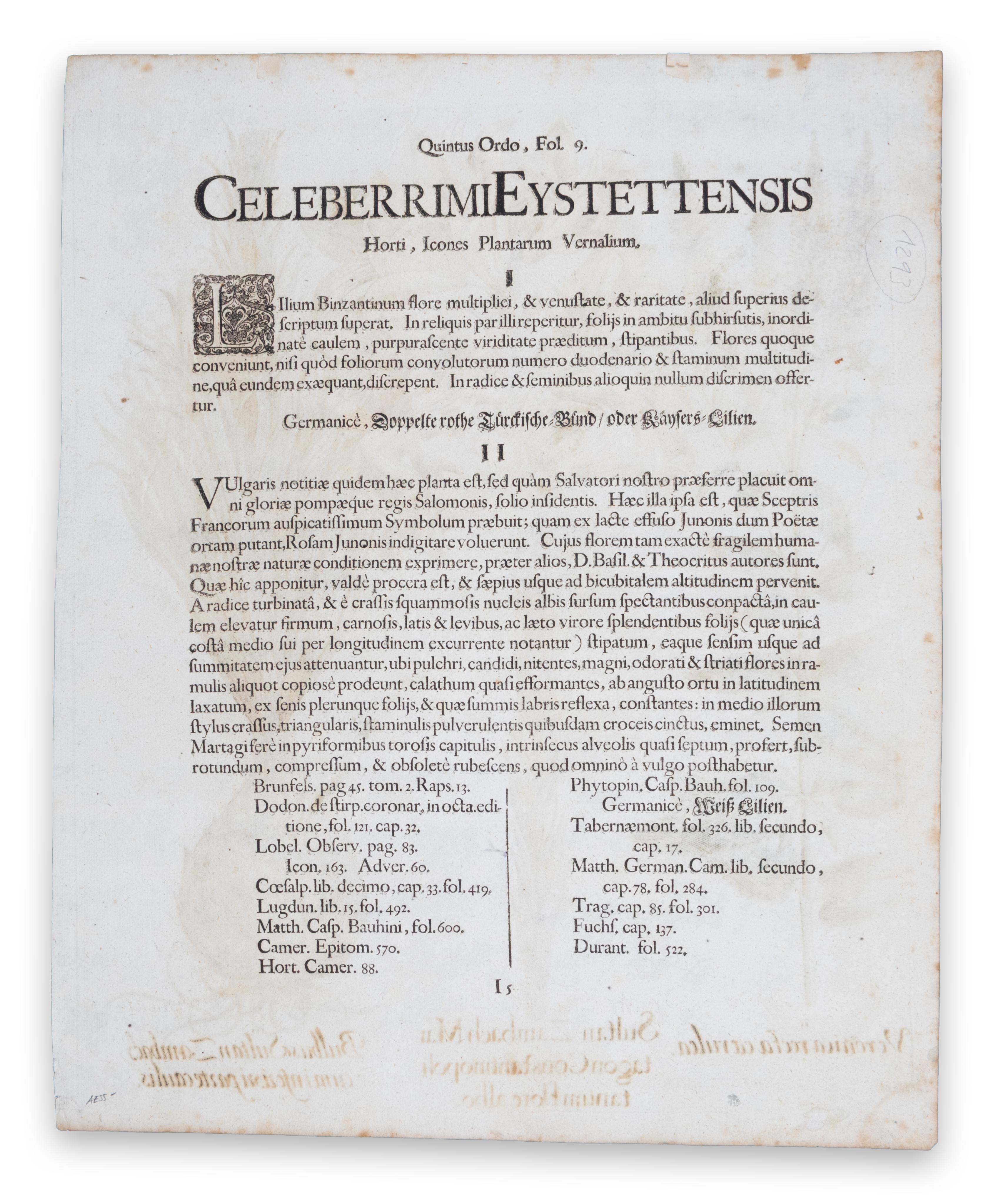
[Nürnberg, ca. 1613.]A veronika virágos, illetve a fehér liliom virágos és hagymás állapotának kézzel színezett rézmetszete, fólió méretű merített papírra nyomtatva, hátoldalán latin nyelvű nyomtatott szöveggel. A lap a Hortus Eystettensis (Eichstätti kert) című műből származik, amely forradalmasította a botanikai ábrázolásokat.
A Johann Konrad von Gemmingen eichstätti hercegpüspök megbízásából, tizenhat éven át készült Hortus Eystettensis véglegesen szakított a középkor füvészkönyveinek ábrázolás-politikájával. Ez volt az első olyan botanikai munka, amely a taxonómia mellett az esztétikai szépséget is előtérbe helyezte, a négy évszak szerinti elrendezést követve. A páratlan gazdagsággal és részletességgel kidolgozott illusztrációk szinte életnagyságúak, nagyméretű (kb. 56×45 cm) lapokon. A mű latin leírásai a tudományos nevezéktan rendszerének figyelemreméltó előképét mutatják.
Besler (1561-1629) munkája nemcsak művészi értéke, hanem kiadástörténete miatt is figyelemreméltó. A műből két változat készült 1613-ban: egy olcsóbb, fekete-fehér kiadás referenciamű gyanánt, valamint egy szöveg nélküli luxusváltozat.
E mű lapjai páratlan darabok minden természettudományi gyűjtő számára.
Nagyon jó állapotban, a verson a szélek mentén szöveget nem érintő apróbb elszíneződések.
Hand-colored copper-plate engraving of the variations of the plants Veronica (commonly known as Speedwell, Bird's Eye, and Gypsyweed) and Martagon (commonly known as White Martagon Lily, Turk's Cap Lily or Madonna Lily) with it's flowers and its bulbs separately. Printed on a large folio-sized sheet of laid paper, with typographical Latin text on the verso. From the Hortus Eystettensis (Garden of Eichstätt), a breathtaking work that revolutionized botanical art.
Commissioned by Johann Konrad von Gemmingen, Prince-Bishop of Eichstätt, and sixteen years in the making, Hortus Eystettensis represents a definitive break from the crude, utilitarian herbals of the medieval era. It is the first botanical work to prioritize aesthetic beauty alongside taxonomy, with an arrangment that followed the four seasons. The illustrations are rendered near life-size with unprecedented richness and detail, printed on large sheets (approx. 54 x 45 cm). The Latin descriptions show a striking foresight of the binomial system.
Besler’s (1561-1629) work is legendary not only for its artistry but for its opulent production history. Two versions were produced in 1613, a cheap black and white for use as a reference book, and a luxury version without text.
Sheets from this work are seminal for any collector of natural history.
In very good condition, some minor discoloring along the edges, not affecting the text.