

![Hondius, Jodocus: Iaponia [Amstelodami, 1619.]](http://kozpontiantikvarium.hu/sites/default/files/2025-06/japonia_rec.jpg "Hondius, Jodocus: Iaponia [Amstelodami, 1619.]")
Iaponia
[Amstelodami, 1619.]Hondius Japánt és Koreát ábrázoló térképének szép példánya, amely a 17. század közepén jelent meg, és egyben az egyik legismertebb térképészeti tévedést is bemutatja. Eredetileg 1606-ban adták ki, és a térkép a térség egyik legkiválóbb korai holland ábrázolásának számít.
A térkép a portugál jezusita, Luíz Teixeira által készített, Ortelius Theatrum Orbis Terrarum-hoz készített térképén alapul. Korea szigetként szerepel rajta – ez korának egyik legismertebb földrajzi tévedése –, valamint Japán három fő szigete és Kína egy része is látható. Hondius a térképhez fűzött megjegyzéseiben leírja, hogy akkoriban még nem volt egyértelmű, vajon Korea sziget-e vagy a szárazföld része.
A térképet tengeri szörnyek, egy japán dzsunka és egy holland gálya díszítik. Ez a változat megkülönböztethető a későbbi Jansson-féle kiadástól, amelyben a dzsunkát már egy európai típusú hajóval helyettesítették.
Jelen térkép mérföldkőnek számít Japán térképészetében, és 1655-ig, Martini térképének megjelenéséig a térség legelterjedtebb európai ábrázolása maradt.
Először megjelent: Gerardi Mercatoris - Atlas sive Cosmographicae Meditationes de Fabrica Mundi et Fabricati Figura. J. Hondius. 1606. (Van der Krogt 1, 101)
Lapméret: 57,5×47,5 cm
Térkép mérete: 50×37,5 cm
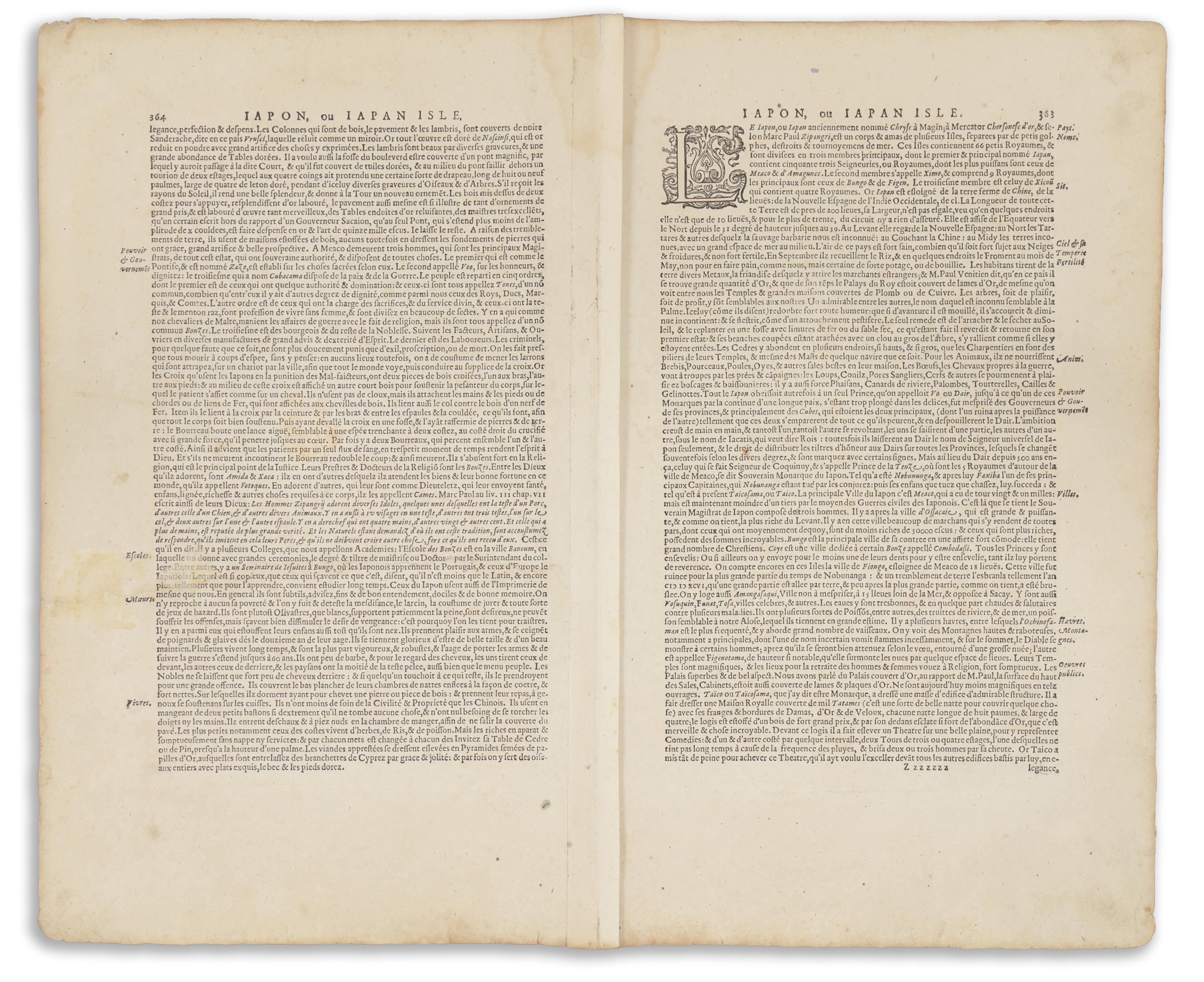
Restaurált, a verson a hajtás mentén megerősítve. A verson francia szöveg, 363-364-os oldalszámok, "Zzzzzzz", a hajtás mentén megerősítve. A felső margón, középen halvány vízfolt, alighogy érinti a képmezőt.
Van der Krogt 1 - 8410:1A; Caboara (China, 2022) - p. 198, #11
The map is derived from the 1595 Ortelius-Teixeira map and portrays Korea as an island—one of the most famous geographic errors of the time—along with Japan’s three main islands and a portion of the Chinese coast. In his accompanying commentary, Hondius notes the uncertainty surrounding Korea’s true geographic nature, acknowledging that it was still unclear whether it was an island or connected to the mainland.
The map features decorative elements such as sea monsters, a Japanese junk, and a Dutch galleon. It can be identified as the Hondius edition by the presence of the Asian-style junk; later versions by Jansson replaced it with a European-style ship.
This map is regarded as a landmark in the mapping of Japan and remained the authoritative European depiction of the region until the appearance of Martini’s map in 1655.
First published in: Gerardi Mercatoris - Atlas sive Cosmographicae Meditationes de Fabrica Mundi et Fabricati Figura. J. Hondius. 1606. (Van der Krogt 1, 101)
Sheet size: 57,5×47,5 cm
Map size: 50×37,5 cm
Restored and reinforced along the fold on the verso. Slight waterstain to the upper margin, barely affecting the image field. French text on verso, page numbers 363-364, "Zzzzzzz".
Van der Krogt 1 - 8410:1A; Caboara (China, 2022) - p. 198, #11