

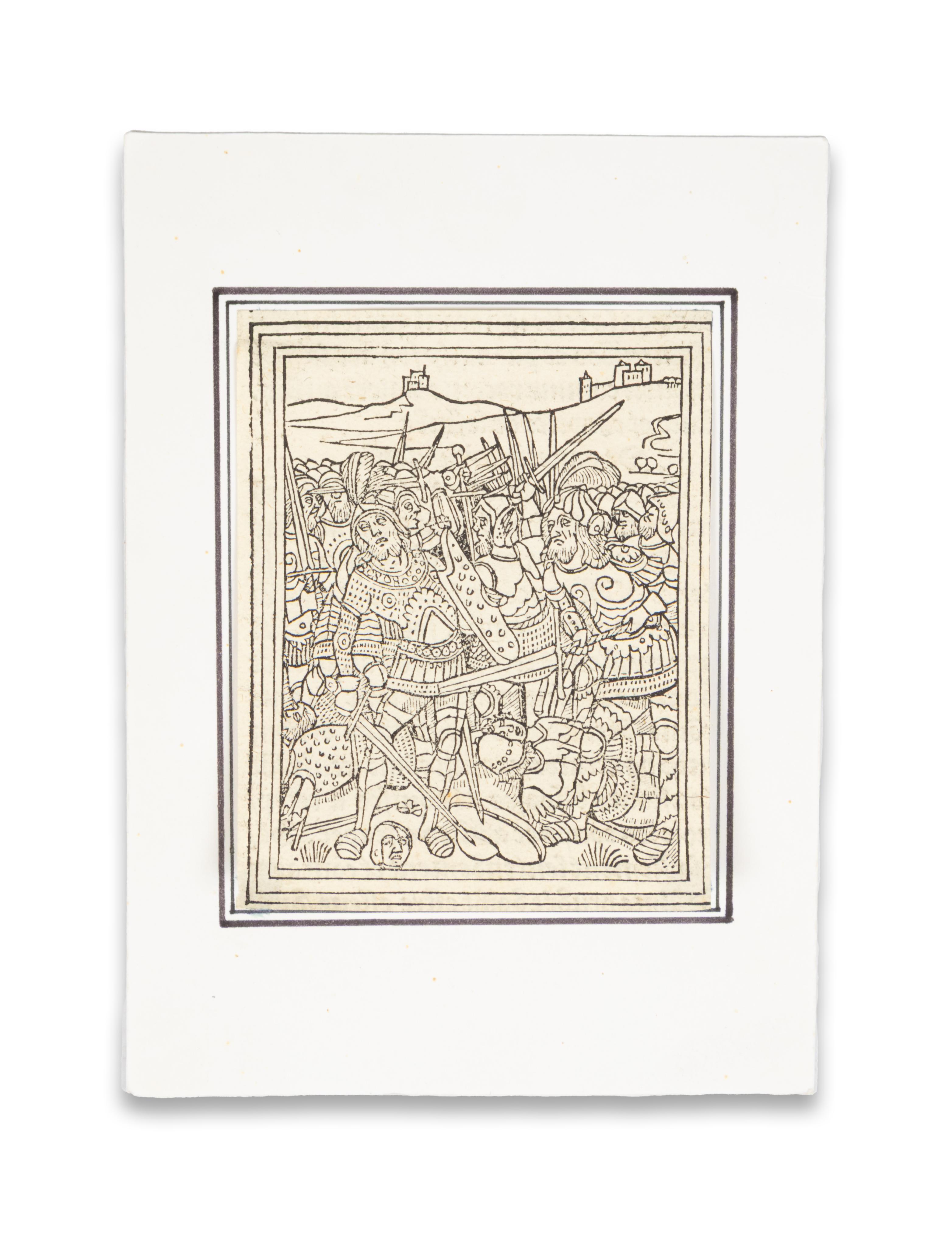
Csatajelenet: fametszet a La Mer des hystoires ősnyomtatványból
A fametszet a középfrancia nyelven íródott La Mer des histoires című ösnyomtatványból származik, mely a 15. századi francia illusztrált könyvművészet egyik legremekebb példájaként ismert. A La Mer des Hystoires első kiadása 1488-ban, az utolsó pedig 1550-ben jelent meg, összesen huszonegy kiadást ért meg.
A művet az a Pierre Le Rouge nyomtatotta Vincent Commin könyvkereskedő számára, aki elsőként viselte Franciaországban a királyi könyvárus és nyomdász (libraire et imprimeur du roi) címet. Bár a mű címét Giovanni Colonna Mare historiarum elnevezésű munkájától kölcsönözte, szövege valójában a Rudimentum novitiorum című egyetemes krónika francia fordítása. Ez utóbbit egy névtelen lübecki klerikus állította össze 1470 és 1474 között, majd ugyanitt Lucas Brandis nyomtatta ki 1475 körül. A világ teremtésétől 1473-ig tartó elbeszélés a hagyományos, hat korszakra osztott történelmi felosztást követi, és a legkülönfélébb forrásokból merít: a Bibliától és az egyházatyáktól kezdve az antik és középkori szerzők soráig. A kronologikus rendet szerteágazó betétek szakítják meg, többek között egy pogány isteneket felsoroló jegyzék, egy földrajzi szótár, a német dominikánus Burchardus de Monte Sion Szentföld-leírása, valamint harminc ezópusi állatmese. A Beauvaisis-ból származó, André de La Haye, Chaumont urának pártfogását élvező ismeretlen fordító a művet a francia királyok történetével is kiegészítette a Chroniques de France alapján, így a krónika egészen VIII. Károly 1484-es koronázásáig vezeti az eseményeket.
Méret: 10,4×9,1 cm
Az ősnyomtatvány illusztráció egy reprezentatív példánya, kézzel merített papíron, kartonra ragasztva. Kiváló állapotban.
La mer des histoires is a loose translation of the Rudimentum novitiorum, which was originally printed in Lübeck in 1475. Conceived as an encyclopedic world history intended for the instruction of young clerics, the Rudimentum weaves together secular and ecclesiastical chronicles, ancient history, and pagan mythology; notably, twenty-nine of Aesop’s Fables are integrated into the "Fifth Age." The French adaptation incorporates supplemental material regarding the kings of France and is accompanied by a martyrology by Usardus. To this day, both the author of the original Latin work and the translator of the French edition remain anonymous. The printer of the French edition, Pierre Le Rouge, was evidently familiar with the Lübeck Latin version, as his work largely mirrors its arrangement and illustrative program. Manfred von Arnim has succinctly detailed its iconographic antecedents, which include Vérard’s Grandes Heures and Levet’s Maître Pierre Pathelin. Interestingly, several of the smaller woodcuts in Du Pré’s Book of Hours (printed 14 February 1489/90) are copies of those found in La Mer des histoires, rather than the reverse (Schäfer 294). Among Le Rouge’s original contributions to the series are several historical scenes, as well as an extensive application of delicate borders and woodcut initials.
Size:: 10,4×9,1 cm
A handsome example of early woodcut on thick handmade paper, glued on cardboard. In excellent condition.
La gravure sur bois illustrant une scène de bataille a été publiée dans La Mer des histoires, l'un des incunables français les plus richement illustrés. La première édition paraît en 1488, la dernière en 1550, en tout, elle connaît vingt-une éditions.
La Mer des histoires, imprimée par Pierre Le Rouge pour le libraire Vincent Commin, est largement considérée comme l'un des plus beaux livres illustrés français du XVe siècle. Issue des presses de celui qui fut le premier en France à porter le titre de libraire et imprimeur du roi, l'ouvrage emprunte son titre au Mare historiarum de Giovanni Colonna. Le texte est en réalité la traduction française d’une chronique universelle intitulée Rudimentum novitiorum, compilée vers 1470-1474 par un clerc anonyme de Lübeck, ville où elle fut imprimée vers 1475 par Lucas Brandis. Débutant à la création du monde pour s’achever en 1473, le récit adopte la division traditionnelle en six âges et puise aux sources les plus diverses, allant de la Bible et des Pères de l’Église aux auteurs de l’Antiquité classique et du Moyen Âge. Le fil chronologique est ponctuellement interrompu par des textes disparates, tels qu'une liste de dieux païens, un dictionnaire géographique, la Description de la Terre Sainte du dominicain allemand Burchardus de Monte Sion, ou encore une trentaine de fables d’Ésope. Le traducteur anonyme, originaire du Beauvaisis et protégé par André de La Haye, seigneur de Chaumont, a enrichi l'œuvre d'une histoire des rois de France rédigée à partir des Chroniques de France, menant ainsi le récit jusqu’au sacre de Charles VIII en 1484.
10,4×9,1 cm
Exemplaire d’une célèbre impression ancienne, sur papier à la cuve,collé sur du carton. En excellente condition.