

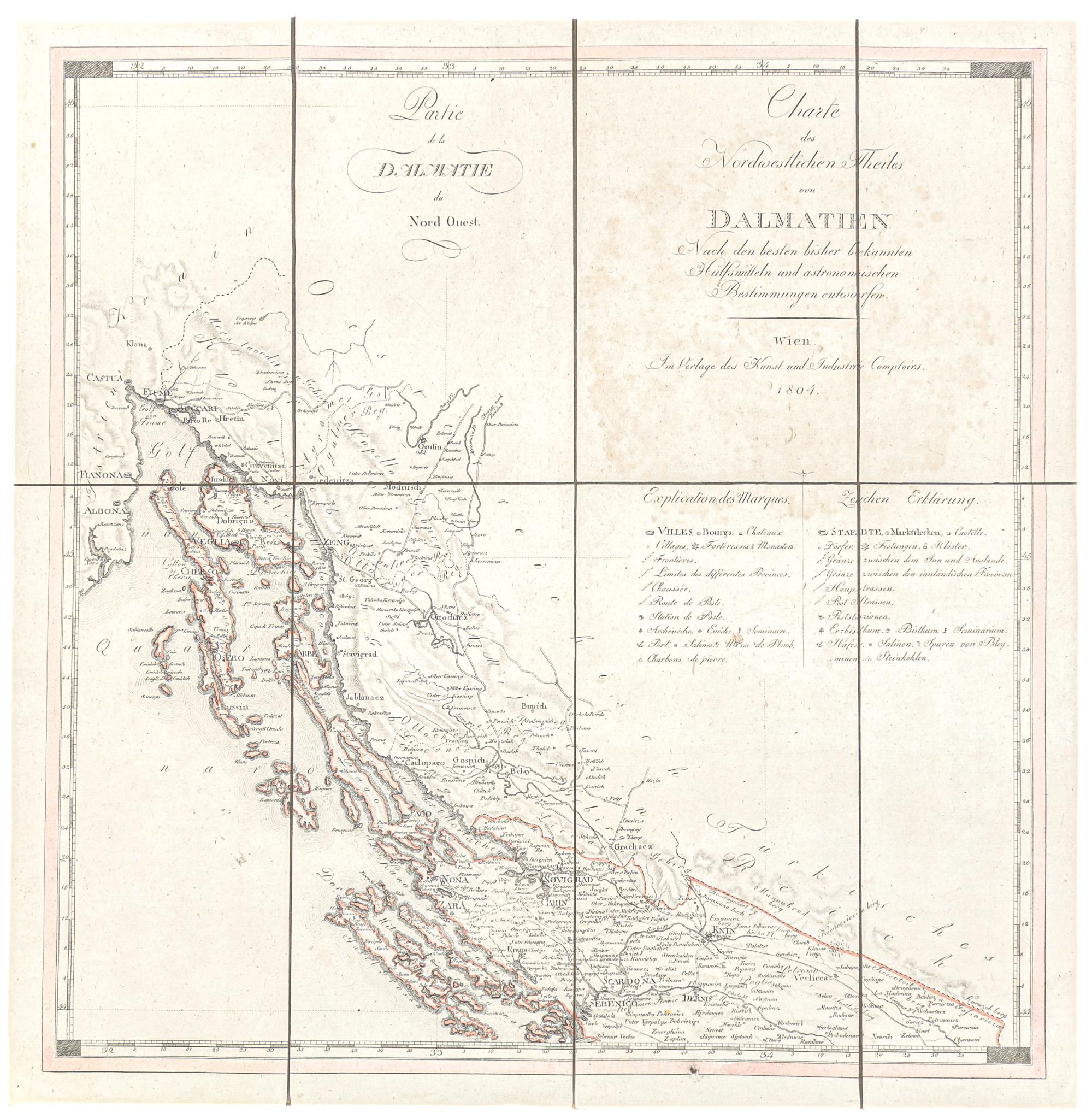
Charte des Nordwestlichen Theiles von Dalmatien. – Partie de la Dalmatie du Nord Ouest.
Wien, 1804. Kunst und Industrie Comptoirs.Dalmácia észak-nyugati részeinek ritka, rézmetszetű, kézzel határszinezett térképe. A horvát tengerpartot mutatja be Kelet-Isztriától Šibenikig. A hátországban a zölddel jelölt határ az Osztrák és az Oszmán Birodalom közötti demarkációs vonalat jelzi. A domborzatot árnyékolással ábrázolják, és különösen a Velebit-hegység emelkedik ki. A térkép postai állomásokat és útvonalakat is tartalmaz. Francia cím balra.
A térkép 1804-as, azaz a Velencei Köztársaság összeomlása (1797) utáni és az illír tartományok létrehozása előtti (1809) állapotot mutatja be. A Köztársaság kelet-adriai birtokai Franciaország és Ausztria közötti vita tárgyává váltak. A Habsburgok végül biztosították őket (1815-re): Dalmácia és Isztria az osztrák birodalom része lett, míg Horvátország és Szlavónia Magyarországhoz tartozott. A térkép tehát az Osztrák Birodalom részévé vált Horvátország részeinek térképsorozatába tartozik.
Megjelent: Joseph Karl, Kindermann – Liechtenstern, Joseph Marx von: Atlas Des Österreichischen Kaiserthums / Atlas De L'Empire Autrichien. Wien, Verlag des Kunst- und Industrie-Comptoirs. 1805.
Méret/Size: 48,5×50 cm
Joseph Karl Kindermann (1744-1801) geográfus és térképész. A Holland Kelet-indiai Társaságnál dolgozott, majd később Fokvárosba utazott, és Joachim van Plettenberg kormányzó titkára lett. Ezután Ceylonba indult, de súlyosan megbetegedett, ezért 1774-ben visszatért Hollandiába. Innen Stájerországba utazott, ahol családja letelepedett. 1801 tavaszán Bécsbe érkezett, ahol az Atlas des Österreichischen Kaiserthums főszerkesztőjévé nevezték ki.
Joseph Marx von Liechtenstern (1799-1848) Emil von Sydowval együtt a módszertani kartográfia egyik megalapítójának és az atlasz térképek úttörőjének számít.
Karl Joseph Kipferling bécsi térképész és metsző volt a 19. század első felében. Bécsben dolgozott, ahol Kindermann, Walch és Müller munkatársa volt.
Az atlasz különleges érdeme, hogy a tartományok statisztikai leírását is tartalmazta.
A birodalmat II. Ferenc 1804-ben kiáltotta ki válaszul Napóleon első francia birodalmának kikiáltására, egyesítve az összes Habsburg-birtokot egy központi kormányzat alatt. A Szent Római Birodalom része maradt annak 1806-os felbomlásáig.
Kiváló állapotban, vászonra vont, hajtogatott. A verson korabeli, kézzel írt címvignettával.
The map depicts the status quo in 1804, after the collapse of the Venetian Republic (1797) and before the creation of the Illyrian provinces (1809). The Republic's possessions in the eastern Adriatic became the subject of dispute between France and Austria. The Habsburgs eventually secured them (by 1815) and Dalmatia and Istria became part of the Austrian empire, while Croatia and Slavonia were under Hungary. The map is part of a series depicting parts of Croatia that were then part of the Austrian Empire.
Published in: Joseph Karl, Kindermann – Liechtenstern, Joseph Marx von: Atlas Des Österreichischen Kaiserthums / Atlas De L'Empire Autrichien. Wien, Verlag des Kunst- und Industrie-Comptoirs. 1805.
A special merit of the atlas is that it also provides a statistical description of the provinces.
Joseph Karl Kindermann (1744-1801) was a geographer and cartographer. He worked for the Dutch East India Company and later travelled to Cape Town to become secretary to Governor Joachim van Plettenberg. He then left for Ceylon, but fell seriously ill and returned to the Netherlands in 1774. From there he travelled to Styria, where his family settled. In the spring of 1801 he arrived in Vienna, where he was appointed editor-in-chief of the 'Atlas des Österreichischen Kaiserthums'.
Liechtenstern (1799-1848) is considered, along with Emil von Sydow, to be one of the founders of methodical school cartography and a pioneer of the physical atlas map.
Karl Joseph Kipferling was a Viennese cartographer and engraver in the first half of the 19th century. He worked in Vienna, where he worked with Kindermann, Walch and Müller.
The empire was proclaimed by Francis II in 1804 in response to Napoleon's declaration of the First French Empire, unifying all Habsburg possessions under one central government. It remained part of the Holy Roman Empire until the latter's dissolution in 1806.
Excellent condition, mounted on cloth, folded. With contemporary handwritten title-vignette on the verso.