

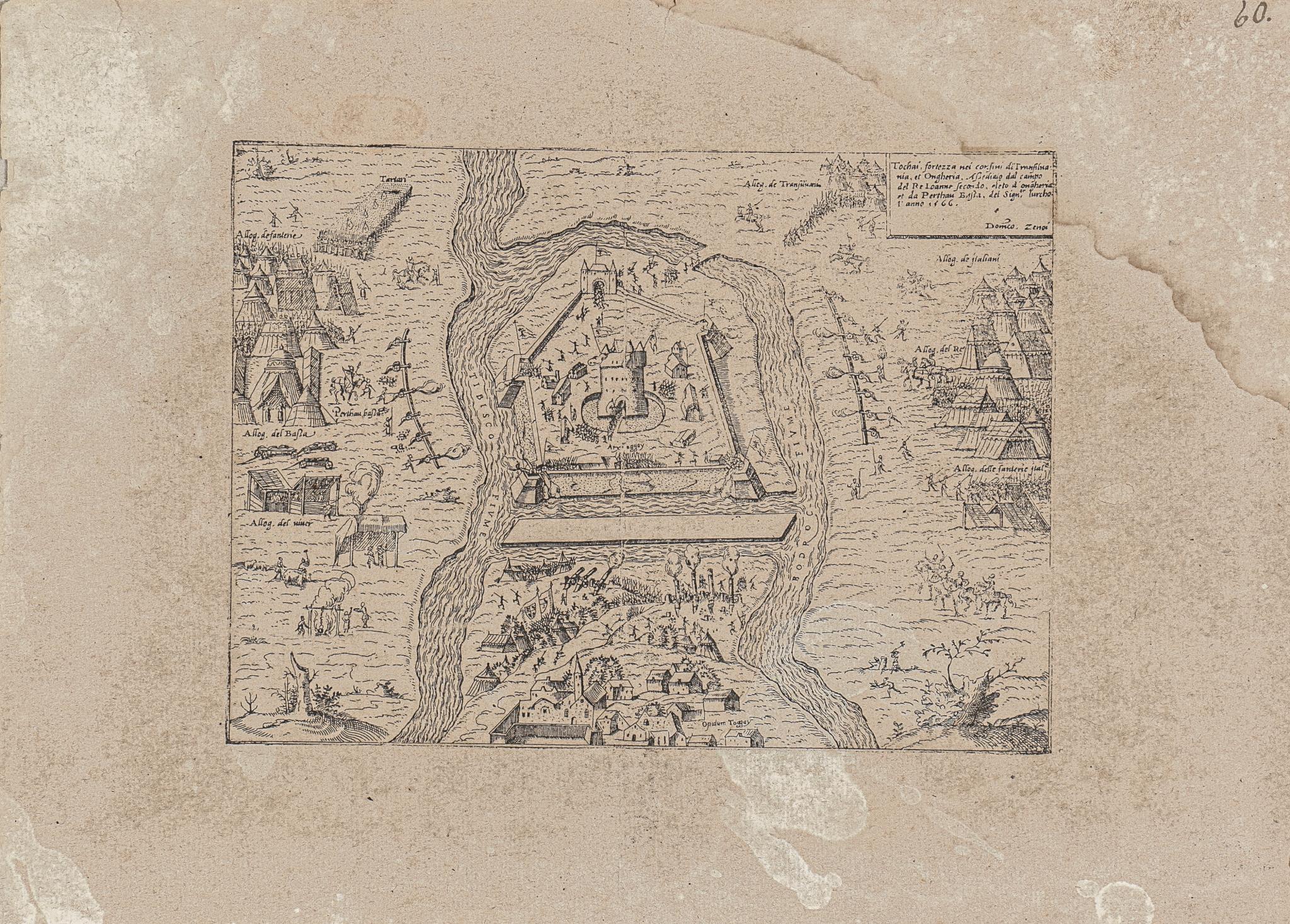
Zenoi, Domenico - Tokaj 1565-ös ostroma – Tochai, fortezza nei confini di Transilvania et Ongheria
Velence, 1566Igazi ritkaság: rézmetszet Tokaj várának 1566-os ostromáról, madártávlatból, nyugat felől. Szapolyai János Zsigmond magyar király seregei alul, a török és perzsa pasa táborai balra. Az erődített város a 16. század közepén nagyon fontos folyami átkelőhely volt. A metszeten láthatjuk, ahogy minden oldalról ostromolják Szapolyai seregei, ahogy megpróbálja visszafoglalni a várost 1565-ben elfoglaló a Habsburg hadaktól.
Zenoi 1565-ben készített egy másik térképet Tokajról, amelynek egy példányát az OSZK őrzi (App. M. 23.) Tudomásunk szerint az OSZK gyűjteményében nem szerepel az alábbi térkép. Bifolco & Ronca (2018) a térkép egyetlen példányát jegyzi fel az olaszországi Fanóban található Biblioteca Comunale Federiciana könyvtárban.
A térképet először Paolo Forlani hihetetlenül ritka, 1567-ben Domenico Zenoi közreműködésével megjelent „Il primo libro delle citta, et fortezze principali del mondo” című városkönyvében tették közzé. A táblák ezután Bolognino Zaltieri kiadó kezébe kerültek, és a De' disegni delle più illustri città e fortezze del mondo”, Giulio Ballino által 1569-ben, Velencében kiadott könyvében jelentek meg.
Méret/Size: 20x15cm
Giulio Ballino műve az első olasz kísérlet egy világ főbb erődítményeit és városait tartalmazó atlasz/szöveg létrehozására. Elődeivel ellentétben, akiktől az ikonográfiát másolta, Ballino egy komplex művet akart megvalósítani, szöveggel és indexszel, hogy az olvasó azonnal tudja, hány mű található a könyvben. Du Pinet Plantz, Pourtraitz et descriptions de plusieurs ville set forteresses című művét követve. Ballino munkája minden valószínűség szerint csak az első része egy nagyszabású, nagyobb projektnek. Lehet, hogy latin nyelvű kiadást akart megjelentetni, remélve, hogy könyve nagy hírnévre tesz szert Európában, de meg kellett gondolnia magát, amikor Georg Braun és Frans Hogenberg kiadta Civitates Orbis Terrarum című művét, amely a korban az első városikonográfiát leíró könyv volt.
Ballino táblái 1566 és 1568 között jelentek meg, Albert Ganado (1993) szerint 32 ezek közül történetesen Paolo Forlani és Domenico Zenoi lemezeinek újranyomása, amelyek az Il primo libro delle città, et fortezze principali del mondo (1567) című könyvben már megjelentek. E metszetek tábláit utólag módosították. Néhányat közülük Bertelli Disegni di alcune più illustri città di fortezze del mondo con aggiunte di alcune isole principali, (1568) című művében tettek közzé.
Festékfoltos, széles margókkal. Jobb felső sarokban tintás számozás. Korához képest összességében jó állapotban.
Bifolco & Ronca (2018) 553; cf. Szalai-Matkovic (2012), 4-36p.; Szalai-Szantai (2006) (1566)/1.
Zenoi made another map of Tokaj in 1565, a copy of which is preserved in the Hungarian National Library (App. M. 23.) To our knowledge, the following map is not in the collection of the HNL (OSZK, in Hungarian).
The map was first published in Paolo Forlani's incredibly rare city book 'Il primo libro delle citta, et fortezze principali del mondo', published in 1567 with Domenico Zenoi. The plates then passed into the hands of the publisher Bolognino Zaltieri and were published in his book 'De' disegni delle più illustri città e fortezze del mondo', published by Giulio Ballino in Venice in 1569.
Giulio Ballino's work is the first Italian attempt to create an atlas/text of the world's major fortifications and cities. Unlike his predecessors, from whom he copied the iconography, Ballino wanted to create a complex work, with text and index so that the reader would know immediately how many works were in the book. Du Pinet followed Plantz, Pourtraitz et descriptions de plusieurs ville set forteresses. Ballino's work is in all likelihood only the first part of a larger, more ambitious project. He may have wanted to publish a Latin edition, hoping that his book would gain a great reputation in Europe, but he had second thoughts when Georg Braun and Frans Hogenberg published 'Civitates Orbis Terrarum', the first book describing city iconography at the time.
Ballino's plates were published between 1566 and 1568, according to Albert Ganado (1993) 32 of them happen to be reprints of plates by Paolo Forlani and Domenico Zenoi, which had already appeared in 'Il primo libro delle città, et fortezze principali del mondo' (1567). The plates of these engravings were subsequently modified. Some of them were published in Bertelli's 'Disegni di alcune più illustri città di fortezze del mondo con aggiunte di alcune isole principali', (1568).
Stains. Wide margins. Number written in ink in the top right corner. Overall good condition for its age.
Bifolco & Ronca (2018) record a single example of the map in the Fredericiana Library in Fano, Italy.
Bifolco & Ronca (2018) 553; cf. Szalai-Matkovic (2012), 4-36p.; Szalai-Szantai (2006) (1566)/1.