

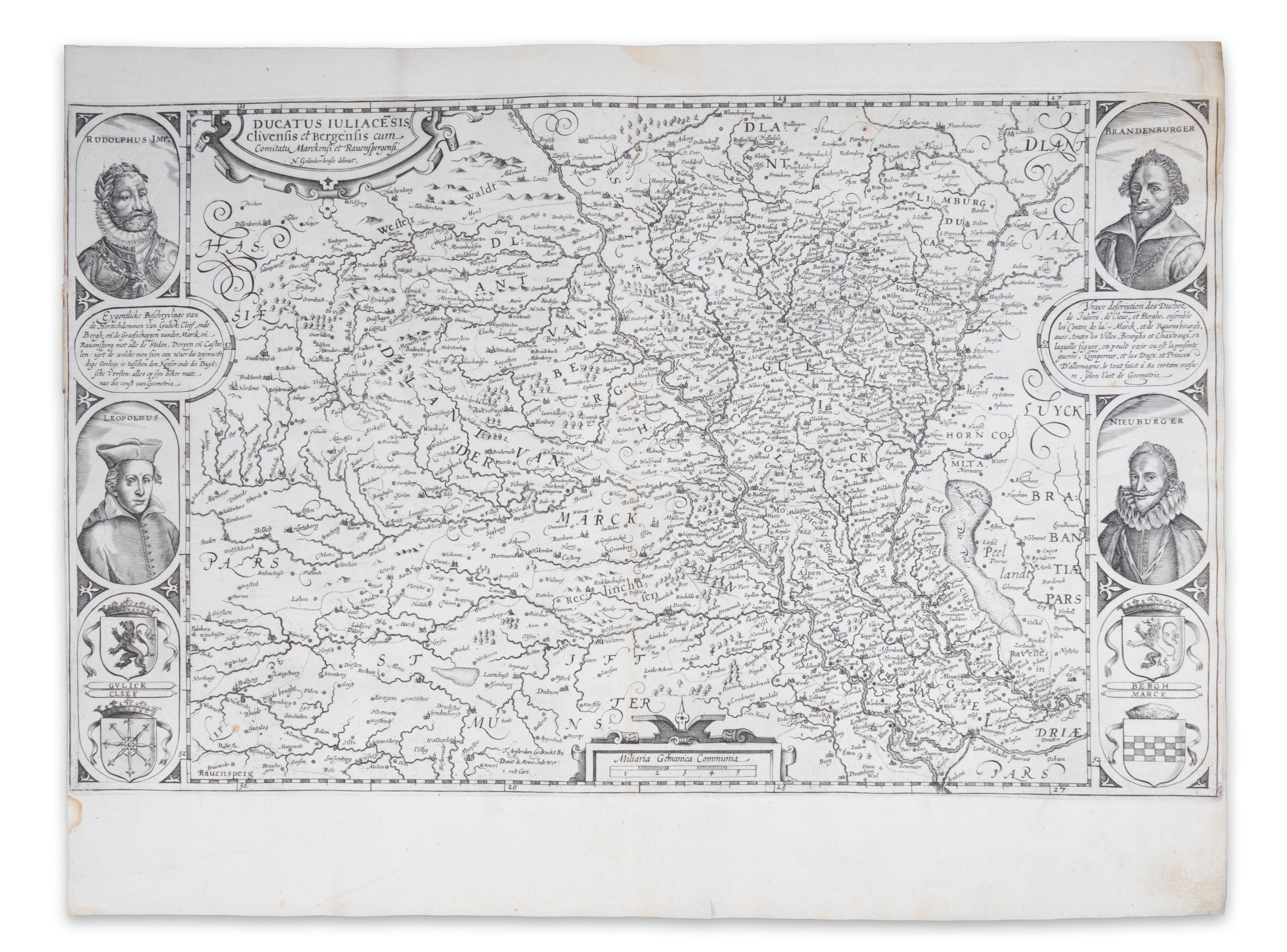
Ducatus Iuliace(n)sis, Clivensis et Bergensis cum Comitatu Marckensi et Ravenspergensi. N. Geilenkerckensis deliniat.
Amsztedam, 1610.Páratlanul ritka, Nicholas van Geelkercken által készített, dél-északi tájolású, és Rajna vidékét ábrázoló önálló lapként megjelent „hírtérkép”. A David de Meine által kiadott lap kartográfiai alapjául Gerard Mercator munkái szolgáltak, és nagy valószínűséggel – kétnyelvű, holland és francia feliratai miatt – nemzetközi piacra szánták, a Jülich-Cleves utódlási válság híradásaként. Mivel 1609-ben János Vilmos herceg utód nélkül halt meg, nemcsak a legközelebbi nőági rokonok, a brandenburgi és a pfalz-neuburgi herceg tartottak igényt az örökségre, hanem II. Rudolf, a Német-római császár is a Habsburg birodalomhoz akarta csatolni. A háborúval fenyegető helyzetet örökítette meg a korban divatos „carte-à-figures” stílusban készült metszet, amelynek két oldalsó keretdíszében az örökösödés iránti vitában szemben álló feleinek portréi – bal oldalt II. Rudolf császár és Lipót főherceg, jobboldalt pedig János Zsigmond brandenburgi választófejedelem, illetve Wolfgang Vilmos pfalz-neuburgi herceg –, valamint a Jülich (Gulick), a Cleves (Cleef), a Berg (Bergh) és a La Marck (Marck) dinasztiák címerpajzsai kaptak helyet. Tételünk – mivel az első Jülich-válság rövid életű volt, ezért hírértéke lecsökkent, valamint van Geelkercken 1610-ben publikált egy másik, ezzel a témával kapcsolatos térképet is – valószínűleg aránylag kis példányszámban látott napvilágot. Kocman világszerte mind-össze öt darabját említi bibliográfiájában.
Mérete: 32,5×53 (41×55,9) cm.
Hibátlan, tiszta példány.
van der Krogt I.:2381:1B.
Our item – since the first Jülich crisis was short-lived and its news value decreased, moreover, van Geelkercken published another map on the subject in 1610 – was probably published in a relatively small number of copies. Koeman mentions only five copies worldwide in his bibliography.
Dimensions: 325 x 530 (410 x 535) mm. Fine, clear copy.
van der Krogt I.: 2381:1B.