

Budai vár látképe.
Basel, 1550. Henric PetriKézzel színezett fametszet levél.
Megjelent: Münster, Sebastian: Cosmographei: oder beschreibung aller länder, herschafften, fürnemsten stetten, geschichten, gebreüche[n], hantierungen. [Basel, 1630. Heinrich Petri]. Ismeretlen német művész metszete.
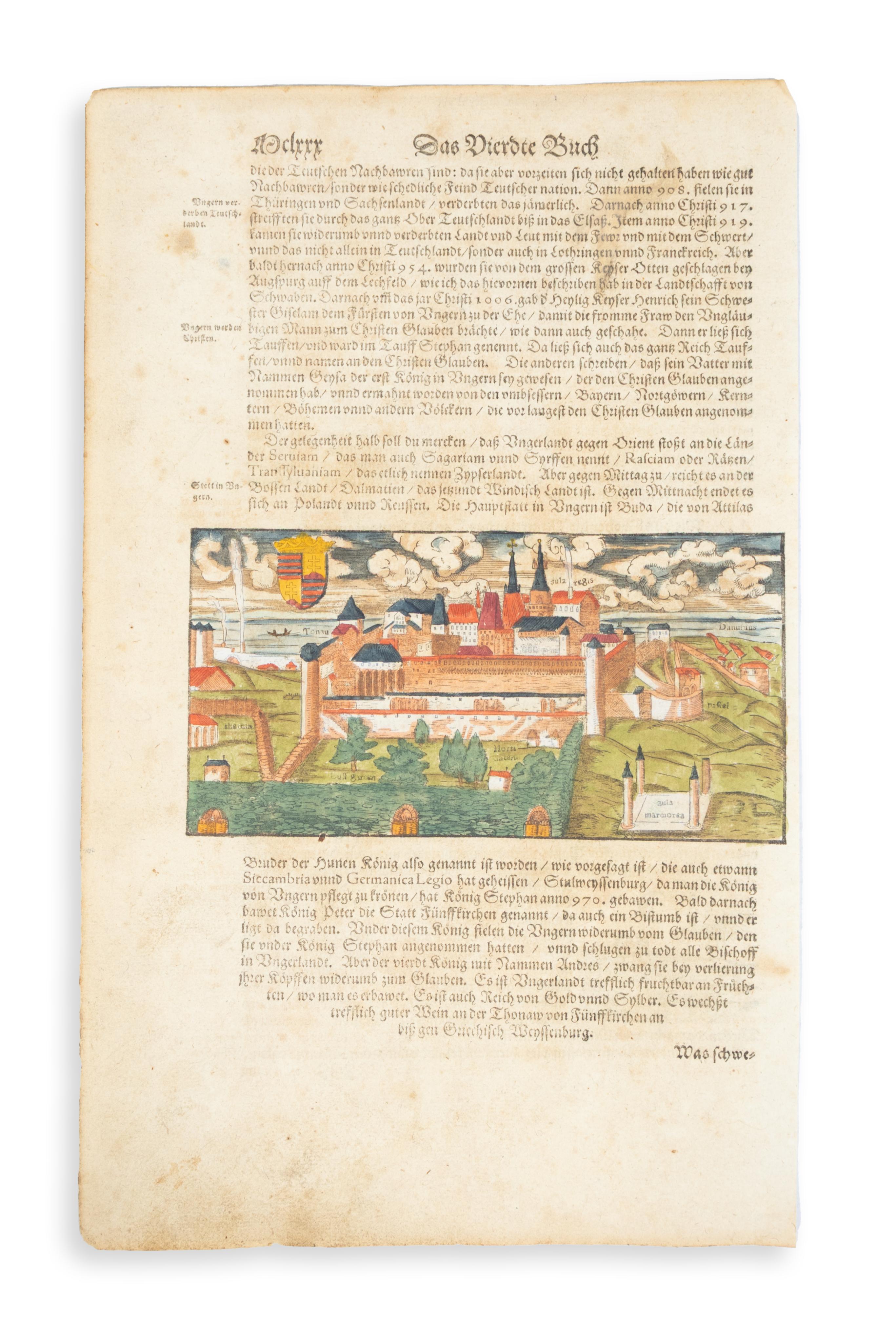
Sebastian Münster híres, XVI. századi fametszete a Budai Várról az egyik legfontosabb korabeli vizuális forrás. A neves német térképész Cosmographia című művében jelent meg, és egyes részleteiben hitelesen mutatja be Buda városképét a korabeli európai metszetek stílusában. A korábbi ábrázolásoktól eltérően ez a kép nem keletről (a Duna felől), hanem a nyugati oldalról (a mai Krisztinaváros irányából) mutatja be a várost és a királyi palotát.
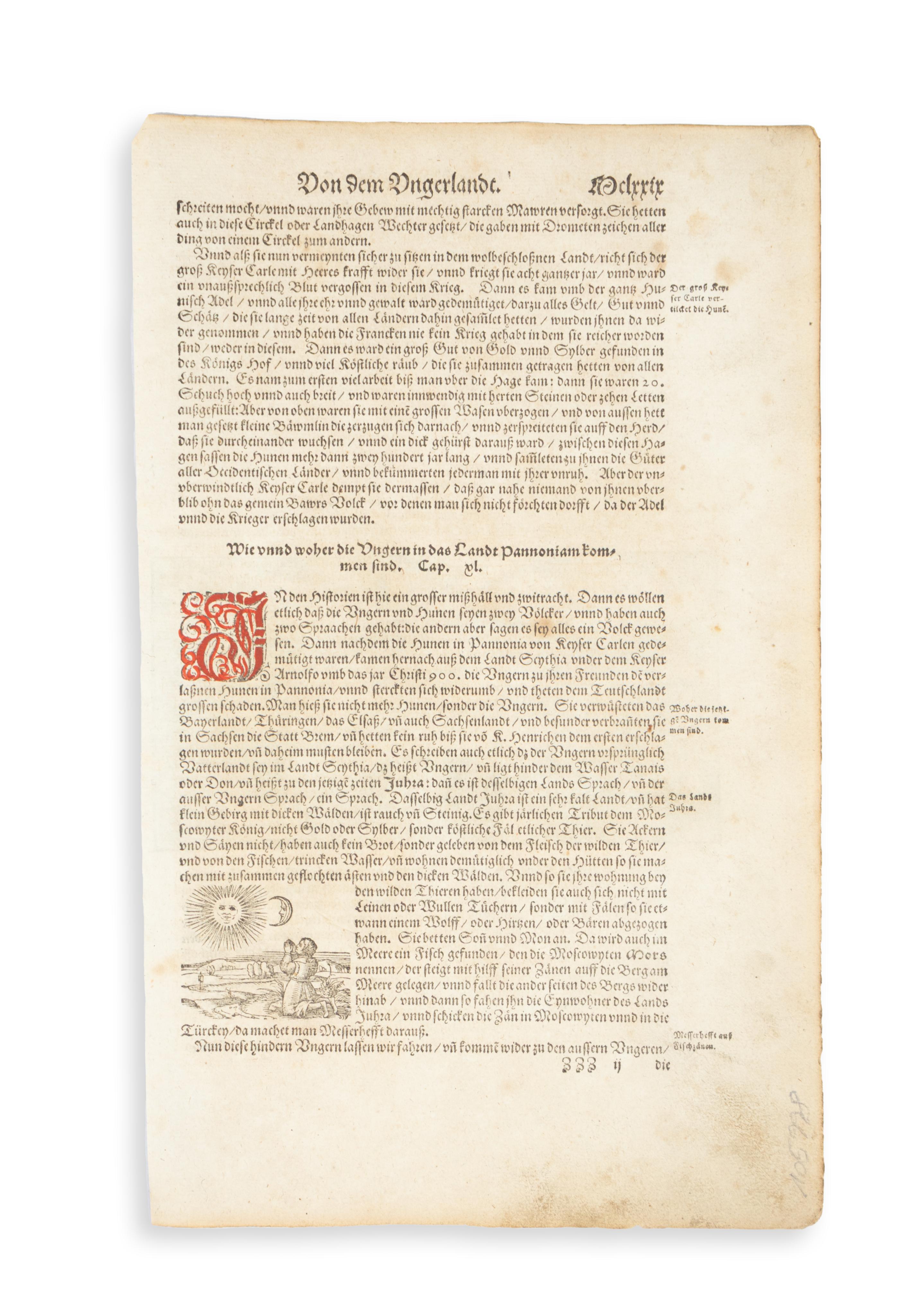
A levél enyhén barnás tónusú, a színezés valamivel későbbi, erőteljes színekkel. A verzón egy iniciálé is pirossal színezve. Balra fent a magyar címer. A rajzon szöveggel jelölve a kiemelt épületek. Pl: thermae-fürdő; Alba Regis-királyi palota; Tonau-Danubius.; horticult-királyi kertek. Az Aula Marmorea, a márványcsarnok Mátyás király budai váralatti, nyugati lejtőn álló reneszánsz kerti lakának pazar építménye volt. A szellős, loggiás csarnokot vörös és fehér márványoszlopok díszítették. Egy fennmaradt oszlopa ma is látható a Dózsa György téren.
Képméret: 17,5×9 cm. Lapméret: 21×34 cm. Ritka fametszet.
Published in: Münster, Sebastian: Cosmographei: oder beschreibung aller länder, herschafften, fürnemsten stetten, geschichten, gebreüche[n], hantierungen. [Basel, 1630. Heinrich Petri]. Woodcut by an unknown German artist.
Sebastian Münster's famous 16th-century woodcut of Buda Castle is one of the most important contemporary visual sources. It was published in the renowned German cartographer's work titled Cosmographia, and in certain details, it authentically presents the cityscape of Buda in the style of contemporary European engravings. Unlike previous depictions, this image shows the city and the royal palace not from the east (from the Danube), but from the western side (from the direction of present-day Krisztinaváros).
The leaf has a slightly brownish tone; the coloring was added somewhat later, featuring strong, vibrant colors. On the verso, an initial is also colored in red. In the top left corner is the Hungarian coat of arms. The prominent buildings are identified with text on the drawing. For example: thermae – bath; Alba Regis – royal palace; Tonau – Danubius; horticult – royal gardens. The Aula Marmorea (Marble Hall) was a magnificent structure of King Matthias's Renaissance garden pavilion, standing on the western slope beneath Buda Castle. The airy, loggia-style hall was decorated with red and white marble columns. One of its surviving columns can still be seen today in Dózsa György Square.
Image size: 17.5 × 9 cm. Sheet size: 21 × 34 cm. Rare woodcut.